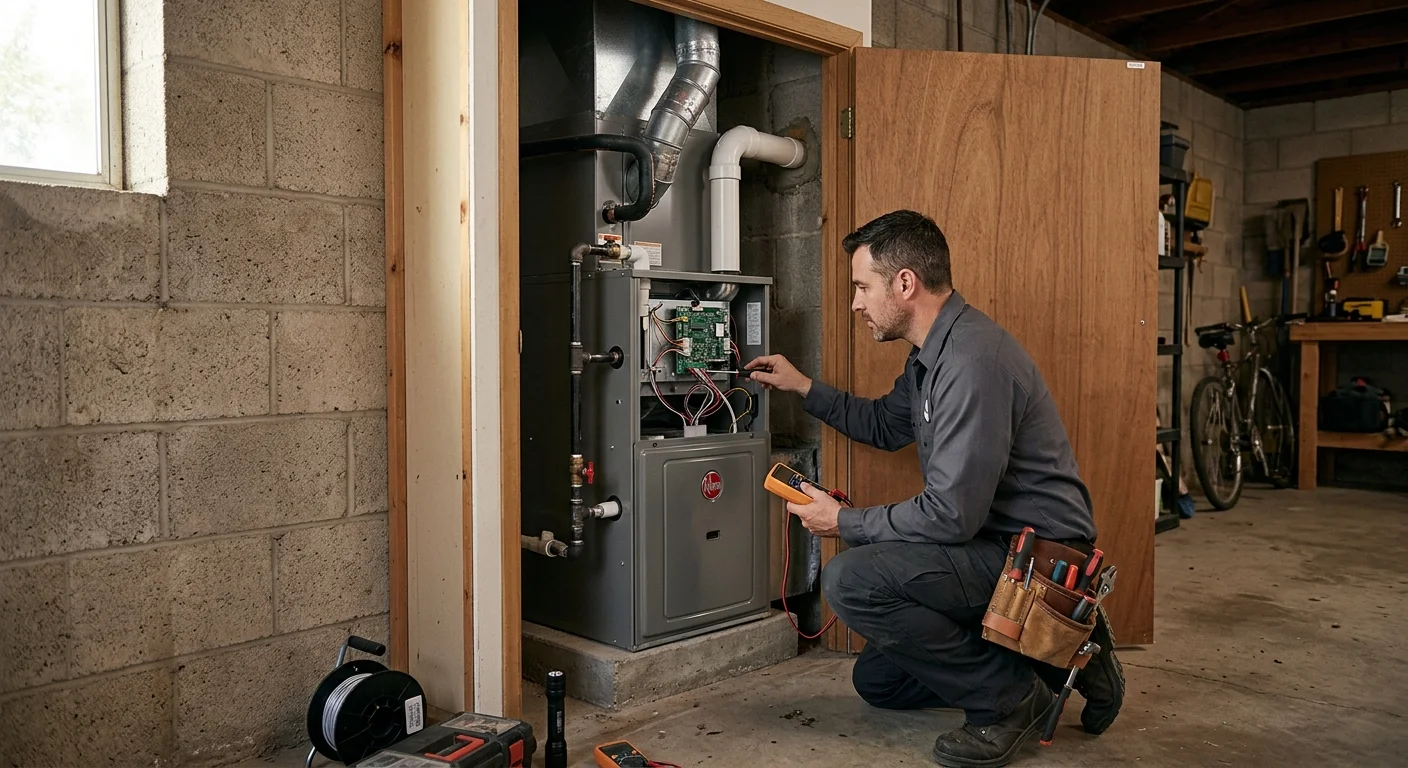
A Tucson furnace that clicks but never lights is usually trying to start and then shutting the gas off for safety. After a long cooling season, a dirty flame sensor is a common reason the flame never “proves.” Climate Pros Tucson matches you with a licensed local pro for furnace repair. The pros we send handle the gas-side work. You should not.
If you hear no click at all, that is a different ignition path. Use why a furnace will not ignite for that case. This page is the click, retry, and no-heat moment.
Clicking with no flame: what that usually is
The click is the furnace attempting a light-off. A typical gas furnace runs a short safety sequence: the inducer motor starts, a switch proves airflow, the igniter glows or sparks, and the gas valve opens. A flame sensor then has to confirm that a flame is really there. If it cannot, the valve closes. You get another click, or a few, and then the unit stops.
That stop is a lockout. It is the control board refusing to keep feeding gas. It is doing its job.
On a Tucson gas furnace, the sensor often sits unused from late spring until the first real heat call. Dust from the monsoon window (June 15 through September 30) settles in the burner area. A thin film on the sensor rod is enough to hide the flame from the board. The igniter may still glow. The burners may even flash and go out. From the hallway, all you hear is clicking and no heat.
A heat pump does not use that flame-sensor sequence. If your heat is a heat pump, this pattern is not your system. Stay on this page only if you have a gas furnace, a gas pack, or another unit that burns fuel.
Southwest Gas is the natural gas utility in the area. If you smell gas, leave the house and treat it as a leak, not a sensor job. Read what to do if you smell gas.
Safe checks before you call a licensed pro
Do the household checks. Leave the burner compartment, gas valve, and igniter alone.
- Set the thermostat to heat, not off or cool. Raise the setpoint a few degrees above the room.
- Replace weak thermostat batteries if the display is dim or blank.
- Confirm the furnace switch (it looks like a light switch) is on.
- Check the breaker for the furnace.
- Change a packed filter. Tucson dust loads filters fast, and a clogged filter can trip a limit and stop a clean light-off.
- Make sure supply and return vents are open.
- If you have a homeowner gas shutoff at the meter or appliance that you already know how to read, confirm it was not left off. Do not take apart the furnace gas valve.
If a carbon monoxide alarm sounds, get everyone out and call 911. For more on that risk, see carbon monoxide in a Tucson home.
Do not sand parts, jump wires, or hold the gas valve open. Those are not homeowner tests. Ask the licensed tech which checks they will run. Every pro we send is licensed. You can confirm the class at the Arizona Registrar of Contractors. Residential heating and cooling is class R-39, or an R-39R subclass that includes warm-air heating.
Renters: an Arizona landlord must supply reasonable heat and keep HVAC facilities in good and safe working order. Call your landlord, then call us if they need a licensed pro.
Why Tucson’s first heat week brings this on
Tucson is a cooling town that still has a real, short heating season. At Tucson International Airport (1991-2020 normals) there are 1,333 heating degree days and 3,424 cooling degree days, about 2.6 cooling degree days for every heating degree day. December’s normal low is 40.5F. January’s is 40.8F. Fewer than 12 nights a year drop to 32F or below. The furnace can sit through about 68 days at or above 100F, then get asked to light on a 40F night.
That idle is the setup. The first heat week is when people in midtown, the east side and Vail, Marana, and Oro Valley all hit heat at once. Homes in the Catalina Foothills and Oro Valley sit above the airport basin, so they feel that first heat call sooner. Green Valley and Sahuarita see the same click-no-flame pattern when a house that was closed up gets opened and the thermostat jumps to heat.
Mount Lemmon and Summerhaven are a different climate. Pima County treats land above 4,000 feet as zone 5B, with a 4F winter design temperature. Up there, normals show about 53 nights a year at or below 32F, and about 4,024 heating degree days, roughly three times the airport. A dirty sensor still matters. The furnace also works much harder, so a click that will not clear should not wait.
Statewide, 55% of Arizona homes used a central furnace as main heat in 2020. Natural gas was the main heating fuel in 36% of Arizona homes that year. Those are Arizona figures, not a Tucson count. They still explain why this click shows up the week nights finally drop.
A furnace tune-up before the first freeze is how you catch a dirty sensor before the lockout. The first cold night furnace guide covers the rest of that week: filters, vents, and what “heat” on the thermostat should do.
TEP winter on-peak (October to April, Monday to Friday, 6 to 9 a.m. and 6 to 9 p.m.) is when a lot of households ask the furnace to run. The rate plan does not cause the click. It is just when you notice you have no heat.
What the pro cleans or replaces, in plain words
The licensed tech opens the burner area, inspects the flame, and tests whether the sensor can see it. Cleaning a filmed-up flame sensor is often the whole repair. If the rod is pitted or cracked, they replace it.
They should also look at the rest of the light-off chain, because a click with no fire is not always the sensor:
- Igniter (hot surface or spark). If it never glows or never sparks, the gas may never be allowed to stay on.
- Inducer motor and pressure switch. If the furnace cannot prove vent airflow, it will click and refuse to light.
- Burner ports. Dust and debris after monsoon season can keep a clean light-off from holding.
- Condensate trap and drain on a high-efficiency furnace. A clog can stop the sequence. Ask the tech if your unit is that type.
- Gas supply and the gas valve. That is licensed work. Do not touch it.
- Control board and wiring. The click you hear may be a relay that never gets a “flame on” signal.
Ask the pro to show you the failed part and to say, in plain words, whether this is a clean, a part swap, or a “watch this furnace” situation. Ask what their diagnostic fee is and whether it applies toward the repair. Each company sets its own policy. You hear the price before any work starts.
If the furnace itself is done, a replacement in the City of Tucson needs a permit, and load and sizing calculations are required for new and replacement HVAC equipment. The matched contractor pulls the permit, never Climate Pros Tucson. City rules are on the Tucson residential permits page. Unincorporated Pima County and the towns set their own permit rules. Confirm those with the contractor and the jurisdiction before you pay.
When the click points past the flame sensor
A dirty sensor is the everyday version of this symptom. These signs mean you are past a quick clean:
- You smell gas, or you hear a whoosh that feels late. Get out. Call 911 from outside if the smell is strong.
- The furnace locks out again right after a sensor cleaning. Ask the tech to recheck the igniter, gas pressure, and venting.
- The flame looks yellow, lifting, or sooty. That is a combustion problem, not a thermostat problem.
- You see rust flakes, water under a high-efficiency unit, or scorch marks. Read signs a furnace is going out.
- Anyone in the house has headaches or nausea when the furnace runs. Get out and treat it as a carbon monoxide emergency.
A cracked heat exchanger is a safety stop, not a wait-until-Monday item. The pro decides that with inspection, not with a guess from the hallway. If they call for replacement, stay on the permit path above.
For no heat at night, or a house that will not stay safe for older adults or small children, use emergency HVAC. Ask whether a tech is available, yes or no. Do not let anyone work on a furnace who cannot show an ROC license.
Why does it click a few times, then go quiet?
The board tries to light, cannot prove flame, and locks out so it will not keep dumping gas. Power-cycling it may buy one more try. It does not fix the sensor, igniter, or valve. Call a licensed pro if it keeps doing that.
Can I clean the flame sensor myself?
Leave it. Getting into the burner compartment puts you next to gas parts. The notes that belong on this job are the tech’s: pull the sensor, inspect it, clean or replace it, then confirm a stable flame. If a test method matters (ohms, microamps, gas pressure), ask the licensed tech to run it. Those checks are not homeowner work.
How do I know the pro is allowed to do this?
Check the license at roc.az.gov. You want R-39, or an R-39R subclass that covers warm-air heating. Casual handyman work under $1,000 does not cover a job that needs a local building permit, and a furnace replacement in the City of Tucson needs a permit.
Climate Pros Tucson covers this work across the metro from the HVAC service in Tucson hub, including Oro Valley, Marana, Vail, Sahuarita, and Green Valley. The brand matches you with the pro. The pro does the repair.
When to call us
Call when the furnace clicks and will not hold a flame, when you have done the thermostat, filter, and power checks, or when you smell gas or a CO alarm sounds. Call (520) 353-2520 and we’ll match you with a licensed local pro.