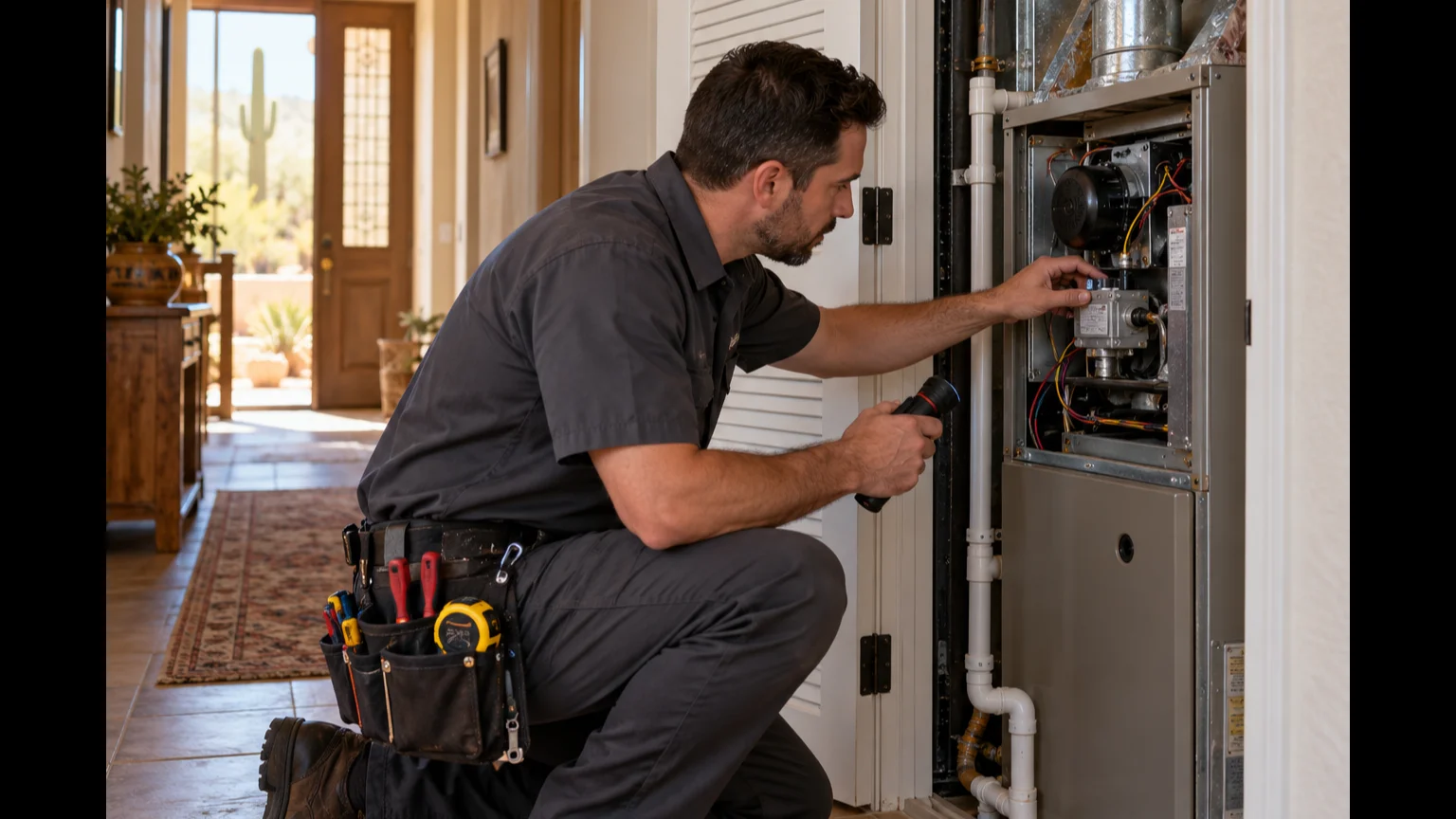
Different odors call for different responses
A furnace that smells burnt when first turned on doesn’t have one confirmed explanation. This page couldn’t confirm a safety rule based on odor alone. Follow the furnace manufacturer’s instructions and current guidance from the responsible utility or emergency authority. Climate Pros Tucson can match you with a licensed local pro when the source isn’t clear.
Don’t use an online burn-off time to decide whether an odor is safe. No confirmed time limit can distinguish ordinary dust from a furnace problem. Record the odor’s character, where it appears, and whether it returns.
This question is especially relevant in the Tucson basin. The 1991-2020 normals at Tucson International Airport show 3,424 cooling degree days and 1,333 heating degree days. That works out to about 2.6 cooling degree days for every heating degree day. Heat can feel unfamiliar after a cooling-heavy year.
Mount Lemmon and Summerhaven are different. Their annual heating demand is about three times the airport’s. Still, location alone doesn’t identify the source of an unexplained odor.
Dust, gas and electrical odors are not interchangeable
Record each reported odor separately. A description can help the contractor begin an inspection, but it can’t diagnose the furnace.
| What you notice | What to do next | What not to assume |
|---|---|---|
| Dry or dusty odor during the first heating cycle | Note when it began, where it’s strongest, and whether it returns | Don’t declare it harmless or assign a safe burn-off time |
| Hot plastic, rubber, metal, or a sharp electrical odor | Check the furnace manufacturer’s instructions and arrange a licensed inspection | Don’t assume the odor identifies a specific failed part |
| Visible smoke or fire | Follow current instructions from the proper emergency authority | Don’t rely on this page as emergency guidance |
| Raw gas or sulfur-like odor | Consult our Tucson furnace gas-odor guide and Southwest Gas for current instructions | Don’t treat the odor as a diagnosis |
| No odor, but a carbon monoxide concern exists | Follow the alarm manufacturer’s instructions and consult our Tucson carbon monoxide guide | Don’t rely on smell to settle the concern |
Southwest Gas is the natural gas utility in the Tucson area. Check its official website or your utility account for current emergency instructions and contact information.
A smell from the furnace also isn’t proof of one failed part. A licensed pro must identify the actual source.
Observations that do not open the furnace
Keep your observations outside the furnace cabinet. This page couldn’t confirm safety procedures for smoke, suspected gas, alarms, or other immediate hazards. Follow the current instructions from the equipment manufacturer and the responsible authority.
You can record a few details for the contractor:
- Note whether the odor began when heat started.
- Write down whether it came from one vent or several.
- Note any unusual sound or loss of airflow.
- Look for an object resting on an accessible register.
- Check whether return and supply grilles are visibly blocked.
- Read the filter label and installation instructions.
- Photograph the thermostat display without changing hidden settings.
- Record whether the odor returned during another normal cycle.
This page couldn’t confirm a safe homeowner procedure for opening equipment panels or handling burners, wiring, gas controls, or internal switches. Check the manufacturer’s instructions and leave internal inspection to a licensed contractor. Ask the manufacturer or contractor before applying any cleaner or fragrance to the system or repeating a cycle to reproduce the odor.
If the filter can be reached without opening furnace equipment, follow the furnace or filter manufacturer’s directions. A filter’s appearance alone can’t prove what caused the smell. Give the pro the filter size, condition, and replacement date instead.
The Tucson HVAC filter guide explains how to compare filter markings without diagnosing internal equipment. For a broader seasonal review, use the Tucson fall HVAC checklist.
Where to find emergency instructions
This page couldn’t confirm emergency rules for smoke, fire, suspected gas, or an alarm. Follow current instructions from the responsible emergency authority, gas utility, alarm manufacturer, or equipment manufacturer.
Use the proper authority’s official contact information for an immediate hazard. The emergency HVAC service page connects customers with licensed independent HVAC pros. It doesn’t replace an emergency authority.
A carbon monoxide concern belongs in a different decision path. Use the linked carbon monoxide guide and the alarm manufacturer’s instructions rather than judging it by a burnt odor.
No verified rule here establishes when equipment with a persistent or sharp electrical odor can be used again. Check the manufacturer’s instructions and arrange a licensed evaluation.
What a licensed heating pro should inspect
The pro should identify the odor’s source before recommending work. Ask for findings in plain language and in writing.
The inspection should address the observations you reported, including:
- Where the odor enters the air stream
- Whether the filter fits and airflow is restricted
- Whether accessible material near a register is heating
- Whether electrical parts show heat damage
- Whether the blower and controls operate correctly
- Whether combustion and venting need further testing
- Whether the odor returns during controlled operation
These are inspection topics, not a homeowner repair checklist. Burner cleaning, wiring tests, gas-valve adjustments, and cabinet work belong with a licensed contractor.
Arizona residential heating and cooling contractors use the R-39 license class or an applicable R-39R subclass. Check the contractor’s status through the Arizona Registrar of Contractors. Every pro Climate Pros Tucson sends is licensed, and you contract with that independent professional directly.
If repairs are recommended, ask for a written quote that separates diagnosis, parts, labor, and any further testing. Each company sets its own prices and policies. The contractor’s written quote is the number that counts.
Our furnace repair service connects Tucson-area homeowners with licensed independent pros. The Tucson HVAC service hub covers the wider service area.
Why does a new furnace smell burnt?
A new furnace odor can’t be declared safe from its age alone. Check the manufacturer’s instructions and contact the installing contractor. This page couldn’t confirm a safety rule based on smoke, raw gas, or an electrical odor, so follow current instructions from the responsible authority or manufacturer.
How long should a dusty furnace smell last?
No verified burn-off time separates a harmless odor from a fault. Don’t rely on a fixed number of minutes or cycles. Arrange an inspection if the odor persists, strengthens, changes, or returns.
What are the signs of a failing furnace?
A smell alone doesn’t identify a failed furnace or component. Record related changes such as unusual sounds, poor airflow, repeated stopping, or loss of heat. A licensed pro should diagnose the system before recommending repair or replacement.
What smell indicates an electrical fire?
No odor description can confirm or rule out an electrical fire. This page couldn’t confirm safety rules for smoke, sparking, or hot-plastic and electrical odors. Follow current instructions from the responsible emergency authority and the equipment manufacturer.
When to call us
Call when a burning odor persists, returns, changes, or resembles hot plastic or an electrical smell. Call (520) 353-2520 and we’ll match you with a licensed local pro.