Is Corona de Tucson part of the City of Tucson?
No. It's unincorporated Pima County. City of Tucson permit rules don't apply directly; the contractor confirms the county's requirements and pulls any permit.
Last updated: October 3, 2026
Call and we match you with a licensed HVAC company that works in Corona de Tucson. That covers AC repair and installation, heat pumps, furnaces, mini splits, evaporative cooler questions, ductwork and emergency calls. You describe the problem, and the company you're matched with quotes the job before any work starts.
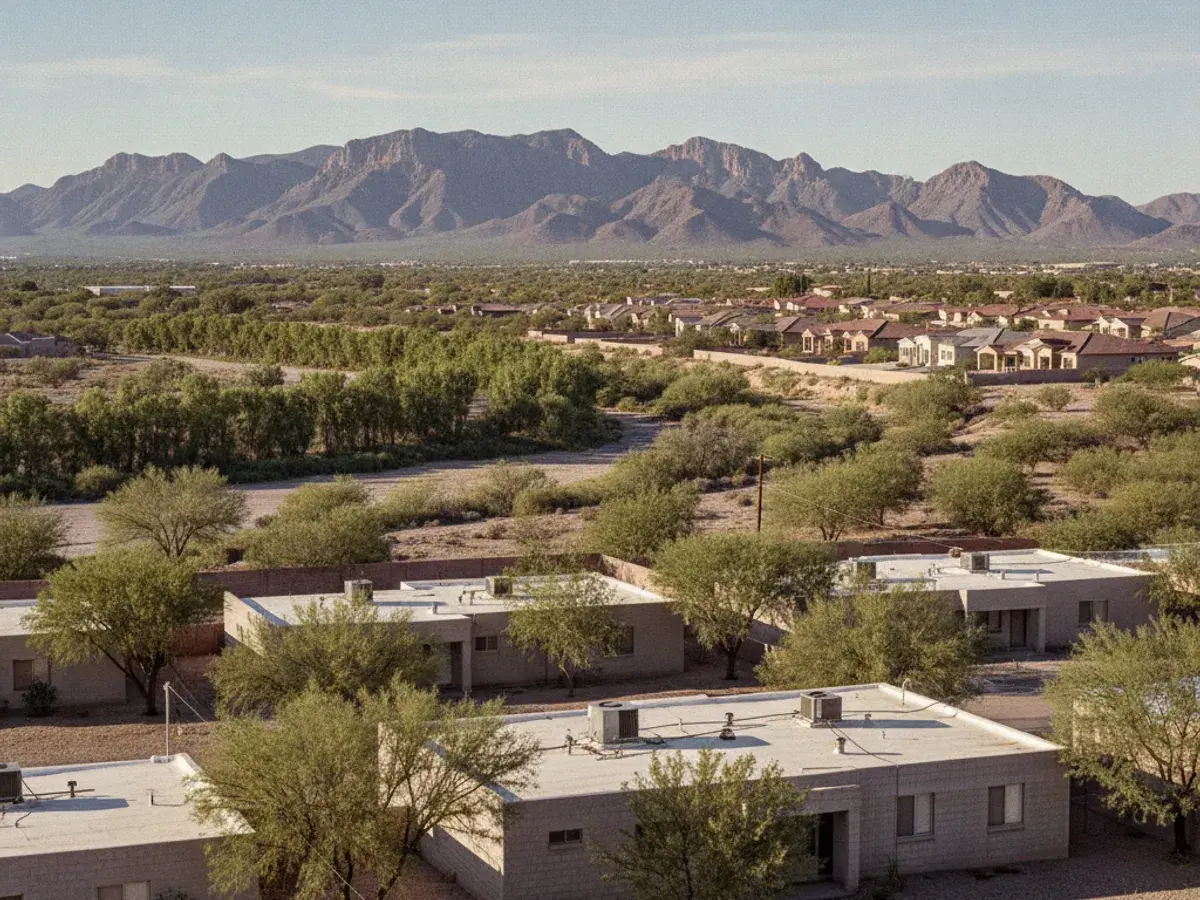
Corona de Tucson sits southeast of Vail off SR-83 and Houghton Road. It has 9,566 residents with a median age of 35.7, an ACS median year built of 2007 and 95.7% owner-occupancy (ACS 2020-2024). The large plats are Sycamore Canyon (2004 onward) and Santa Rita Ranch (2002 to 2018), on top of 1960s New Tucson lots (Pima County plats).
Most homes are 2000s tracts with split systems or heat pumps reaching their first replacement. Climate Pros Tucson matches Corona de Tucson homeowners with a licensed company for repairs and replacements.
Tucson's Eastside runs out to the Rincon foothills, then the southeast growth corridor takes over: Rita Ranch and Civano inside the city, and Vail, Rincon Valley and Corona de Tucson beyond it. Ground climbs from about 2,650 feet on the Eastside to about 3,340 at Vail and Corona de Tucson, so the southeast sees cooler nights than downtown.
At about 3,340 feet, Corona de Tucson is roughly 900 feet above downtown Tucson, so winter mornings run colder and heat pumps defrost more often, but below 4,000 feet the county's code winter design temperature is still 35F. Builder equipment in its second decade usually wants a fresh load calculation before replacement, not a copy of the original tonnage.
Corona de Tucson is unincorporated Pima County, so the contractor confirms county permit requirements. Check your bill for your electric provider before counting on a utility rebate.
Local guides: HVAC on the east side and in Vail · Replacing builder-grade AC in newer tracts
In Tucson-area heat the usual failures are capacitors and contactors, condenser fan motors, refrigerant leaks, and indoor coils that freeze when a dirty filter or monsoon humidity meets weak airflow. Homes in Corona de Tucson have an ACS median build year of 2007. Builder-installed equipment from that era is reaching its second decade, when capacitors, contactors, fan motors and slow refrigerant leaks start to show up.
Before you call, check the breaker, replace a dirty filter, make sure the thermostat is set to cool with good batteries, and look for a tripped condensate float switch near the indoor unit. If the refrigerant line or coil is iced over, switch to fan only and let it thaw. Climate Pros Tucson doesn't set prices. The company you're matched with diagnoses first and quotes the repair before work starts, so ask for its diagnostic fee as a dollar figure. On older equipment, ask for a repair price and a replacement price side by side. The $5,000 rule (the unit's age times the repair cost) is a trade rule of thumb, not a verdict.
For a no-cool or no-heat problem in Corona de Tucson, call with the address, the system type, the symptoms and anyone at risk in the home. We match you with a licensed HVAC company that covers Corona de Tucson, and that company tells you directly when it can come. Climate Pros Tucson is a referral service: it doesn't dispatch trucks, promise arrival times or set fees. Any after-hours service is the matched company's own policy. While you wait in summer heat, move people to the coolest room or an air-conditioned building. The CDC advises older adults not to rely on a fan as the main cooling when it is very hot. Shut the system off if you smell burning or see sparking, if you can do it safely. A gas odor or carbon monoxide alarm means leave the building and call 911 or the gas utility from outside.
Installation and replacement. The company you're matched with sizes a new system from a load calculation on the house, not the tonnage on the old nameplate, and quotes it in writing before anything is ordered. Corona de Tucson is unincorporated Pima County, so the City of Tucson's permit page doesn't govern it; the contractor confirms the county's requirements and pulls any permit. A first replacement of builder equipment should be sized from a fresh load calculation rather than copied from the original nameplate. If TEP is your utility, ask whether the company you're matched with is a participating contractor in TEP's Efficient Home Program, which pays instant rebates as listed by TEP in October 2026.
Heating. At about 3,340 feet, Corona de Tucson sits above the valley floor, so winter mornings run colder and heat pumps run more defrost cycles, which is normal. A heat pump is the sensible default here: the area needs about 2.6 cooling degree days for every heating degree day, so the same unit does the cooling you need anyway.
Maintenance. A tune-up before the first 100F day covers the coils, refrigerant charge, electrical connections, capacitor and condensate drain, and a second look after the monsoon clears the dust. Newer systems mostly need clean coils, the right refrigerant charge and clear condensate drains to reach their second decade in good shape.
Check any contractor's license with the Arizona Registrar of Contractors at roc.az.gov. Residential air conditioning and heating work falls under the R-39 class. The service pages below go straight to the job you need.
No. It's unincorporated Pima County. City of Tucson permit rules don't apply directly; the contractor confirms the county's requirements and pulls any permit.
Not by default. Ask for a load calculation. Insulation, windows and how the house is used can all change the right size, and an oversized system short-cycles.
Yes. We cover all of Corona de Tucson and match you with a licensed company that works the area.
You hear the price before any work starts.