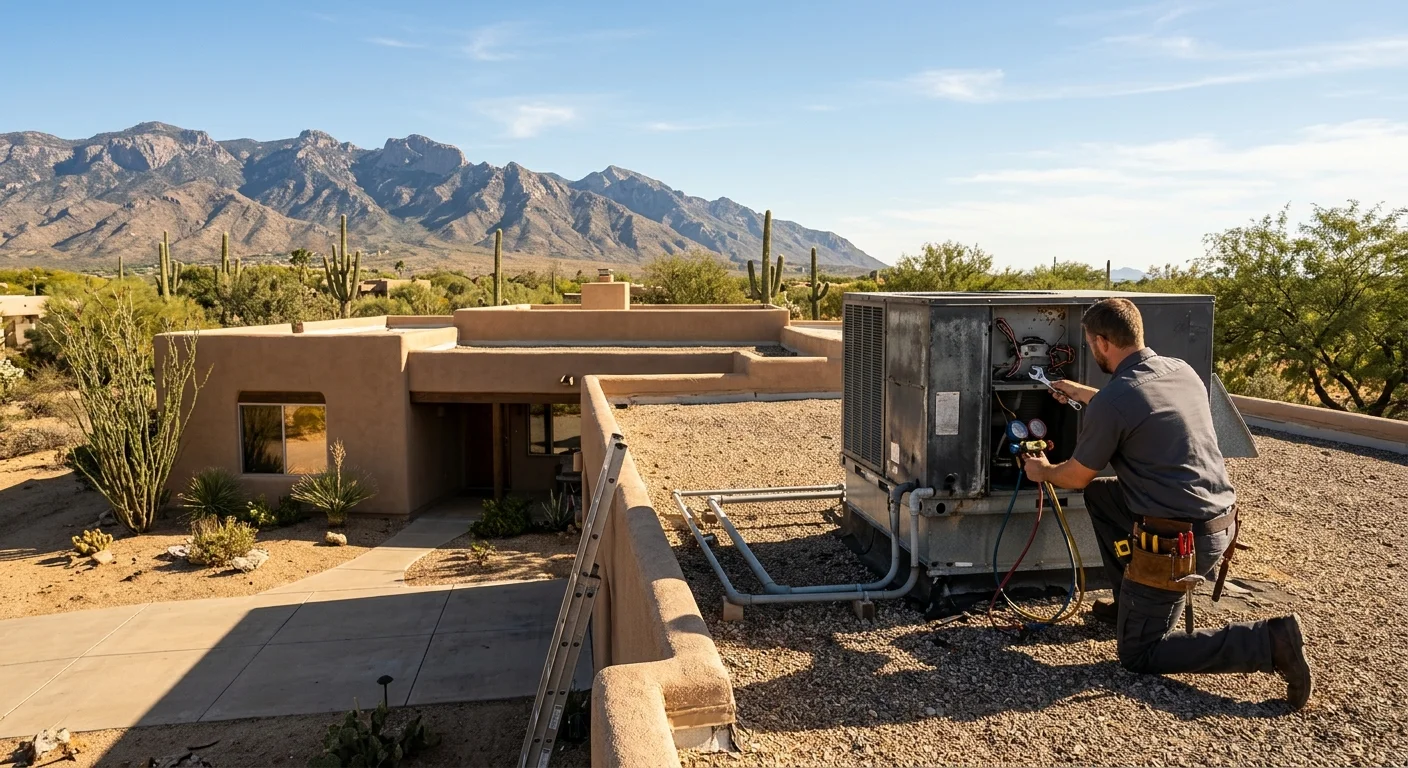
A rooftop gas pack that cooled a Tucson house all summer can sit silent on the first heat call. The cooling half of that cabinet ran for months. The gas furnace in the same box did not. Stay off the roof. Climate Pros Tucson matches you with a licensed local pro who can inspect the pack in place.
Tucson’s heating season is short next to its cooling season. 1991-2020 normals at Tucson International Airport show 1,333 heating degree days and 3,424 cooling degree days, about 2.6 cooling degree days for every heating degree day. Fewer than 12 nights a year drop to 32F or below. The heat side of a pack can sit idle from spring until a November or December night finally asks for it.
How does a rooftop gas pack heat a Tucson house?
A gas pack is a packaged gas-electric unit: air conditioning and a gas furnace in one outdoor cabinet, usually on the roof, with ducts dropping into the house. Southwest Gas is the natural gas utility in the area. The cooling half uses electricity. The heating half burns gas in that same cabinet, then the blower pushes warmed air through the ducts.
That is a different machine from a heat-pump pack, and from a split system with a ground condenser and an indoor furnace. If you are still sorting which one you have, read heat pump vs gas pack on a package unit. If the rooftop unit is a heat pump and the air is cool in heat mode, that is a heat pump not heating problem, not a gas-furnace problem.
City of Tucson energy code puts the basin in climate zone 2B, with a winter design dry bulb of 35F. A pack on a Marana, Vail, or midtown ranch is doing mild heating duty. Mount Lemmon and Summerhaven sit in a different climate zone entirely. This page is about the basin-floor pack that loafed through a long cooling season.
Why did cooling work all summer if heat does not?
Cooling and heating share a cabinet, a blower, and often a thermostat. They do not share the gas train. Compressors, condenser fans, and evaporator coils can run from May through September while the igniter, gas valve, burners, and heat exchanger never fire.
October through April, Tucson Electric Power time-of-use on-peak is weekdays from 6 to 9 a.m. and 6 to 9 p.m. That matters for electric heat. A gas pack’s heat is gas. The first heat call still has to wake parts that sat through monsoon, dust, and months of heat on a roof.
Ask the licensed tech to treat this as a heat-side failure until proven otherwise. Common questions for that visit, not a homeowner diagnosis:
- Is the thermostat actually in heat, and is it calling?
- Is gas on at the meter and at the unit’s shutoff?
- Does the inducer start, then ignition, then a steady flame?
- Is a flame sensor, igniter, gas valve, or limit switch open?
- Is the heat exchanger intact, or is a safety switch locking the unit out?
The heat side is furnace repair. If you flip back to cool and the air is weak or warm, that is a separate AC repair question on the same cabinet.
Snowbird houses add one more indoor check. Gas is sometimes shut off for the summer. The pack cannot heat if the valve at the house is closed.
What monsoon dirt and roof residue fail first?
Official monsoon season runs June 15 through September 30, a fixed window the National Weather Service adopted in 2008. Dust storms occur in Arizona during that window. At Tucson’s airport, average dew points sit in the 20s for most of the year and jump into the high 50s in July and August. A rooftop cabinet takes sun, dust, and monsoon rain that a garage furnace never sees.
Do not guess which part failed from the driveway. Ask the tech to look at what a summer on a Tucson roof actually loads:
- Intake screens and louvered panels packed with dust
- Burner ports dirty enough that flame will not hold
- Debris in the cabinet, including nests or seed pods
- A condensate path that sat wet, then dry, then wet again
- Cabinet seams, curb flashing, and duct collars at the roof
- The heat exchanger, after a long idle stretch in a dusty cabinet
ENERGY STAR notes that a typical forced-air house can lose about 20% to 30% of the air moving through ducts to leaks, holes, and poor connections. That is a national typical-house statement, not a measured Tucson result. On a rooftop pack the first leak the tech can see is often at the roof curb and the drop, not in an attic. Ask for that to be on the quote.
Stay off the roof while you wait. Monsoon residue is the tech’s problem, not a ladder project.
What can you check from the ground, not the roof?
You can confirm the call for heat without climbing. You cannot safely service a gas pack from a ladder.
From inside the house:
- Set the thermostat to heat, and raise the setpoint a few degrees above room temperature.
- Give it a few minutes. Listen for the system to start, not for heat at the register in the first seconds.
- Check the indoor switch and the breaker that feed the pack.
- Check the filter. A packed filter can trip a limit and stop heat.
- If you smell gas, leave the house. Do not flip switches, and do not go on the roof. Call 911 from outside.
- If a carbon monoxide alarm sounds, get out and treat it as an emergency. Read carbon monoxide in a Tucson home only after you are safe. A rooftop pack still vents. A cracked exchanger is a licensed-tech finding, not a ground check.
From the yard, look. Do not climb.
- Is the pack still on the curb, or is it shifted after wind?
- Are supply and return drops obviously crushed or disconnected at the soffit or chase?
- Is anything draped over the unit from the roof, visible from the street?
That is the whole homeowner list. Igniters, flame sensors, gas valves, and heat exchangers are not DIY on a roof. For the first cold night on an indoor furnace instead of a pack, see the first cold night furnace checklist.
What should a licensed quote inspect on a pack?
A useful quote names the rooftop gas pack, the heat symptom, and the checks above as line items, not a vague “tune-up.” Ask the pro you are matched with to put these in writing:
- Confirmation that the thermostat heat call reaches the pack
- Gas supply and combustion: inducer, ignition, flame, and shutdown
- Heat exchanger condition, plus rollout and limit safeties
- Blower operation in heat, and static if they measure it
- Roof curb, flashing, and the duct drop through the roof
- Whether repair is on the table, or a roof package unit replacement is the honest next step
Every pro we send is licensed. Residential heating and cooling in Arizona is Registrar of Contractors class R-39 or an R-39R subclass. Check the license at roc.az.gov before anyone goes on your roof.
If the pack has to come off, the City of Tucson requires a permit for a new or replacement furnace, heat pump, or air conditioner, with load and sizing calculations. The matched contractor pulls that permit, never Climate Pros Tucson. Start at the City of Tucson residential permits page. Do not assume unincorporated Pima County, Marana, Oro Valley, or Sahuarita use the same permit desk.
If you live in San Ignacio Heights in Green Valley, rooftop equipment has to be concealed from an adjoining street or lot, and roof parapets have to cut off the sight line from five feet above the viewing location. That rule is in that association’s handbook. It is not a valley-wide HOA rule. Confirm it with the association before a like-kind swap if you are in that community.
Ask what the diagnostic fee is and whether it applies toward the repair. Each company sets its own policy. You hear the price before any work starts.
Is a rooftop gas pack the same as a heat pump that will not heat?
No. A gas pack burns gas for heat. A heat-pump pack moves heat with refrigerant. Cooling can work on both. The no-heat causes are not the same, so say which cabinet you have when you call.
Can I reset the pack from the roof myself?
No. Stay on the ground. A rooftop gas unit is a fall hazard and a combustion appliance. The licensed contractor goes on the roof.
Why wait until the first cold night to find this?
Tucson’s cooling season is long. June’s normal high at the airport is 101.2F. The pack’s gas section can sit unused through that stretch. The first real heat call is often the first time those parts have to work since spring.
Does a landlord have to restore heat?
A landlord in Arizona must supply reasonable heat where the unit is installed, and keep HVAC facilities in good and safe working order. Put the outage in writing and ask for the repair timeline from the owner or manager.
When to call us
Call when a Tucson rooftop gas pack will not heat, you smell gas, a carbon monoxide alarm sounds, or the ground checks above still leave cold registers. Call (520) 353-2520 and we’ll match you with a licensed local pro.