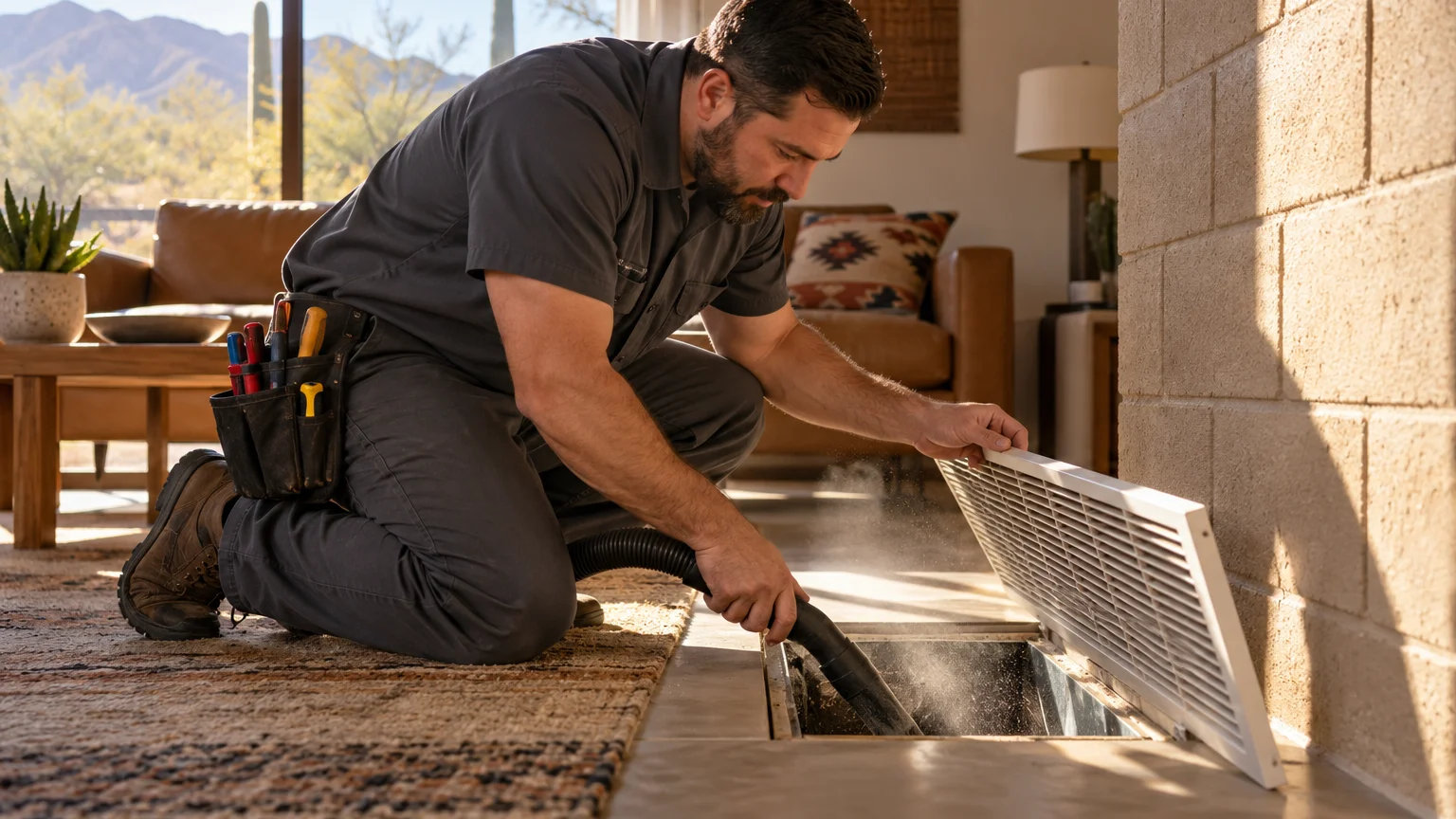
A dusty first cycle has several possible sources
Dust blowing from Tucson heating vents doesn’t automatically prove the ducts need cleaning. The material may be sitting on the register, near the vent opening or somewhere within the system. A poorly seated filter or a duct problem also deserves investigation.
Climate Pros Tucson can match you with a licensed local pro when basic checks don’t identify the source. The contractor can inspect the system and show you what they find.
Tucson’s heating season is modest compared with its cooling season. The 1991-2020 normals at Tucson International Airport record 3,424 cooling degree days and 1,333 heating degree days. That seasonal difference makes the return to heat mode a noticeable change for many households.
Dust storms also occur during Arizona’s official monsoon season, June 15 through September 30. However, outdoor dust doesn’t prove that a visible plume came through the ductwork. An inspection needs to trace the material instead of assuming its source.
Start by noting exactly what happens:
- Does dust appear from one register or several?
- Does it happen only when heating begins?
- Is there loose material sitting on the register?
- Does dust return soon after nearby surfaces are cleaned?
- Is the filter seated evenly in its slot?
- Are there visible gaps around the filter?
- Can you see debris just inside the register opening?
- Are particles visibly leaving the register while the blower runs?
These observations give a licensed pro a clearer starting point. They also help separate a surface issue from a system-wide symptom.
Check filters, registers and nearby surfaces
Begin with the parts you can see without opening HVAC equipment. A dusty register face doesn’t show where the dust originated.
Clean the nearby floor, wall or ceiling surface. Clean the removable register cover if you can do so without disturbing duct connections. Then watch the area during another heating cycle. This simple comparison shows whether the material was already resting near the opening.
Next, examine the filter and its placement. Our Tucson HVAC filter guide explains the filter questions to review. Follow the equipment manufacturer’s instructions when selecting and installing a replacement.
Check these visible details:
- The filter matches the size marked for its holder.
- The filter sits squarely rather than leaning or bowing.
- Air can’t clearly pass around an open edge.
- The filter isn’t missing, torn or visibly damaged.
- The access panel closes as designed.
- The filter’s airflow arrow follows the equipment instructions.
Don’t select a filter based only on the promise of capturing more particles. The correct choice depends on the equipment and its approved filter setup. Ask a licensed pro to confirm compatibility when the labeling is unclear.
A dark filter also doesn’t prove the ducts need cleaning. It shows that the filter has collected material. The source and condition of any visible particles still require separate evaluation.
Tucson homes don’t all share the same equipment layout. A filter may be at a return grille or near the indoor equipment. Some systems may have more than one return location. Follow the system’s documentation rather than assuming every grille contains a filter.
For broader concerns beyond one dusty vent, review the available indoor air quality options. That evaluation should begin with the symptom and the equipment already installed.
Duct leaks and dirty ducts are different
Duct leakage and dirty duct interiors aren’t the same finding. One concerns air escaping through leaks, holes or poor connections. The other concerns material inside the duct system.
ENERGY STAR says a typical forced-air house can lose about 20% to 30% of the air moving through ducts because of leaks, holes and poor connections. That’s a national typical-house statement, not a measurement of your Tucson home.
A visible puff at a register doesn’t measure leakage. A contractor needs to inspect or test the duct system before recommending sealing. If leakage is confirmed, ask where it was found and how the proposed repair addresses it. Our guide to duct leak repair in Tucson explains what to request during that discussion.
Dirty ducts require different evidence. The EPA’s duct-cleaning guidance doesn’t recommend routine cleaning on a fixed schedule. It says cleaning should be considered as needed for substantial visible mold, vermin, excessive dust or debris, or particles released from registers.
The EPA also says duct cleaning hasn’t been shown to prevent health problems. It reports little evidence that cleaning ducts alone improves system efficiency. Cleaning shouldn’t be sold as a guaranteed solution for health, comfort or utility bills.
| Finding | Evidence to request | Possible next discussion |
|---|---|---|
| Dust resting on a register | Photos before cleaning and after another cycle | Surface cleaning and continued observation |
| Filter fit concern | A clear view of the filter holder and any open edge | Correct filter size, placement or holder repair |
| Suspected duct leakage | Location of the defect and results from any testing performed | Repair or sealing of confirmed leakage |
| Debris inside ducts | Photos or video showing the affected sections | Scope and limits of cleaning |
| Particles leaving registers | Video or direct observation while the system runs | Inspection of the filter, blower area and ducts |
| Suspected mold | Visible evidence and an explanation of how it was identified | Correcting the source before discussing cleaning |
| Suspected vermin | Visible evidence of the affected area | Appropriate removal and correction of access points |
If cleaning is proposed, ask which EPA condition applies. Ask the contractor to identify the affected sections and explain what the service includes. Our article on whether duct cleaning is worth it in Tucson provides a fuller decision guide.
When indoor air equipment may help
Visible dust alone isn’t enough to select indoor air equipment. First identify whether the issue involves filter fit, particles leaving registers, duct condition or material near the vent.
An indoor air quality assessment can examine those questions. The contractor should explain what each proposed item is meant to address. Ask how it fits the existing system and what maintenance it requires.
Avoid any promise that equipment will prevent a medical condition. Climate Pros Tucson is a referral service and doesn’t provide medical advice. Anyone concerned about symptoms should speak with a qualified healthcare professional.
Useful questions for the HVAC contractor include:
- What specific condition did you find?
- Where is the dust entering or collecting?
- Did you observe particles leaving the registers?
- Does the current filter fit its holder correctly?
- Is the proposed filter approved for this equipment?
- Did you find a duct defect, or are you recommending cleaning?
- What result can be checked after the work?
- What ongoing maintenance does the proposed equipment require?
A recommendation should connect directly to visible evidence. If the finding is limited to one register, ask why a whole-home service is necessary. If several rooms are affected, ask how the contractor traced the shared source.
What evidence to request from a licensed pro
Ask for evidence that distinguishes observation from assumption. Photos, video and test results can make the proposed scope easier to evaluate.
A useful inspection record should identify:
- Which registers were checked
- Whether particles were observed during operation
- The filter size and installation condition
- Any visible gaps around the filter holder
- The location of confirmed duct damage
- Any testing performed and its results
- Photos of debris, vermin or suspected mold
- The exact sections included in proposed cleaning
- The maintenance required after any equipment change
For duct cleaning, ask whether the recommendation follows one of the EPA’s conditions. Don’t accept a fixed cleaning interval as proof that the work is needed. EPA guidance says ducts should be cleaned as needed, not automatically on a schedule.
For duct sealing, ask what leakage was confirmed and where. Cleaning and sealing solve different findings. One shouldn’t be substituted for the other without evidence.
Every pro Climate Pros Tucson sends is licensed. You can also check a contractor through the Arizona Registrar of Contractors. Residential HVAC work falls under the R-39 class or its R-39R subclasses.
The customer contracts with and pays the independent professional directly. Ask for a written scope that separates inspection, cleaning, sealing and any indoor air equipment. You hear the price before any work starts.
Climate Pros Tucson covers homeowners through its Tucson HVAC service hub. Tell the matched pro whether the dust appears from one vent, several vents or only when heating begins.
When to call us
Call when particles visibly leave the registers, dust keeps returning, or you need a licensed HVAC pro to distinguish filter, duct and indoor air concerns. Call (520) 353-2520 and we’ll match you with a licensed local pro.