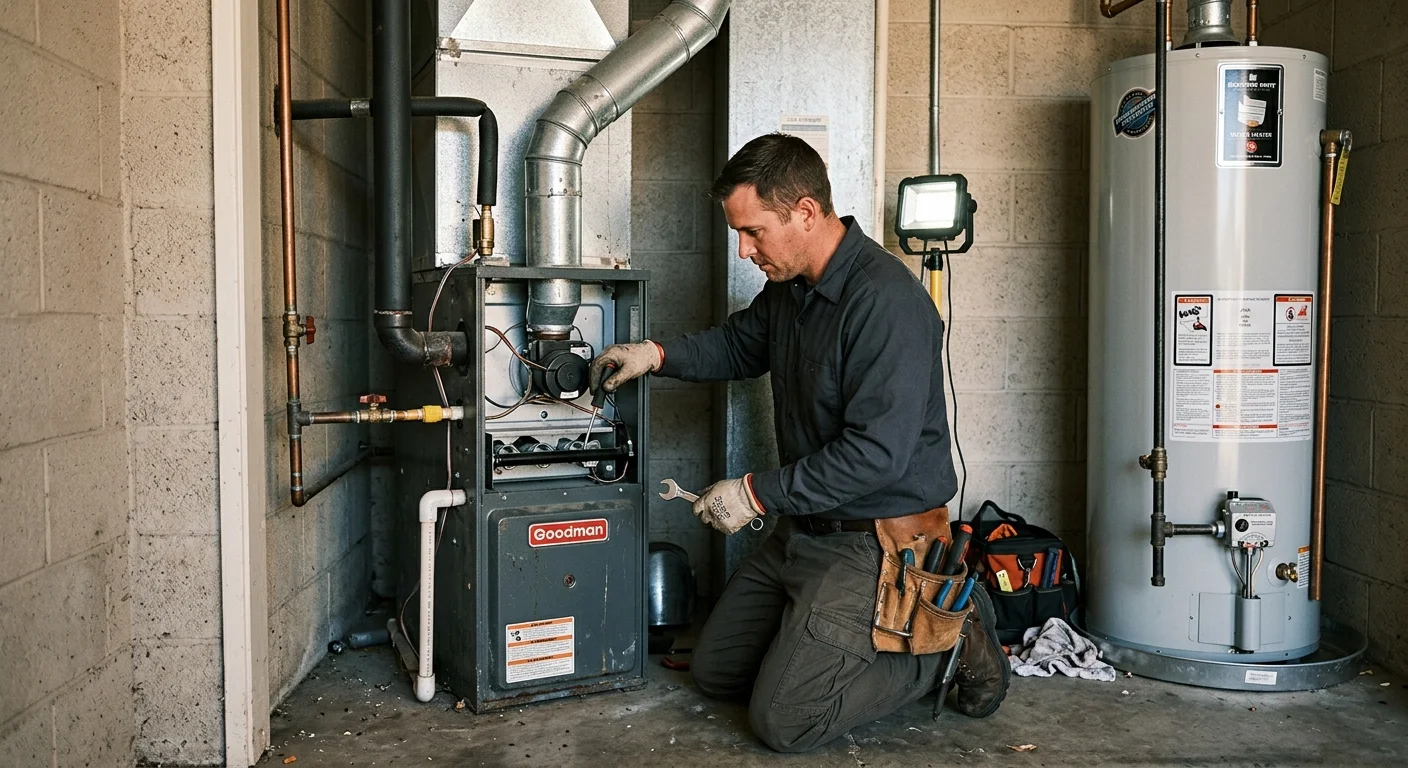
Soot at the registers, a carbon monoxide alarm while the furnace runs, or a sick feeling that lifts when you leave the house. Treat those as cracked heat exchanger signs in a Tucson home, and put them on a same-week call list. The exchanger is the metal wall that keeps furnace exhaust away from household air. A crack can mix those two streams. If a carbon monoxide alarm sounds, get people and pets out and follow the get-out steps in our carbon monoxide in a Tucson home guide. Climate Pros Tucson matches you with a licensed independent pro for furnace repair. We don’t inspect exchangers.
At Tucson International Airport, 1991-2020 normals show fewer than 12 nights at or below 32F, and 1,333 heating degree days. The basin runs about 2.6 cooling degree days for every heating degree day. A gas furnace can sit quiet through a long cooling season, then fire on the first cold night. That idle-then-hot cycle is a hard test for old metal. Homes on Mount Lemmon and in Summerhaven live a different winter: about 53 nights at or below 32F, and about 4,024 heating degree days. Heat there is a real load, not a short snap.
What does a heat exchanger do in a gas furnace?
It is the wall between fire and household air. Burners heat one side. The blower pushes return air across the other side, then into the ducts. Exhaust is supposed to leave through the flue. Indoor air is supposed to stay on its own side. A crack, hole, or separated seam can let those two streams mix.
Tucson gas furnaces often live in a garage closet, a mechanical closet, or a rooftop package unit that also heats. Arizona homes used a central furnace as main heat in 55% of cases in 2020, and natural gas heated 36% of Arizona homes that year. Those are statewide figures, not a Tucson share. Southwest Gas is the natural gas utility here. If your heat is electric, a heat pump, or a package unit, ask the tech which part is the heat exchanger before you assume this page applies.
On a high-efficiency furnace, a second exchanger runs cooler and can rust from condensate. Ask the tech which exchanger they found, primary or secondary.
A heat pump is the sensible default for a Tucson-basin home. Mild heating duty is why. City of Tucson energy code is climate zone 2B, with a 35F winter design dry bulb. Mount Lemmon and Summerhaven sit in Pima County zone 5B above 4,000 feet, with a 4F winter design. Backup heat there is a question for the pro, not a default.
Which signs belong on a same-week call list?
Treat these as a reason to shut the furnace down and call a licensed pro. None of them is a home diagnosis of a crack.
- A carbon monoxide alarm that sounds while the furnace is on. Leave. Then use emergency HVAC service matching through us, or call 911 if someone is sick.
- Headache, nausea, dizziness, or a flu-like feeling that eases when you leave and returns when the heat runs.
- Exhaust smell, soot, or a sharp chemical odor at supply registers when the furnace fires.
- Scorch marks, rust holes, or warped metal on the furnace cabinet or around the burner area.
- Flame that rolls out of the burner compartment, or a burner flame that looks unstable while the blower is running.
- Moisture or rust on the exchanger once a tech has the cabinet open. Don’t take the panels off yourself.
On the basin floor, the first cold night is often the first real run of the season. Oro Valley, Marana, the Catalina Foothills, east-side Vail, Sahuarita, and Green Valley all share that short heating window. A unit that sat through monsoon dust (June 15 through September 30) and a long cooling season can fail on that first fire. Summerhaven does not get that long rest. If heat is how the house stays livable up the mountain, don’t wait on a maybe.
Ask whether a tech is available, yes or no. We don’t publish arrival windows.
What is not proof of a crack on its own?
A furnace that blows cold air, short cycles, or fails to ignite can be a dirty flame sensor, a bad blower, a thermostat, or a gas-valve issue. Those belong on the signs a furnace is going out list. They do not confirm a cracked exchanger by themselves.
A yellow burner flame can be dust, a dirty burner, or a combustion-air problem. Tucson dust after monsoon season is a real cause. It does not confirm a crack.
A higher winter electric bill does not confirm one either. From October to April, TEP time-of-use on-peak is weekdays 6 to 9 a.m. and 6 to 9 p.m. Heat that runs in those windows costs more on that plan. Trico Electric Cooperative serves northwest Tucson and Marana south to Green Valley and Sahuarita, and Trico’s standard residential rate (RS1) has no peak split. Neither bill pattern diagnoses a crack.
Age is not a diagnosis. Neither is a furnace that sat unused since spring. Get a licensed look. A phone photo cannot confirm a crack.
How does a licensed tech confirm a crack?
You don’t. Climate Pros Tucson does not inspect heat exchangers. The independent licensed contractor you are matched with does.
Ask, before they start, how they will confirm a crack on your model. Camera, combustion testing, a visual check with the heat on, and pressure or smoke methods are all things some techs use. None of those is a promised procedure on this page. Ask what they will do, what they will photograph, and whether they will show you the defect before they talk replacement.
Residential heating and cooling work in Arizona is ROC class R-39, or an R-39R subclass such as Warm Air Heating, Evaporative Cooling and Ventilating. Check the contractor’s license at roc.az.gov. Our guide on how to check an HVAC contractor’s Arizona ROC license walks through that lookup. Every pro we send is licensed.
If the tech wants to open the furnace, that is their licensed work. Combustion gas and gas piping are not a weekend project.
Repair or replace once the exchanger is bad?
Once a crack is confirmed, treat the furnace as unsafe to run. Ask the pro whether the maker sells a replacement exchanger for that exact model, and whether they will warrant installing it. Ask whether a weld or patch is even offered. Get the answer in writing. Climate Pros Tucson does not set that call, and we don’t warrant the work.
A full furnace replacement in the City of Tucson needs a permit. Load and sizing calculations are required for new and replacement HVAC equipment. The matched contractor pulls the permit, never the brand. City of Tucson residential permit rules list furnaces as permitted work. An HVAC replacement in the City of Tucson needs a permit, so the handyman exemption does not cover it. For a house outside city limits, confirm the permit with the contractor and the city or county that has the house.
For what a replacement quote should list, see furnace replacement cost in Tucson. The written quote from the pro is the number that counts for your home.
On the basin, this is also the moment to ask about a heat pump instead of another gas furnace. The same unit does the cooling the house needs anyway. If you’re weighing that path, start at our HVAC service in Tucson hub and ask the matched pro which system fits the house. TEP listed up to $720 for a heat pump quality installation in October 2026 through a participating Efficient Home contractor. Amounts change, so confirm with TEP’s Efficient Home Program or the contractor at quote time. The federal 25C credit does not apply to equipment placed in service in 2026. Southwest Gas’s 2026 Arizona residential rebate application lists no furnace rebate.
On Mount Lemmon, a like-for-like furnace, a cold-climate heat pump, or backup heat is a question for the pro. Zone 5B is not the basin.
Arizona landlords must supply reasonable heat and keep HVAC facilities in good and safe working order. Renters don’t have to diagnose an exchanger. They do need a licensed look if the heat is unsafe.
Common questions
Can I keep the furnace on until a tech arrives?
Shut it down if a CO alarm sounded, you smell exhaust, you see soot, or anyone feels sick when the heat runs. Hold heat with extra layers in rooms you use. Leave the furnace off until a licensed tech clears it.
Does a cracked heat exchanger always mean a new furnace?
Only the licensed tech and the manufacturer rules for that model can say. Ask whether a factory exchanger is available, and whether the rest of the furnace is worth the job. Get both options in writing.
When to call us
A suspected cracked heat exchanger is licensed HVAC work, and a carbon monoxide risk until a pro says otherwise. Call (520) 353-2520 and we’ll match you with a licensed local pro.