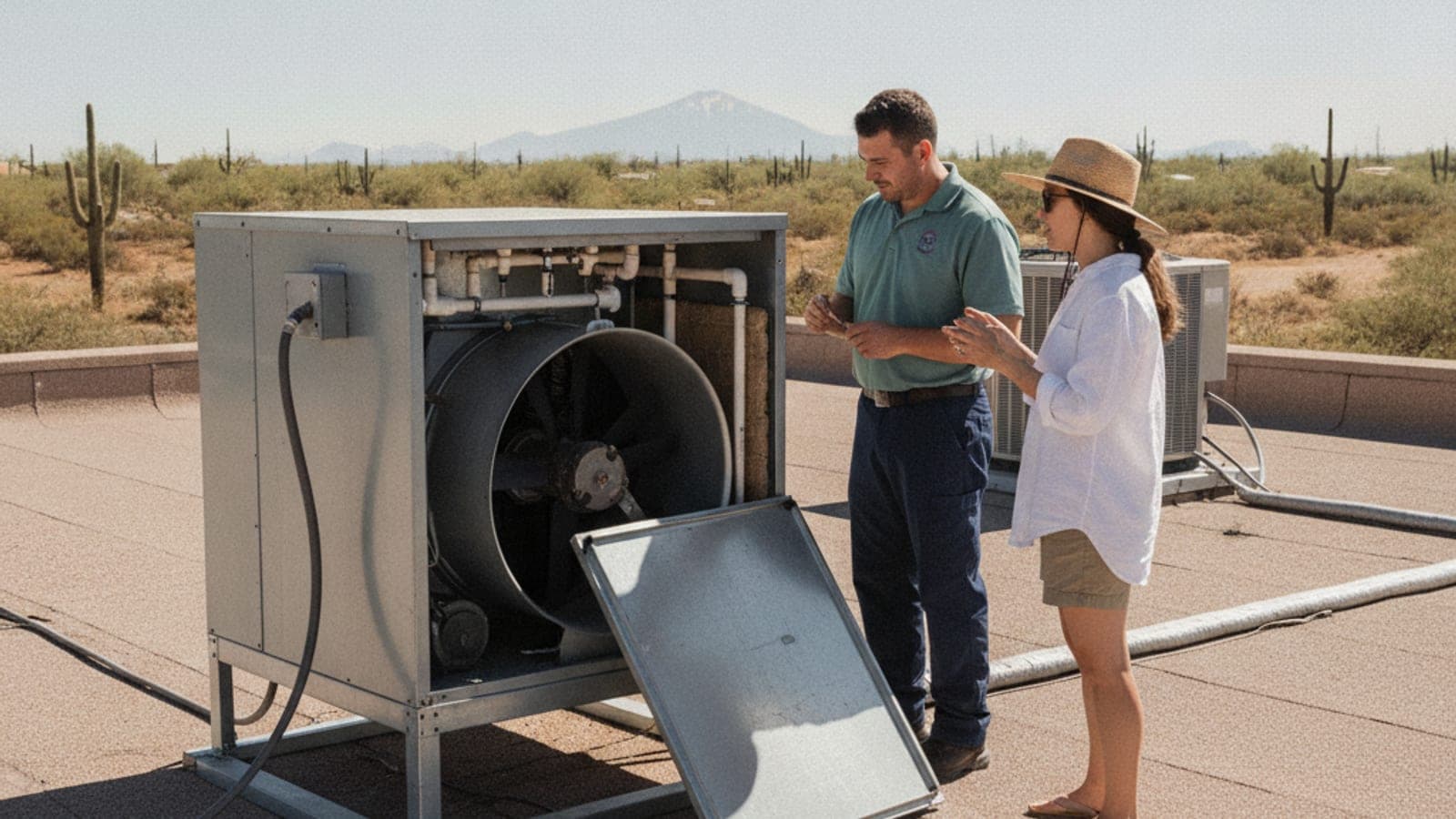
When a cooler’s motor runs and little air comes out, the belt is the first suspect: a loose or broken belt lets the motor spin without turning the blower. Worn bearings and a weak motor start are next. All of it sits behind an access panel, often on a roof, so cut the power first and decide honestly whether the job is yours. Climate Pros Tucson matches you with a licensed pro; when you call, ask whether that pro works on evaporative coolers.
Why does the motor run but the air is weak?
Several different faults look the same from the living room.
| Sign | Likely cause |
|---|---|
| Motor hums, blower doesn’t turn | Broken or slipped belt, seized bearing |
| Squealing at start | Loose or glazed belt |
| Grinding or rumbling | Worn bearings |
| Slow start, then gets going | Weak start capacitor or tired motor |
| Air weak only on low speed | Two-speed motor or switch problem |
| Pads soaked, little air | Clogged or caked pads, or no window open in the house |
How do you check the belt?
With the power off, look at the belt. Cracks, shine or fraying mean replace it. Press it at the midpoint: your manufacturer’s manual gives the right deflection, and too tight loads the bearings while too loose slips. Check that the motor pulley and blower pulley line up.
What about bearings?
Spin the blower shaft by hand. It should turn smoothly with little noise. Grinding, wobble or hard spots point to bearing wear. Some coolers use oil ports and some are sealed, so follow the manual. Look at the pulleys and shaft for crust while you’re there: Tucson Water notes that hard water leaves calcium deposits in evaporative coolers, and a cooler that throws spray onto the motor side has a pad or distribution problem to fix too.
Is it the motor or its capacitor?
A motor that hums but won’t turn, or starts slowly, may have a weak capacitor. Capacitors hold a charge even when the power is off, so leave that to a licensed pro. A two-speed motor adds a second winding and a switch, and either can fail. A pro can test the motor, its capacitor and the wiring. On roc.az.gov, the R-39 class and the R-39R evaporative cooling subclasses are the licenses that cover cooler work, so check the pro’s class before booking.
Is it the house, not the cooler?
Check that a window or two is open. A cooler pushes air in, and a sealed house gives it nowhere to go. Also check the pads for scale. The spring start-up checklist covers pads, pump and float valve.
Is roof work safe?
Only with care. A Tucson roof in summer is hot to the touch, and an access panel means leaning over the unit near the edge. Never touch wiring with power on. If you’re unsure, stop. If the cooler is old and keeps failing, swamp cooler vs AC helps you decide whether to switch to refrigerated air, which a licensed pro can quote through AC installation. The Tucson HVAC hub lists where we cover.
When it’s more than a belt
For a motor, capacitor or wiring fault, or a cooler that keeps failing, call (520) 353-2520 and we’ll match you with a licensed local pro.