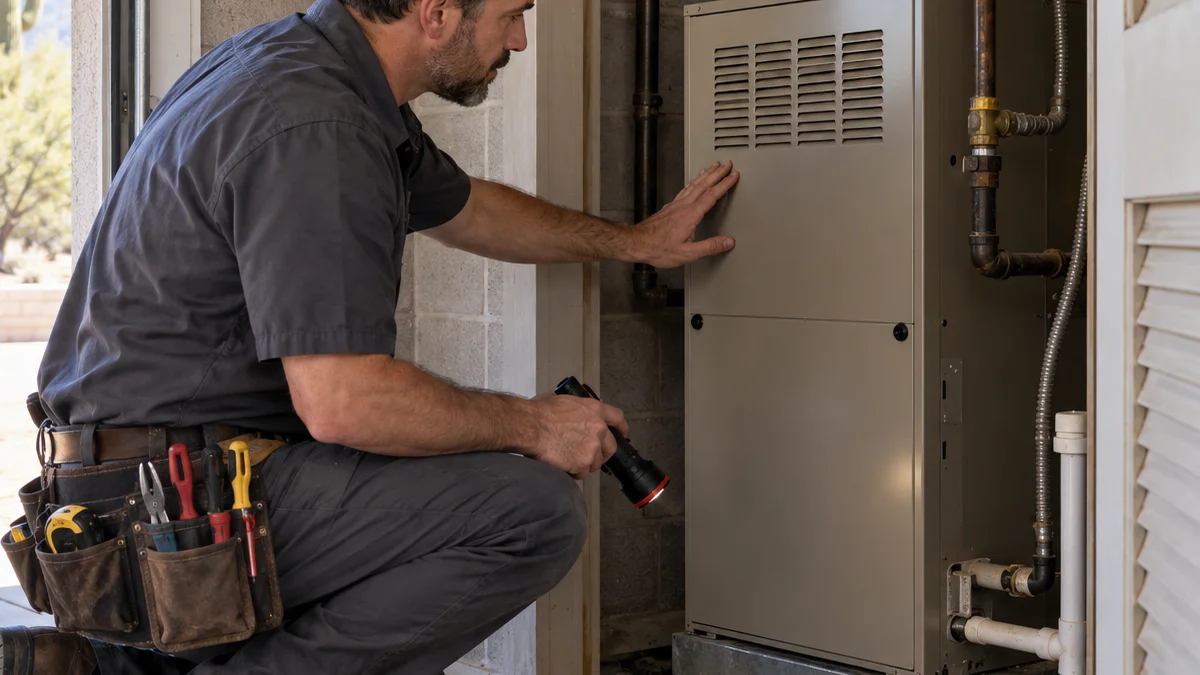
A pilot light that won’t stay lit needs an on-site diagnosis. Note what happened, then leave the cause for the contractor to identify. Climate Pros Tucson can match you with a licensed independent contractor for furnace repair.
If you smell gas, use our Tucson furnace gas odor guide for the next steps.
Standing pilot vs electronic ignition, in plain words
Check the furnace label or owner’s manual before calling the problem a pilot-light failure. Use the equipment’s written instructions when identifying the ignition system or looking for a relighting procedure.
Use this distinction when describing the problem:
| What to verify | Standing pilot | Electronic ignition |
|---|---|---|
| Furnace label or manual | Identifies a standing pilot | Identifies electronic ignition |
| Relevant symptom | A visible pilot won’t remain lit | Ignition clicks, glows, or fails during a heat call |
| Next guide | Stay on this page | Read why a furnace won’t ignite |
| Relighting | Refer to the model’s instructions | Refer to the model’s instructions |
A clicking furnace that never produces heat belongs in our click-no-fire guide. That symptom needs a different diagnostic path.
Don’t identify the ignition system by the home’s age. An adobe or slump-block house may have received equipment changes over time. Our guide to HVAC in older Tucson adobe and block homes covers broader planning issues without assuming which furnace is present.
Does first heat in Tucson blow a weak pilot out?
The first heat call doesn’t prove that airflow extinguished the pilot. It only tells you when the symptom became noticeable.
Tucson’s cooling season dominates the year. The 1991-2020 normals at Tucson International Airport show 3,424 cooling degree days and 1,333 heating degree days. They also show fewer than 12 nights per year at or below 32°F.
A furnace may therefore sit unused before the first chilly morning. That timing doesn’t identify the failed part. Ask the contractor to diagnose the actual system instead of accepting “first start of the season” as the whole explanation.
Check National Weather Service Tucson for the current forecast. Don’t rely on an assumed first-freeze date. If several heating problems appeared when temperatures changed, the first cold night furnace guide separates common symptoms without treating them as one fault.
Useful details to note before calling include:
- Whether the furnace label identifies a standing pilot
- Whether the pilot goes out immediately or after running
- Whether the thermostat is calling for heat
- Whether another unusual sound or odor appeared
- The furnace make and model from the exterior label
- Any exact message or code shown on the equipment
Describe what you observed and share those details with the contractor.
Basic information to check before calling
Focus on visible controls and information that can help the contractor understand the problem. Leave the diagnosis of gas controls, pilot components, burner areas, safety devices, and vent connections to the contractor.
Useful details include:
- The thermostat display
- Whether heat mode is selected
- The information on the furnace’s exterior label
- The owner’s manual, if available
- Whether a panel appears loose or displaced
- Whether the problem has happened more than once
Ask the contractor to examine any suspected pilot component, opening, gas valve, or ignition control.
If the furnace label is missing, damaged, or unreadable, ask the licensed contractor to identify the equipment and the applicable instructions.
A pilot that lights only while a control is held still doesn’t prove which component failed. Share that observation with the contractor so it can be considered during the inspection.
Use emergency HVAC service when the situation involves an immediate safety concern. That page explains the referral option without promising an arrival time.
What should a licensed HVAC contractor inspect?
Ask the contractor to inspect the entire pilot and combustion system, not just one suspected part. The exact tests depend on the furnace model and its manufacturer instructions.
A useful work-order request asks the contractor to check:
- The ignition system shown on the model label
- The pilot assembly and related safety components
- The gas control and connections
- Combustion airflow and venting
- The burner area
- Any visible soot, scorching, damage, or displaced parts
- The thermostat’s heat call
- The furnace’s overall condition
- Whether repair parts are available for that model
These are inspection requests, not a diagnosis. Only the on-site contractor can say which condition caused the pilot to go out.
Arizona’s Registrar of Contractors licenses residential heating and cooling work under class R-39 or an applicable R-39R subclass. Check the contractor’s current license at roc.az.gov.
Every pro Climate Pros Tucson sends is licensed and independent. You contract with and pay that professional directly. The contractor sets the price and provides any warranty terms.
Before authorizing work, ask for a written quote that identifies:
- The diagnosed fault
- The proposed repair
- Each part being replaced
- Labor and other charges
- Any separate diagnostic fee
- Warranty terms from the contractor or manufacturer
- The alternative if the repair doesn’t correct the fault
The written quote from the professional is the number that counts for your furnace.
Climate Pros Tucson covers the Tucson area through its Tucson HVAC service hub. Availability and service boundaries should be confirmed when you call.
When does a going-out pilot mean replace, not relight?
A pilot problem alone doesn’t establish that the furnace needs replacement. Ask for a repair diagnosis and a separate replacement option when the contractor finds a broader equipment problem.
Replacement deserves discussion when the written findings raise issues such as:
- A safety condition that can’t be corrected as a limited repair
- Damage beyond the pilot assembly
- Unavailable model-specific parts
- Repeated failures after documented repairs
- Several needed repairs on the same furnace
- A repair that won’t restore dependable operation
Don’t accept furnace age by itself as the diagnosis. Ask the contractor to show the failed component, explain the test used, and state why repair is or isn’t available.
If replacement is proposed inside the City of Tucson, new or replacement furnaces require a permit. The matched licensed contractor pulls it. City rules also require load and sizing calculations for replacement HVAC equipment. Readers can confirm those requirements on the City of Tucson residential permits page.
A replacement quote should identify the equipment, sizing basis, permit, labor, and warranty terms. It should also state what happens to the old equipment. Don’t approve a new furnace based only on “the pilot went out.”
When to call us
Call when the pilot won’t remain lit, the furnace label is unclear, or the system needs an on-site diagnosis. Call (520) 353-2520 and we’ll match you with a licensed local pro.