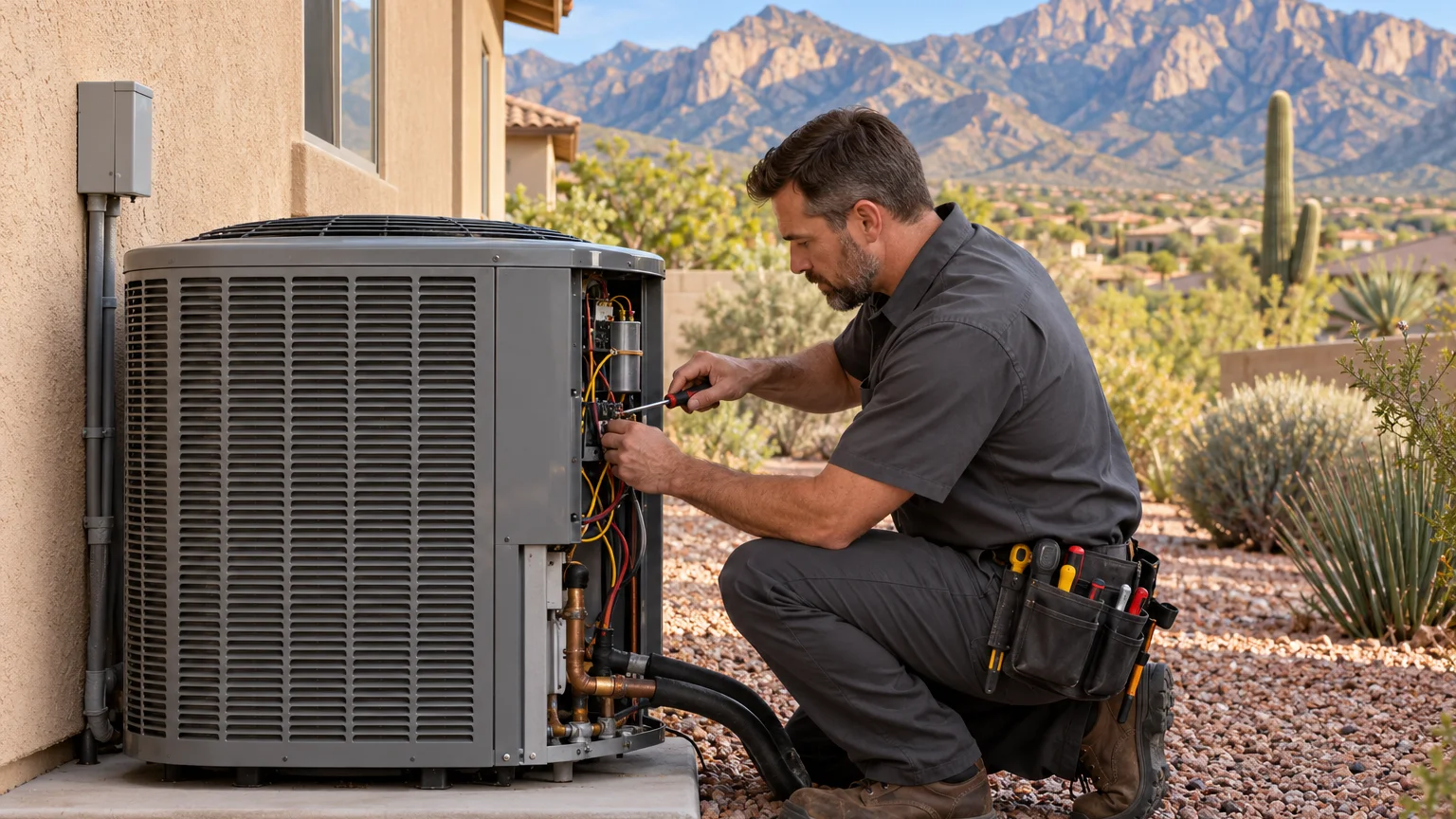
Start with the house and existing system
For AC installation in Oro Valley, compare the proposed scope before comparing the final price. Each proposal should describe the house, existing system, new equipment, installation location, and included work. Climate Pros Tucson can match you with an independent licensed contractor for an AC installation.
Start each contractor with the same information. Otherwise, you may receive proposals solving different problems.
Give each contractor:
- The model numbers from the existing indoor and outdoor equipment
- A list of rooms that feel warmer or cooler
- Any known duct, electrical, drainage, or thermostat concerns
- The location of the indoor and outdoor components
- Photos of equipment labels and access areas
- Your comfort priorities, including noise or room balance
- Any plans to add conditioned space
- HOA documents or approval forms you already have
Ask the contractor to inspect the existing system instead of quoting from equipment age alone. The proposal should explain what will remain, what will be replaced, and why.
Tucson International Airport’s 1991-2020 normals average about 68 days yearly at or above 100F. That doesn’t describe every Oro Valley property. It does show why cooling capacity and installation details deserve careful review.
A heat pump is the sensible default for a Tucson-basin home. It provides cooling and heating through one system. Ask contractors to compare a heat pump with a conventional air conditioner when both fit the home.
Your current equipment type also shapes the project. A split system has separate indoor and outdoor components. A package unit combines major components in one cabinet. This split-system and rooftop package-unit comparison explains the basic differences.
Don’t accept a proposal that identifies equipment only by brand. Ask for complete model numbers. Those numbers let you compare capacity, efficiency, configuration, and manufacturer warranty documents.
Compare rooftop and side-yard proposals
A rooftop and a side-yard proposal may include very different work. Put those differences beside each other before choosing an installation plan.
| Proposal detail | Rooftop proposal | Side-yard proposal |
|---|---|---|
| Equipment configuration | Identify whether it uses a package unit or another arrangement | Identify the outdoor condenser and matched indoor equipment |
| Existing equipment removal | State how the old unit leaves the roof | State how the outdoor and indoor components are removed |
| Access | Describe roof access and any lifting arrangements | Describe access through gates, walls, or narrow passages |
| Mounting | List the curb, adapter, stand, or mounting work | List the pad, stand, anchoring, and clearances |
| Duct connections | Show which transitions or connections change | Show which indoor connections and refrigerant lines change |
| Roof or wall openings | Identify affected openings and who handles them | Identify line-set, drain, control-wire, or wall penetrations |
| Drainage | Describe the condensate route and included work | Describe the condensate route and included work |
| Finish work | List sealing, flashing, patching, and cleanup | List sealing, patching, surface restoration, and cleanup |
| Approval questions | Confirm HOA review and Town requirements | Confirm HOA review and Town requirements |
A lower total can hide omitted access or finish work. Ask whether lifting equipment, roof work, new mounting materials, and removal are included. If any item isn’t included, the proposal should say who handles it.
For a side-yard condenser, ask the contractor to mark the proposed location. Review access, service space, drainage, and nearby windows or outdoor living areas. Don’t rely on a verbal description.
For rooftop equipment, ask whether the new unit fits the existing curb. If an adapter or new curb is proposed, request its description in writing. The quote should also assign responsibility for disturbed roofing materials.
Moving equipment from the roof to the ground changes more than location. Ask what happens to the existing opening, duct route, refrigerant lines, wiring, drain, and roof surface. Every affected part should have an owner in the proposal.
Check sizing, ductwork and electrical scope
The strongest proposal explains how the contractor selected the system. A repeat of the old equipment size isn’t enough by itself.
Ask each contractor to list:
- The proposed cooling and heating capacity
- The sizing method and information used
- The indoor and outdoor model numbers
- The matched-system efficiency rating
- The blower or air-handler configuration
- The thermostat and controls
- Any assumptions about windows, insulation, or additions
- Any rooms excluded from the calculation
Sizing should connect to the actual house and its comfort problems. If one proposal recommends different capacity, ask the contractor to explain the difference in writing.
Ductwork deserves its own scope. ENERGY STAR says a typical forced-air house nationally can lose about 20% to 30% of moving air through duct leaks, holes, and poor connections. That isn’t a measured result for your Oro Valley home. It is a reason to ask whether the contractor inspected the ducts.
A useful duct section should address:
- Visible damaged or disconnected ducts
- Existing supply and return connections
- Proposed transitions
- Airflow testing or balancing included
- Sealing included with the installation
- Insulation disturbed during the work
- Repairs recommended but excluded
Don’t let duct cleaning substitute for duct evaluation. The EPA doesn’t recommend routine duct cleaning on a fixed schedule. It also says cleaning ducts alone has little evidence of improving efficiency. Sealing addresses leakage.
The electrical scope should be equally clear. Ask whether the contractor checked the existing breaker, disconnect, conductors, controls, and equipment requirements. The proposal should identify any electrical work included or excluded.
If another trade is needed, ask who hires that contractor. Get the responsibility, scope, and price in writing before signing.
The same rule applies to condensate drainage. Ask where water will go, which drain components remain, and which ones will be replaced. Don’t accept “as needed” when the work can be identified beforehand.
Use this AC replacement quote checklist to compare model numbers, scope, exclusions, warranties, and payment terms across proposals.
Confirm HOA and permit responsibilities
Confirm HOA approval and Town of Oro Valley requirements before installation begins. Don’t assume rules from the City of Tucson apply inside Oro Valley.
A current Oro Valley HVAC permit rule, fee, or timeline couldn’t be confirmed from the approved sources for this page. Ask the Town of Oro Valley which requirements apply to your address and project. The matched contractor should pull any required permit, not Climate Pros Tucson.
Your written proposal should state:
- Whether the contractor believes a permit is required
- Who confirms that requirement with the Town
- Who submits the permit application
- Whether permit-related charges are included
- Who schedules required inspections
- What happens if the Town requests plan or scope changes
- Which project records you’ll receive
Ask the contractor to correct any conflict between the quote and Town guidance before you sign. Don’t rely on a permit assumption from another Tucson-area jurisdiction.
HOA approval is separate from government permitting. Your association may ask for equipment details, placement drawings, screening information, colors, or contractor documents. Requirements vary, so check your own governing documents and management contact.
The Oro Valley HOA HVAC replacement guide covers the approval questions to ask. It doesn’t replace your association’s current documents.
Keep approval responsibilities specific. The homeowner may need to submit HOA paperwork, while the contractor supplies equipment data. Put that division in writing.
If you’re comparing rooftop and side-yard locations, ask whether the HOA treats them differently. Don’t accept a contractor’s general statement about what associations “usually” approve. Only your association can confirm its current requirements.
Verify the contractor before signing
Verify the contractor’s Arizona license and the complete written scope before accepting a proposal. Every pro Climate Pros Tucson sends is licensed, but you should still check the business and license connected to your contract.
Arizona residential HVAC work falls under ROC class R-39 or its R-39R subclasses. Search the contractor through the Arizona Registrar of Contractors. Confirm that the name on the proposal matches the licensed business you’re hiring.
The homeowner contracts with and pays the independent contractor directly. Climate Pros Tucson doesn’t install equipment, set prices, pull permits, or provide the contractor’s warranty.
Before signing, check these items:
- Licensed business name
- ROC license status and classification
- Complete indoor and outdoor model numbers
- Equipment capacity and efficiency rating
- Installation location
- Included duct, electrical, drain, and control work
- Removal and disposal of existing equipment
- Permit and inspection responsibilities
- HOA document responsibilities
- Written exclusions
- Payment schedule
- Manufacturer parts warranty
- Contractor labor warranty
- Service-contract terms, if offered
- Change-order process
- Final documents supplied after completion
An equipment warranty and a separately purchased service contract aren’t the same. Compare coverage, exclusions, deductibles, claims administration, and repair responsibility. Read the written warranty before buying and keep it with your receipt.
Get oral promises in writing. This includes promised accessories, finish work, registration help, labor coverage, and included corrections.
Price still matters, but compare identical scope. The written quote from the pro is the number that counts for your home. If totals differ, find the missing or upgraded line item before choosing.
A strong final comparison answers five questions:
- Is the proposed equipment clearly identified?
- Does the sizing explanation fit the house?
- Are duct, electrical, drain, and access tasks assigned?
- Are HOA and Town responsibilities written down?
- Is the contractor’s ROC license current and correctly matched?
Climate Pros Tucson covers Oro Valley through its broader Tucson-area HVAC referral service. The goal is a clear match with a licensed independent pro, followed by a contract you understand.
When to call us
Call when you need a licensed HVAC pro to assess the house and prepare a detailed installation proposal. Call (520) 353-2520 and we’ll match you with a licensed local pro.