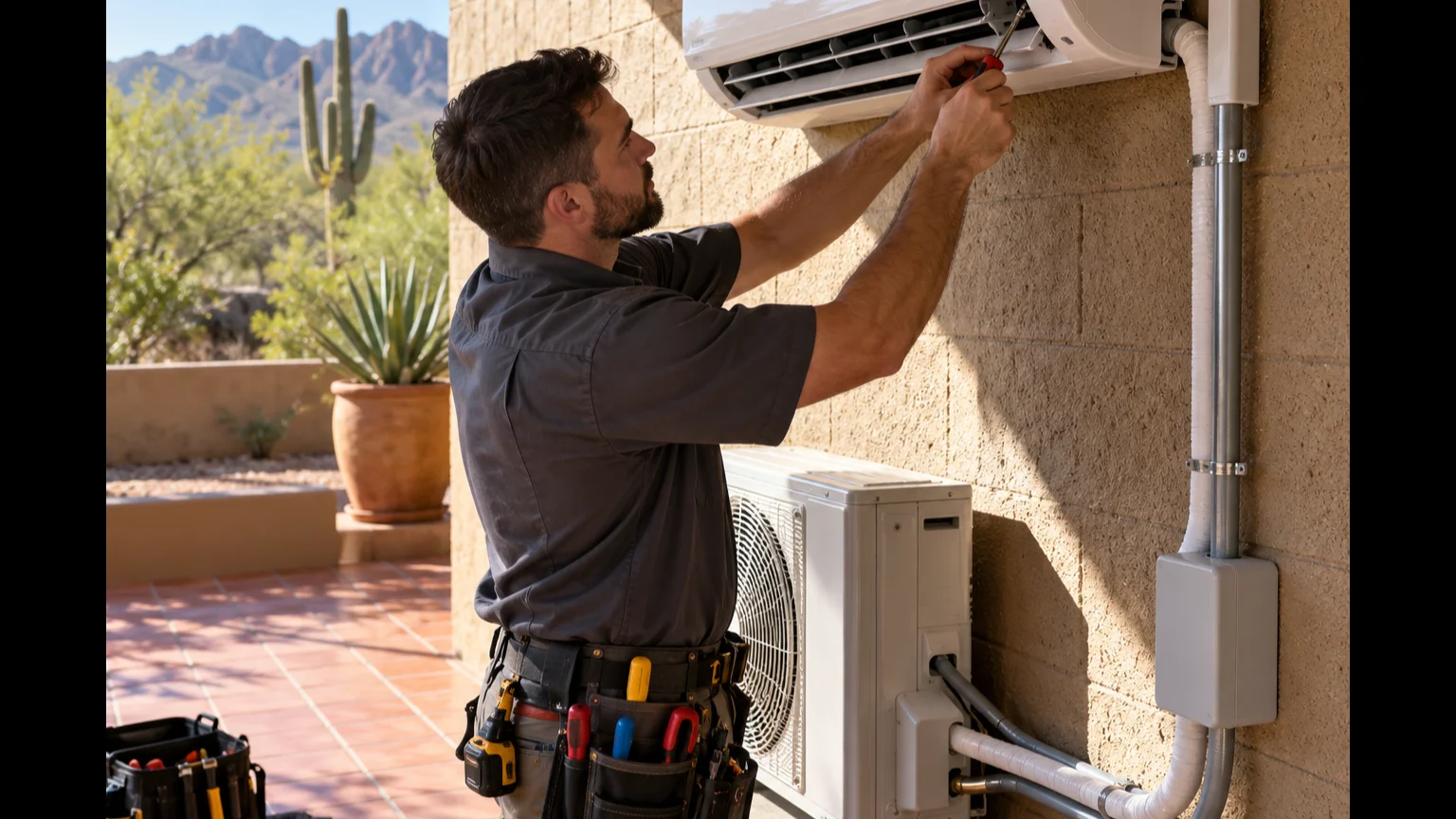
Cooling works and heating does not: the first split
When a mini split cools but won’t heat, start with its controls. Confirm Heat mode, raise the setpoint above room temperature, and note any error code. If those checks don’t restore heat, Climate Pros Tucson can match you with a licensed local pro.
Tell the contractor that cooling worked during summer. That detail separates a heat-mode problem from a complete system shutdown. It doesn’t identify the failed part, but it gives the pro a useful starting point.
This seasonal change matters in Tucson. The 1991-2020 normals at Tucson International Airport show 3,424 cooling degree days and 1,333 heating degree days. That’s about 2.6 cooling degree days for every heating degree day. A mini split may spend much more of the year cooling than heating.
If you want a simple equipment overview, read how a mini split works. Owners of ducted systems should use the separate guide for a heat pump not heating in Tucson.
Start by recording what the system does:
| What you notice | What you can check safely | What to report |
|---|---|---|
| The head runs but the air doesn’t feel warm | Mode, setpoint and remote display | Whether cooling still works |
| The head doesn’t respond | Remote display and batteries | Any lights, symbols or error code |
| One head heats but another doesn’t | Settings on each head | Which zones work |
| The outdoor unit doesn’t appear to run | Look from a safe distance | Sounds, visible damage or an error code |
| Airflow feels weak | Visible filter condition and blocked furniture | Which head has weak airflow |
Homeowner checks should stay within the instructions for your exact model.
Mode, setpoint and the outdoor unit in Tucson sun
Set the controller to Heat, not Auto, Cool, Dry or Fan. Then choose a setpoint above the displayed room temperature. Confirm that the indoor unit receives the command.
Remote symbols and button sequences aren’t universal. Use the manual for the exact indoor head and remote. If the remote display is dim or unresponsive, check its batteries and resend the command.
For a multi-zone system, review every head. Record whether one zone heats while another stays cool. Don’t assume all heads received the same setting.
Next, look at the outdoor unit from a safe position. Tucson sun alone doesn’t identify the fault. What matters is giving the contractor a clear description of visible conditions.
Check for:
- Objects resting against the cabinet
- Windblown debris around the unit
- Visible damage after a storm
- Ice or unusual moisture
- A fan that appears stopped
- A displayed or blinking fault code
If the owner’s manual gives a specific response to an error code, follow that instruction.
There isn’t one reset method for every mini split. Some models use the remote, while others have model-specific procedures. Search the manufacturer’s manual using the full model number. Avoid a generic online reset sequence that may belong to different equipment.
A model-specific cooling problem needs a different checklist. For example, the guide to a Fujitsu mini split not cooling focuses on Cool mode rather than this first heating attempt.
Dust, filters and heads that sat on cool all summer
A visibly dirty filter deserves attention before deeper diagnosis. Tucson’s monsoon runs from June 15 through September 30, and dust storms occur during that window. Dust left from the cooling season can make a filter check especially useful.
Follow the manufacturer’s directions for accessing, removing, cleaning or replacing the filter.
If the visible filter is clean but airflow remains weak, tell the technician.
Also inspect the room around the head. Furniture, curtains and stored items shouldn’t cover its intake or discharge. Record whether the louvers move when you select Heat mode.
A dirty filter can’t explain every no-heat problem. If cleaning it changes nothing, stop treating airflow as the answer. The next step is a licensed diagnosis through mini split repair in Tucson.
When it is a sensor, a valve or a charge question
Sensor, valve and refrigerant questions need diagnostic tools. A homeowner can’t confirm those faults by changing settings or cleaning a filter.
Ask the licensed tech to determine:
- Whether the indoor unit received the Heat command
- Whether temperature sensors are reporting correctly
- Whether the controls are calling for heating
- Whether the system changes operating modes correctly
- Whether the refrigerant charge matches the equipment requirements
- Whether a leak is present if the charge is low
- Whether the outdoor and indoor units communicate correctly
- Whether the recorded error code points to a specific test
Don’t accept refrigerant alone as a repair for a confirmed leak. Adding refrigerant doesn’t repair the leak itself. The technician should identify the cause and explain the proposed work.
The EPA requires Section 608 certification for technicians who maintain, service or repair equipment that could release refrigerant. Existing R-410A systems can still be serviced. You can review the current EPA refrigerant transition rules.
If repair isn’t the sensible path, compare the diagnosis with a written proposal for mini split installation. The contractor should explain equipment selection, installation scope and warranty terms. The written quote from the pro is the number that counts for your home.
What to tell the licensed tech before they arrive
Good notes reduce guesswork during the service visit. Give the contractor the complete sequence, not only “it blows cold.”
Share these details:
- Indoor and outdoor model numbers
- The remote model, if shown
- The selected mode and setpoint
- The displayed room temperature
- Every error code or blinking pattern
- Whether cooling still operates
- Whether the problem affects one zone or every zone
- Whether airflow changed after checking the filter
- Any ice, moisture, odor or unusual sound
- Any recent outage or storm
- Photos of the remote display and outdoor unit
Don’t clear an error code before recording it. A photo preserves the exact symbols and blinking indicators.
Ask what the diagnostic fee is before booking. Each company sets its own policy. You hear the price before any work starts, and you contract with and pay the professional directly.
Every pro Climate Pros Tucson sends is licensed. Residential HVAC work falls under Arizona ROC class R-39 or an applicable R-39R subclass. Check the contractor through the Arizona Registrar of Contractors.
For broader service coverage, visit the Tucson HVAC service area hub. If the diagnosis concerns the heat-pump side of the system, review available heat pump service.
Do ductless mini splits have emergency heat?
Don’t assume your mini split has a separate emergency-heat setting. Check the exact model’s manual and equipment documentation. Ask the technician what backup heat, if any, is installed for your home.
Tucson-basin conditions differ from Mount Lemmon and Summerhaven. The City of Tucson uses a 35F winter design dry-bulb condition. Above 4,000 feet in Pima County, the design condition is 4F. Cold-climate equipment or backup heat there is a question for the pro.
Why does cooling work when heating doesn’t?
Cooling operation shows what worked in Cool mode. It doesn’t prove that sensors, controls, valves and refrigerant conditions are correct for Heat mode. A licensed tech must test those possibilities rather than guessing from the supply-air feel.
Should I keep resetting the mini split?
Don’t use repeated resets as a diagnosis. Record the error code, follow the exact owner’s manual, and tell the technician what happened before and after the approved reset.
When to call us
Call when basic control, filter and manual checks don’t restore heat, or when the system displays a fault that needs a licensed HVAC pro. Call (520) 353-2520 and we’ll match you with a licensed local pro.