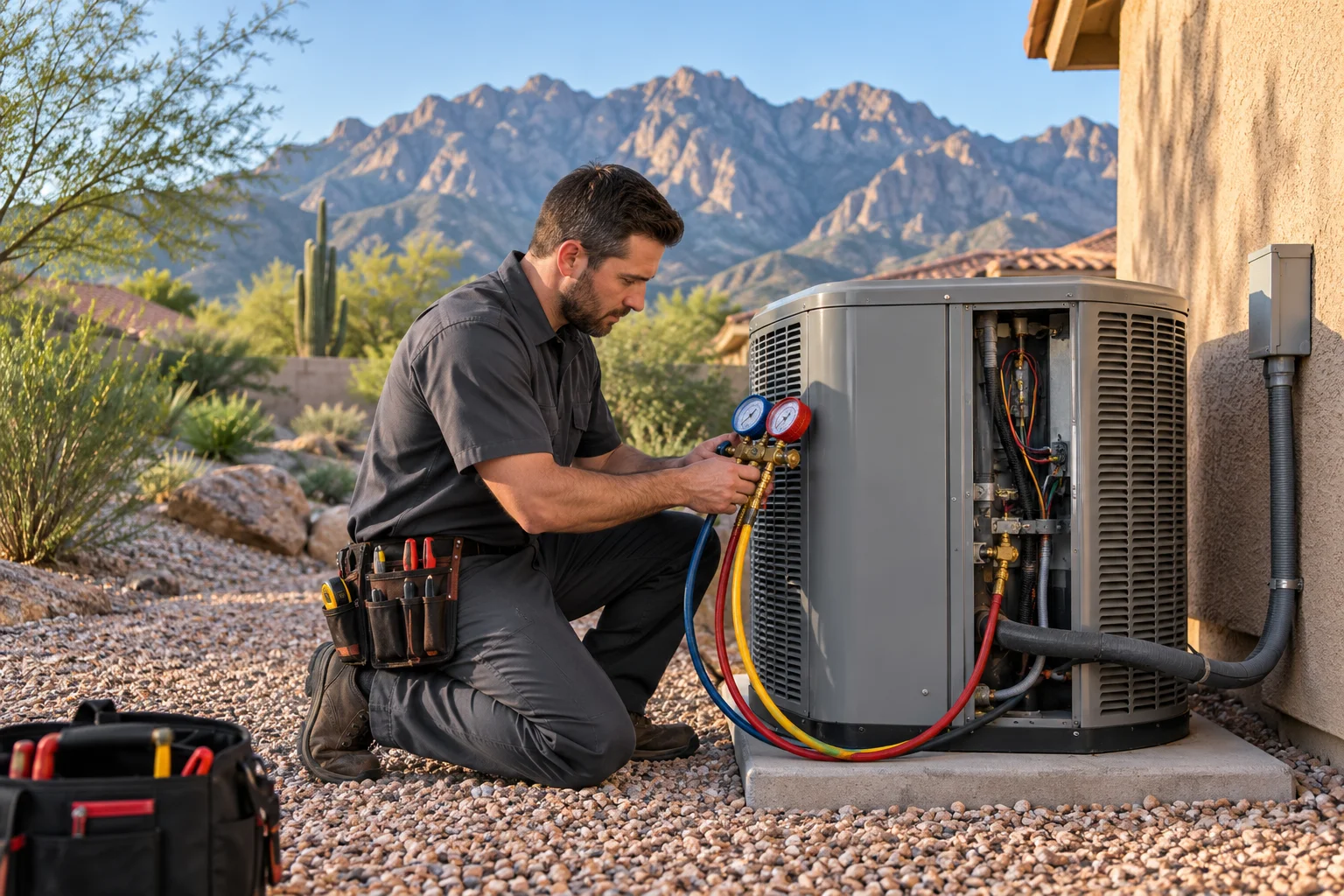
Oro Valley nights vs the Tucson basin floor
A heat pump is the sensible default when an Oro Valley home needs new heating and cooling. A furnace can make more sense when the air conditioner still has useful life, gas service is already present, or the homeowner prefers furnace heat.
Oro Valley foothill nights often run cooler than the Tucson basin floor. That difference matters, but it doesn’t automatically require a furnace. Ask the contractor to size the system for your house, exposure, insulation and ductwork.
Climate Pros Tucson matches Oro Valley homeowners with independent, licensed HVAC professionals. Every pro we send is licensed, and the homeowner contracts with the pro directly.
The closest approved long-term climate figures come from Tucson International Airport. Its 1991-2020 normals show 3,424 cooling degree days and 1,333 heating degree days. That’s about 2.6 cooling degree days for every heating degree day.
The same station averages fewer than 12 nights yearly at or below 32F. Those airport figures don’t describe every Oro Valley foothill property. Check the National Weather Service Tucson forecast for your location during winter cold spells.
That cooling-heavy climate changes the replacement decision. A heat pump handles both cooling and heating. A furnace handles heating and needs a separate air conditioner for summer.
For broader regional context, compare this guide with our Tucson heat pump versus gas furnace guide. Our Oro Valley and Marana HVAC guide covers other local equipment questions.
Keep the gas furnace or swap to a heat pump
Keep the furnace when replacing it alone protects a working cooling system. Consider a heat pump when both heating and cooling are due for replacement.
| Decision point | Heat pump | Furnace with separate AC |
|---|---|---|
| Main role | Heats and cools | Provides heat only |
| Existing equipment | Strong candidate when replacing the full system | Strong candidate when the AC remains serviceable |
| Fuel setup | Uses electricity | May use natural gas or electricity |
| Winter operation | Must be selected for the home’s heating load | Separate heating equipment handles the load |
| Summer operation | Works as the cooling system | Relies on the separate AC |
| Quote comparison | Review cooling and heating performance | Review furnace and AC as one comfort system |
A heat pump deserves the first look when:
- Both the furnace and air conditioner are replacement candidates.
- The home is already all-electric.
- You want one system handling both seasons.
- The contractor’s load calculation supports the proposed equipment.
- The electrical system can support the selected unit.
Keeping or replacing a furnace may make more sense when:
- Only the furnace needs replacement.
- The existing air conditioner remains worth keeping.
- The home already has natural gas service.
- The furnace and AC can operate together correctly.
- The written furnace quote is stronger than a full-system change.
Don’t assume the old equipment size is correct. Comfort problems, additions and duct changes can alter the load. Ask each bidder to explain the proposed capacity and the conditions used for selection.
A national rule of thumb can’t settle an Oro Valley replacement. The contractor needs to account for the actual home, including sunny exposures and cooler foothill mornings. The final choice should also reflect summer cooling, not winter heat alone.
Our heat pump service page explains how Climate Pros Tucson connects homeowners with local pros. If the existing heater may still be repairable, review the furnace repair options before replacing equipment.
Is a heat pump or furnace cheaper to run?
Neither system is automatically cheaper for every Oro Valley home. The answer depends on the homeowner’s utility plan, fuel source, thermostat use, equipment performance and house.
Compare recent electric and gas bills before accepting a savings claim. Ask each contractor to show the assumptions behind any operating-cost comparison. Don’t accept a percentage without the rates, weather inputs and equipment ratings used.
TEP serves the Tucson metropolitan area. Trico Electric Cooperative serves parts of northwest Tucson and a broader area extending south. Use the name printed on your electric bill rather than assuming which utility serves the address. Southwest Gas is the area’s natural gas utility.
Will a heat pump keep an Oro Valley home warm?
A correctly selected heat pump can serve a Tucson-basin home, including its cooling needs. The contractor still needs to confirm capacity for the specific Oro Valley property.
Ask for the unit’s heating output at the temperature used in the load calculation. Also ask when auxiliary heat would operate, if the proposal includes it. Our guide to heat pumps during Tucson winters explains that question in more detail.
Should you consider dual fuel?
Dual fuel pairs a heat pump with a furnace, but it isn’t the default answer. It adds equipment and controls that each quote should explain.
Ask the bidder to state:
- Which system runs under ordinary winter conditions.
- What triggers the change between heat sources.
- Whether existing furnace equipment can remain.
- How the thermostat controls both systems.
- Why the added equipment fits this home’s load.
HOA screening and condenser placement, in brief
Check the property’s governing documents before changing condenser placement or appearance. No verified rule applies to every Oro Valley HOA, and no specific Oro Valley association rule could be confirmed here.
Ask the association or management contact for the current architectural standards and application form. Confirm whether review applies to:
- A like-for-like replacement in the same location.
- A larger outdoor unit.
- Moving equipment from the roof to the ground.
- New screening walls, gates or landscaping.
- Visible line sets, conduit or drain routing.
- Changes that affect neighboring lots or streets.
Don’t rely on a neighbor’s approval from an earlier project. Rules and review procedures can differ by property and may change.
The Town of Oro Valley is the permit authority to contact for work inside town limits. A verified rule or fee for this specific replacement couldn’t be confirmed from the approved information available for this page. Ask the matched contractor to confirm the current permit requirement directly with the Town of Oro Valley and show it on the written quote.
The contractor, not Climate Pros Tucson, handles any required permit. HOA approval and municipal approval are separate matters. One doesn’t replace the other.
Our Oro Valley HOA HVAC replacement guide provides a focused document checklist. Homeowners elsewhere in the region can start with our Tucson-area HVAC service hub.
Rebates: confirm with the utility, never guess
Check the utility named on the electric bill before counting any incentive. Program eligibility can depend on the address, equipment and participating contractor.
TEP’s Efficient Home Program covers qualifying heat pump and AC work through participating contractors. Review the current terms on the TEP Efficient Home Program page before signing a proposal.
Don’t treat a rebate as confirmed until the contractor identifies:
- The program and utility.
- The exact qualifying equipment.
- Required efficiency or installation conditions.
- Whether a participating contractor is required.
- Who submits the paperwork.
- How the incentive appears in the transaction.
- What happens if funding or eligibility changes.
If the bill says Trico, confirm current programs directly with Trico. Don’t apply TEP terms to a Trico account.
The federal 25C credit ended for equipment placed in service after December 31, 2025. Arizona also has no state HVAC tax credit. Don’t let an outdated tax-credit claim decide a 2026 purchase.
How to compare two quotes with no dollar ranges
Compare scope before comparing the final price. A low number can reflect different equipment, missing work or a different permit assumption.
Each written quote should identify:
- The proposed heat pump, furnace and air conditioner models.
- Cooling and heating capacities.
- SEER2 and HSPF2 ratings where applicable.
- The load calculation used for equipment selection.
- Duct repairs or modifications included.
- Electrical, gas or thermostat work included.
- Auxiliary heat or dual-fuel controls, if proposed.
- Outdoor unit placement and screening work.
- Permit responsibility and listed permit charges.
- HOA documents the homeowner must obtain.
- Manufacturer warranty terms and registration duties.
- Labor coverage offered by the contractor.
- Equipment removal and disposal.
- Payment schedule and change-order process.
SEER2 is a seasonal cooling-efficiency rating. ENERGY STAR certified air-source heat pumps meet a 15.2 SEER2 and 7.8 HSPF2 level. That ENERGY STAR level isn’t the legal minimum.
Ask both bidders to quote the same goal. One quote shouldn’t cover a heat pump alone while another includes duct sealing, electrical work and a new thermostat without separating those items.
You hear the price before any work starts. The written quote from the pro is the number that counts for your home.
What is the 5,000 rule for HVAC systems?
The 5,000 rule is a trade rule of thumb, not a guarantee. It multiplies the equipment’s age by the proposed repair price, using the homeowner’s actual numbers.
It can prompt a repair-versus-replacement discussion, but it can’t measure comfort, duct condition or future reliability. Our 5,000 rule guide for Tucson HVAC explains its limits.
How much does a heat pump cost for a 2,000-square-foot home?
Square footage alone can’t produce a dependable Oro Valley quote. No verified Oro Valley market range is available for this page.
Ask for a written proposal based on the home’s load, ducts, electrical system and installation conditions. Compare the included scope line by line.
How do you check the contractor?
Verify the contractor through the Arizona Registrar of Contractors. Residential HVAC work falls under the R-39 class or its R-39R subclasses.
Check that the license belongs to the company named on the contract. Also compare the written warranty, permit responsibility and payment terms before signing.
When to call us
Call when you need a licensed pro to compare an Oro Valley furnace, heat pump or full-system replacement. Call (520) 353-2520 and we’ll match you with a licensed local pro.