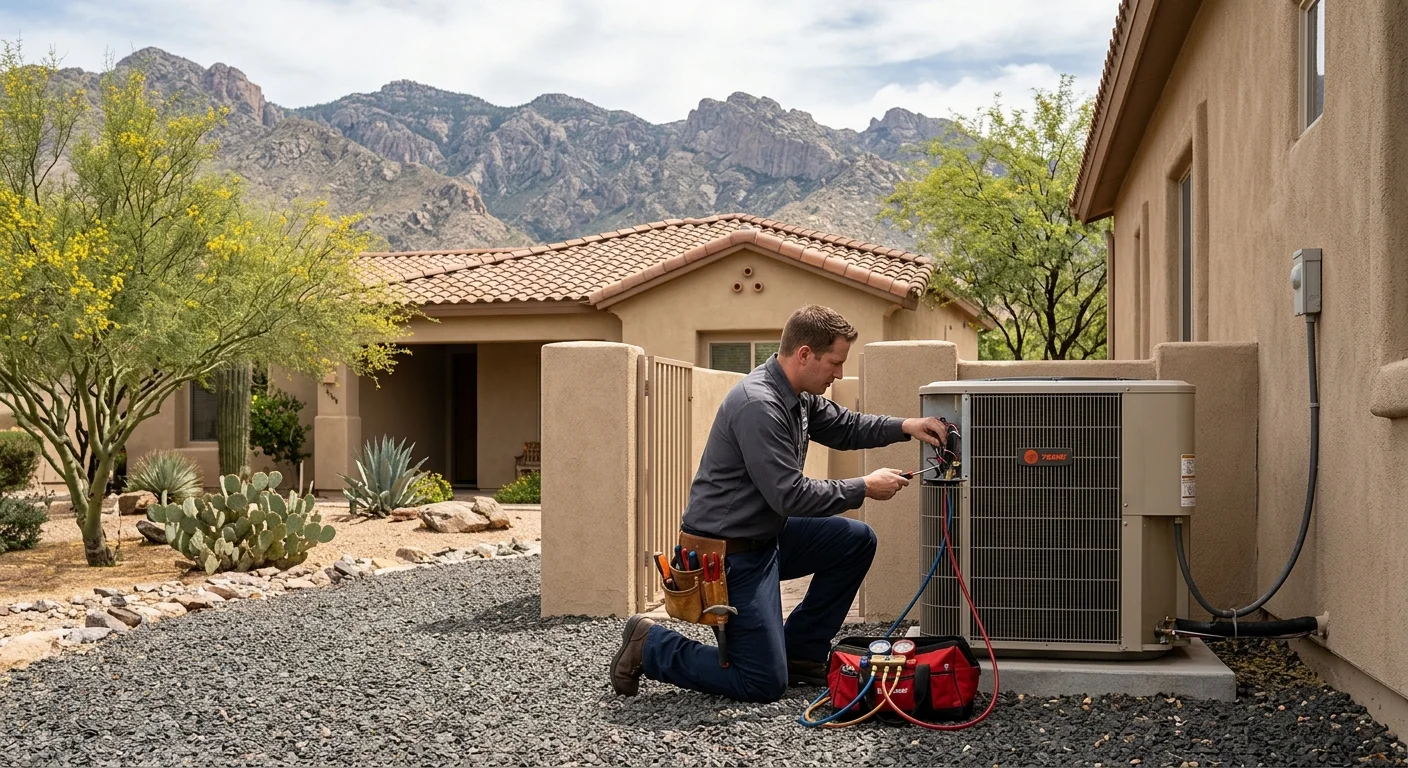
An Oro Valley HOA AC replacement usually stalls on architectural review, not on the Town permit. Your association decides what neighbors can see from the street or the next lot. The Town of Oro Valley decides whether the equipment is legal to install. Climate Pros Tucson covers Oro Valley and matches you with a licensed independent pro for the changeout. You still get the current HOA guidelines and file that request yourself.
Fall is when a lot of north-metro owners plan the swap, before June’s 101.2F normal high at Tucson International Airport. The basin still sees about 68 days a year at or above 100F. A changeout is usually a one-day job once the unit is on site. HOA review is the part that can sit for weeks if the packet is thin.
Why do Oro Valley replacements stall at the HOA, not the Town?
The association is reviewing looks, noise, and placement. The Town is reviewing a construction permit. Those are two offices, two packets, two clocks.
Oro Valley sits on the north side of the Tucson basin, against the Catalinas. Lots are often close, stucco walls face the street, and a condenser in the side yard is easy to see from a sidewalk or a neighbor’s patio. That is why an HOA cares about a pad move, a taller cabinet, or missing screening even when the Town would accept the same equipment.
Climate Pros Tucson does not talk to your HOA for you, and we do not pull permits. Every pro we send is licensed. You contract with that pro directly. For the wider north-metro picture, start with our Oro Valley and Marana HVAC guide, then come back to this HOA sequence before you pick a date.
A public, town-wide Oro Valley rulebook for HVAC equipment was not found. Each association writes its own guidelines. Get the current architectural packet from your HOA or property manager. Do not reuse a neighbor’s old PDF.
Where can the condenser go, and does it need screening?
Put the new unit where the packet allows, with the clearances the manufacturer prints on the cut sheet. HOA sight-line rules and airflow rules are different layers. A wall that hides the cabinet from the street can also choke the coil if it sits too close.
Ask your association, in writing, about:
- Same-pad replacements versus a new location
- Side-yard, backyard, and street-facing pads
- Screening (walls, gates, plants) and who maintains it
- Paint or cabinet color if the unit stays visible
- Rooftop equipment, parapets, and line-of-sight from the street
- Line-set covers, disconnect boxes, and condensate drains on stucco
If the home has a roof-mounted package unit, a ground swap is a bigger request than a same-pad changeout. Treat a move as a new site improvement until the HOA says otherwise. For setbacks, neighbor lots, and airflow around the cabinet, read AC condenser placement rules in Tucson.
A heat pump is the sensible default for a Tucson-basin home. The outdoor cabinet can be a different height or footprint than the AC it replaces. If you are changing system type, say that in the HOA request and attach the new cut sheet. Ask the matched pro about heat pump service before you file, so the drawing matches what will actually sit on the pad.
What should you put in the architectural request?
Give the reviewer enough to picture the finished pad from the street. A one-line “replacing the AC” note is why files bounce.
Include:
- Your name, property address, and contact phone
- Whether this is a same-pad swap or a new location
- Photos of the existing unit, the side yard, and the view from the street
- A simple site sketch (house, wall, pad, property line, proposed screening)
- Manufacturer cut sheets with height, width, depth, and color
- How you will hide or cover the line set if the packet asks for that
- Who will install: the licensed contractor’s company name, so the HOA can see it is not a handyman job
Ask the matched pro for the cut sheet and the sketch. You (or your property manager) submit them. If you live in a condo or townhouse, stop and read condo and townhouse HVAC in Tucson first. The association may own the equipment, the roof, or the pad, and the request path is different from a single-family HOA lot.
Some Green Valley and Sahuarita communities publish screening language in public design documents. Those rules belong to those communities. They do not apply in Oro Valley. If you are comparing towns, use HOA rules for AC replacement in Green Valley and Sahuarita as that area’s page, then still pull your own Oro Valley packet.
Who pulls the permit, and what should you still ask?
The licensed contractor pulls the Town permit. You still ask whether that permit is required, what inspections come with it, and whether load and sizing calculations have to ride with the application.
Oro Valley permit rules and fees are set by the Town of Oro Valley. They were not confirmed here as a published figure, so do not guess them from a Tucson fee schedule. Confirm with the Town before work starts, and read the permit line on the pro’s written quote.
In the City of Tucson, permits are required for furnaces, heat pumps, and air conditioners (new or replacement). Load and sizing calculations are required for that new and replacement HVAC equipment. That City rule is not an Oro Valley rule. Use it only as a reminder that a desert replacement is a permitted trade in this metro, then verify the Town’s list.
Look up the company at the Arizona Registrar of Contractors. Residential heating and cooling is class R-39 or its R-39R subclasses. The handyman exemption is only for casual work under $1,000 that does not need a local building permit. If the Town requires a permit for the replacement, that exemption does not cover it. Confirm the permit question with the Town, then hire the licensed pro.
Ask the pro, before you sign:
- Will you pull the Town of Oro Valley permit in your name?
- Are load and sizing calculations in the packet?
- Is this a same-pad set or a pad move?
- What screening or line-set cover is in the quote if the HOA asked for it?
- Is the written quote the number that counts for this house?
Climate Pros Tucson sets no prices and gives no warranties. You hear the price from the contractor before work starts.
How does this differ from a City of Tucson house?
The equipment is the same kind of split or package system. The paperwork is not. Oro Valley is its own town. The City of Tucson is a different permit counter, and many central Tucson lots have no architectural committee at all.
| Step | House in the City of Tucson | House in an Oro Valley HOA |
|---|---|---|
| Who cares about the look of the unit | The City does not run HOA design review | Your association, using its current guidelines |
| Who issues the building permit | City of Tucson Planning and Development Services | Confirm with the Town of Oro Valley |
| Load and sizing calculations | Required for new and replacement HVAC in the City | Ask the Town and the contractor; do not assume the City packet |
| HOA file | Only if that lot has its own association | Plan on it unless your HOA says a same-pad swap is exempt, in writing |
| Who pulls the permit | The matched licensed contractor | The matched licensed contractor |
| Who files with the HOA | The owner, if there is an HOA | You or your property manager |
A City of Tucson house can still sit in an HOA. The split above is about the permit office and the extra Oro Valley association step, not a claim that Tucson lots never have covenants.
Climate Pros Tucson is a referral service for HVAC service in the Tucson area, including Oro Valley. The pros we send handle AC installation and the Town permit. You keep the HOA clock moving.
Common questions
Does a same-pad swap still need HOA approval in Oro Valley?
Your association sets that. Ask before you schedule the changeout. A like-for-like unit on the same pad can still be visible from the street. Get the current guidelines in writing.
Who talks to the HOA, you or the contractor?
You do, or your property manager does. Climate Pros Tucson does not file HOA papers. Ask the matched pro for cut sheets and a site sketch you can attach.
If the HOA says yes, is the Town permit done?
No. Architectural approval is not a building permit. Confirm permits with the Town of Oro Valley. The licensed contractor pulls that permit.
How do I check the pro is licensed?
Search the company at roc.az.gov. You want class R-39 or an R-39R subclass for residential heating and cooling. Every pro we send is licensed.
When to call us
When the outdoor unit is coming out, you need a licensed HVAC contractor, not a handyman, and you need that pro lined up before the HOA packet goes in. Call (520) 353-2520 and we’ll match you with a licensed local pro.