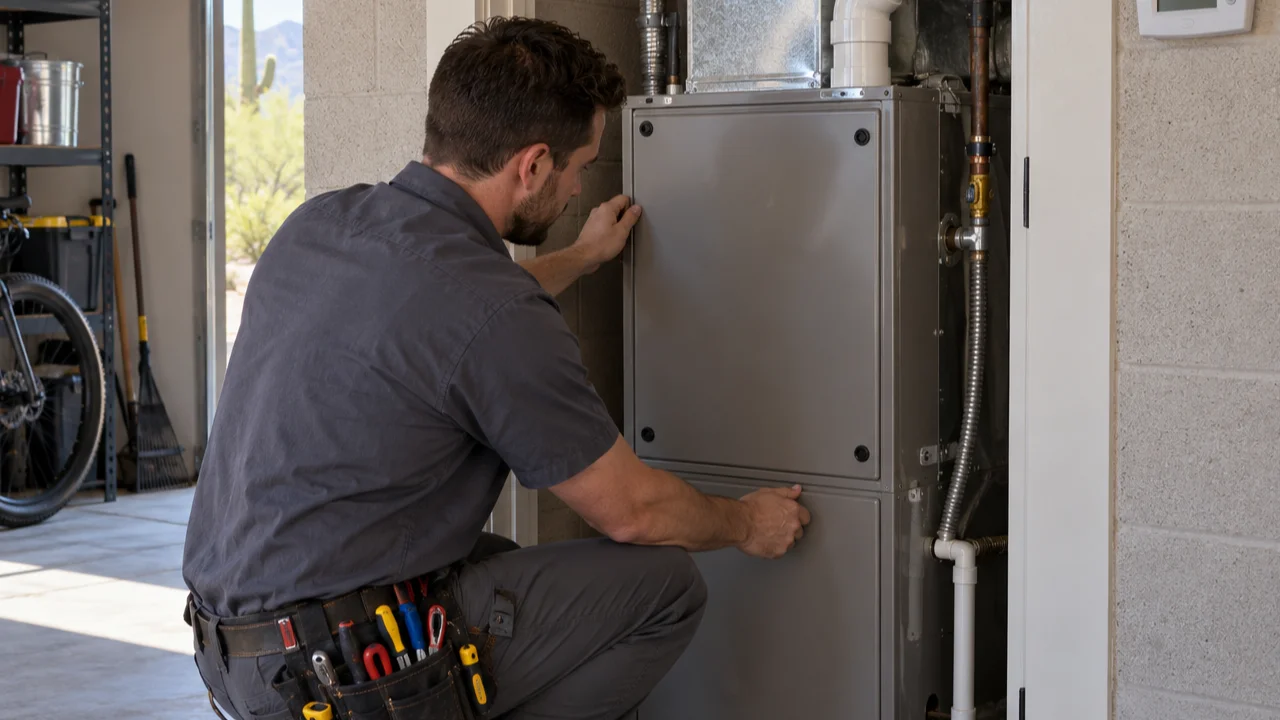
What short furnace cycles look like
A furnace that starts and quickly shuts off needs a proper diagnosis. The symptom can involve airflow, thermostat controls, ignition, or an internal safety response. Climate Pros Tucson can match you with an independent, licensed local pro for furnace repair.
People often describe this problem in several ways:
- The furnace starts, but warm air stops soon afterward.
- The blower begins running, then stops before the house feels warmer.
- The system repeatedly starts and stops.
- The thermostat still shows a heating request after shutdown.
- The furnace tries to start but never produces steady heat.
Watch one cycle from a safe distance. Note what starts, what stops, and what the thermostat displays. You don’t need to remove a panel or identify a component.
This symptom differs from a system that never starts. If there’s no heating cycle at all, use our guide to why a furnace won’t ignite.
Tucson’s heating season is lighter than its cooling season. The 1991-2020 normals at Tucson International Airport show 1,333 annual heating degree days. They also show fewer than 12 nights per year at or below freezing. That lighter use can make a problem noticeable when heat mode returns after months of cooling.
Safe checks before requesting service
Start with these observations:
- Confirm the thermostat is set to heat.
- Confirm the requested temperature is above the displayed room temperature.
- Record any thermostat message or furnace error display.
- Look at the filter without reaching into the equipment.
- Confirm the filter is installed in the marked airflow direction.
- Note whether visible supply and return grilles are blocked.
- Listen for the point when the cycle stops.
- Write down whether the blower ran and whether the air felt warm.
A clear description gives the contractor a better starting point without turning the visit into a DIY repair attempt.
If the system’s behavior changes or creates an immediate concern, request emergency HVAC service. Ask whether a licensed pro is available and describe exactly what happened.
How filters, thermostats and ignition differ
These categories produce different clues, but an observation isn’t a diagnosis. A licensed pro needs to test the complete heating sequence.
| Area to compare | What you can safely observe | What the pro may evaluate |
|---|---|---|
| Filter and airflow | Filter condition, installation direction, blocked grilles | Airflow, blower operation, duct conditions, and internal temperature response |
| Thermostat and controls | Heat setting, displayed temperature, messages, and schedule | Heating call, wiring, control settings, and communication with the furnace |
| Ignition sequence | Whether heat begins before the shutdown | Ignition components, flame sequence, fuel controls, and shutdown timing |
| Repeated cycling | The order of sounds and how often the pattern repeats | Operating sequence, controls, airflow, and equipment condition |
A dirty-looking filter doesn’t prove it caused the shutdown. A thermostat that displays “heat” doesn’t prove its signal reached every control correctly. A brief flame or warm-air period also doesn’t identify the failed part.
That distinction matters when a Tucson furnace won’t stay running. Replacing a part based only on the symptom can miss another condition. Give the pro your observations, then let testing identify the repair.
What a licensed heating pro should inspect
The contractor should trace the cycle from the thermostat’s heating request through shutdown. The goal is to identify where the normal sequence changes, not to guess from one sound.
A useful service assessment can cover:
- The thermostat’s heat request and control settings
- Filter condition and the system’s airflow path
- Blower operation
- Ignition and burner sequence
- Internal controls and shutdown history
- Accessible duct and grille conditions
- Equipment condition related to the repeated stopping
Ask the pro to explain the finding in plain language. The written quote should identify the proposed repair before work starts. Each contractor sets its own diagnostic and repair policies.
Arizona HVAC contractors are licensed by the Registrar of Contractors. Residential heating and cooling work falls under R-39 or an applicable R-39R subclass. You can check the contractor’s status at roc.az.gov.
Climate Pros Tucson is a referral service, not the contractor. Every pro we send is licensed, and you contract with and pay that independent professional directly. Our Tucson HVAC service hub explains the other heating and cooling services covered by the network.
When repeated shutdowns need prompt attention
Repeated shutdowns need professional attention when the furnace can’t maintain steady heat. Stop treating the symptom as a thermostat adjustment when the same start-and-stop pattern returns.
Request an assessment when:
- The furnace repeatedly starts and stops.
- Heat begins but won’t continue.
- The thermostat continues requesting heat after shutdown.
- A filter check doesn’t change the pattern.
- The system displays an error or warning.
- The behavior changes between cycles.
- You’re unsure whether the furnace completed its startup sequence.
The City of Tucson uses a 35F winter design dry-bulb condition. A furnace that won’t remain running can become more disruptive during colder basin mornings, even though freezing nights are uncommon.
Repeated shutdowns can also be one part of a broader equipment problem. Review the signs a furnace may be going out if you’ve noticed other changes. That guide can help organize your notes, but only an equipment assessment can identify the cause.
When to call us
Call Climate Pros Tucson when repeated shutdowns need diagnosis by a licensed HVAC pro. Call (520) 353-2520 and we’ll match you with a licensed local pro.