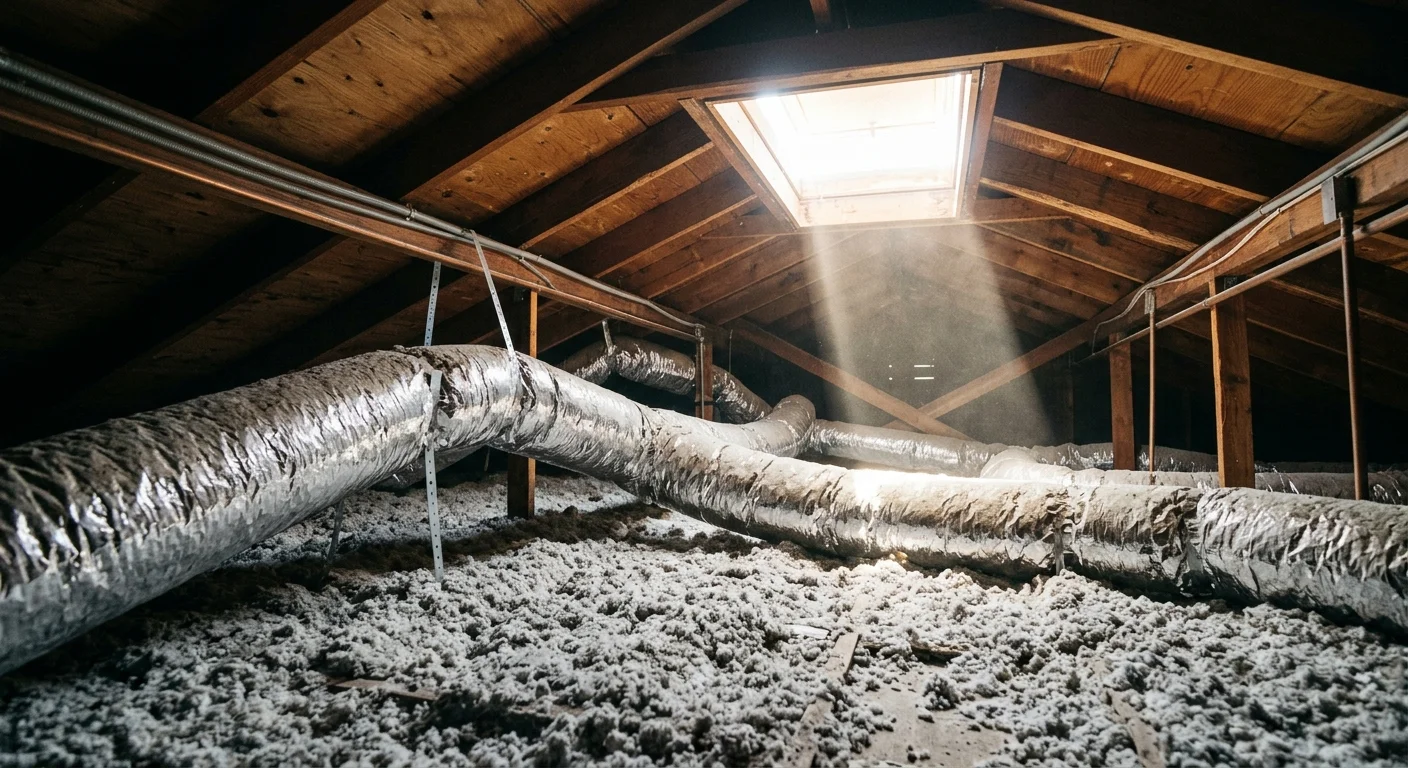
Replace the ducts when runs are crushed, torn, disconnected, or undersized. Cleaning is a different job, and the EPA does not recommend routine duct cleaning on a fixed schedule. Climate Pros Tucson matches you with a licensed local pro who inspects the attic and quotes the product you actually need.
Tucson International Airport averages about 68 days at or above 100F and about 158 days at or above 90F (1991-2020 normals). That heat sits on the roof all season. Dust from the monsoon (June 15 through September 30) can dirty a register. Dirt is not the same problem as a cooked, kinked, or pulled-apart run.
Cleaning vs sealing vs replacing: which job do you need?
You need the job that matches the defect, not the first quote that sounds like ductwork. Cleaning, sealing, and replacing are three products. A licensed pro should name which one they are selling.
| Job | What it does | What it does not do |
|---|---|---|
| Cleaning | Removes dust, debris, vermin waste, or other buildup from inside the runs | Does not close leaks, restore crushed flex, or resize a trunk |
| Sealing | Closes holes, loose joints, and disconnected collars so supply air stays in the duct | Does not repair a torn, sagging, or undersized run |
| Replacing | Puts in new supply and return runs, sized and routed for the equipment | Does not fix a dirty coil, a weak blower, or a failed compressor |
ENERGY STAR states that a typical forced-air house can lose about 20% to 30% of the air moving through ducts to leaks, holes, and poor connections. That is a national typical-house statement, not a measured Tucson result. Sealing is the job that addresses leakage. The EPA says there is little evidence that cleaning ducts alone improves efficiency, and duct cleaning has never been shown to prevent health problems.
If the question is only dust at the grille, start with whether duct cleaning is worth it in Tucson. If rooms never catch up in June and July, look at attic duct leaks in Tucson heat and duct leak repair before you buy a vacuum of the old flex.
Attic flex in Tucson heat: what fails first?
The attic run fails at crush points, pulled boots, and open joints before dirt inside the liner becomes the real problem. Ask the licensed pro to start there.
Tucson is a high desert basin. The living space is already in climate zone 2B, with a City of Tucson summer design dry bulb of 105F. The attic above that space is hotter still. No verified attic-temperature figure is published here, so treat the attic as a heat soak and have the pro look, not guess.
Walk this list with the contractor. Do not treat it as a lab result.
- Flex flattened in the walk path or under stored boxes
- Runs draped into a tight radius or kinked over a truss
- Outer jacket torn, with insulation slumped off the liner
- Supply boots pulled out of the ceiling box
- Return or supply collars loose at the plenum
- Long, skinny runs to a far bedroom that never cools
Catalina Foothills homes often pair long attic paths with older equipment, so replacement day is when those runs finally get seen. Marana’s newer subdivisions can still have builder flex left crushed or undersized in the attic. Vail and the east side take the same airport heat on the roof. Mount Lemmon and Summerhaven are a different climate: about 4,024 heating degree days a year, about three times the airport, so leaky ducts waste heat as well as cooling.
Monsoon dust is a separate issue. Average dew points at the airport sit in the 20s most of the year and jump into the high 50s in July and August. Dust storms happen in that window. Extra dust at a register can be a cleaning question under the EPA’s “as needed” test. It is not automatic proof the flex has to come out.
How the pro checks (camera, pressure test, or a visual attic walk) is not a published rule on this site. Ask what method they will use, and ask to see the damaged section.
When is a cleaning quote the wrong product?
A cleaning quote is the wrong product when the run cannot carry air even if it is spotless. The EPA’s own trigger for cleaning is narrow: substantial visible mold, vermin, excessive dust or debris, or particles coming from the registers. It is not a seasonal package, and it is not a substitute for duct cleaning sold as a comfort upgrade.
Skip a standalone cleaning quote when any of this is true.
- The flex is crushed, disconnected, or torn in the attic
- Upstairs rooms stay hot while the unit runs through 100F afternoons
- You are already replacing the AC or heat pump, and nobody has opened the attic
- The pitch is a fixed cleaning schedule with no inspection of the runs
- The quote never mentions sealing, sizing, or replacement as options
The National Weather Service counted 112 days at or above 100F in Tucson in 2024. A system that already struggles on those days will not be saved by vacuuming leaky flex. TEP time-of-use summer on-peak is May to September, Monday to Friday, 3 to 7 p.m. Cooled air that dumps into the attic during that window is wasted work. Sealing or replacing is the conversation for that loss. Cleaning is not.
Trico Electric Cooperative serves northwest Tucson and Marana south to Green Valley and Sahuarita. As of October 2026, Trico’s program pages list no rebate for a heat pump or AC. TEP’s Efficient Home Program, for TEP customers, lists duct sealing among the measures a participating contractor can bid. Confirm current terms with TEP or the contractor at quote time. Neither program turns a crushed run into a good one.
What should a duct replacement quote list?
The quote should name every run being replaced, how the pro inspected it, and how the new ducts meet the equipment. Climate Pros Tucson does not set prices and does not replace ducts. You hear the price from the licensed contractor before any work starts. There is no sourced Tucson market price on this page, so treat the written quote as the only number that counts.
Ask for these line items in writing.
- Which supply and return runs come out, room by room
- What the pro found (crush, tears, open joints, undersized trunks)
- How they inspected, in their own words
- New duct type and size for each run, without a vague “as needed”
- Connections at the plenum, air handler, and ceiling boots
- Insulation on the new runs (ask the spec; do not accept a shrug)
- Which registers and returns stay, move, or get resized
- Whether remaining ducts get sealed, and with what method
- Whether this job is tied to an AC or heat pump changeout
- Who pulls any required permit, and which city or county it is in
- Whether the contractor is a TEP Efficient Home participant, if you are on TEP
- License class: residential HVAC is ROC R-39 or an R-39R subclass. Check it at roc.az.gov
In the City of Tucson, permits are required for new or replacement furnaces, heat pumps, and air conditioners, and load and sizing calculations are required for that equipment. The matched contractor pulls the permit. A duct-only permit rule for the city could not be confirmed here, so ask the contractor and Planning and Development Services for your address. Do not hire under the handyman exemption for a permitted HVAC replacement. That exemption is for casual work under $1,000 that needs no permit.
How does this decision change an AC or heat pump swap?
Do not hang a new system on crushed or leaky attic flex and call the job done. A heat pump is the sensible default for a Tucson-basin home, because the heating duty is mild and the same unit does the cooling the house needs anyway. If the old ducts are too small, the new unit will short-cycle or starve rooms. Read ducts too small for a heat pump before you sign an equipment-only AC installation or heat pump service quote.
Fall is when a lot of Tucson changeouts get planned, after a long run of 90F and 100F days. Use that visit for an attic inspection, not a courtesy wipe of the registers. City of Tucson load and sizing calculations belong on the replacement permit. Those numbers assume the ducts can actually deliver the air. If they cannot, the equipment size on paper will not match the house.
On Mount Lemmon and Summerhaven, backup heat is a question for the pro, not a basin default. Duct leaks there tax heating as well as cooling. In the basin, TEP winter on-peak (October to April, weekdays, 6 to 9 a.m. and 6 to 9 p.m.) is when a heat pump’s morning recovery can pile onto leaky ducts. Ask the pro whether replacement, sealing, or a different layout is the right product for that house.
If the attic is a maze of failed flex, a ductless layout can be on the table. That is a design choice for the licensed contractor, not a default, and only a small share of Arizona homes use a ductless mini-split as main heat. Keep HVAC service in Tucson as the starting point and let the inspection pick the path.
Does the EPA recommend cleaning ducts on a schedule?
No. The EPA does not recommend routine duct cleaning on a fixed schedule. Clean as needed when there is substantial visible mold, vermin, excessive dust or debris, or particles released from the registers. Cleaning has never been shown to prevent health problems, and there is little evidence that cleaning alone improves efficiency.
Do I need a permit just to replace ducts in Tucson?
A standalone duct-replacement permit rule for the City of Tucson could not be confirmed here. New or replacement furnaces, heat pumps, and air conditioners in the city do need a permit, with load and sizing calculations. The matched contractor pulls that permit. Ask the contractor which jurisdiction your house sits in, because incorporated towns set their own fees and rules.
Can I keep the old flex if I put in a heat pump?
Only if the licensed pro finds the runs intact, connected, and sized for the new airflow. A heat pump is the sensible default in the Tucson basin, but it still needs a duct system that can move the air. If the flex is crushed, torn, or undersized, replacement or a different layout is the job, not a cleaning add-on.
When to call us
When attic runs look crushed, torn, or disconnected, or when you are pairing ducts with a new AC or heat pump, you need a licensed HVAC pro to inspect and quote the right job. Call (520) 353-2520 and we’ll match you with a licensed local pro.