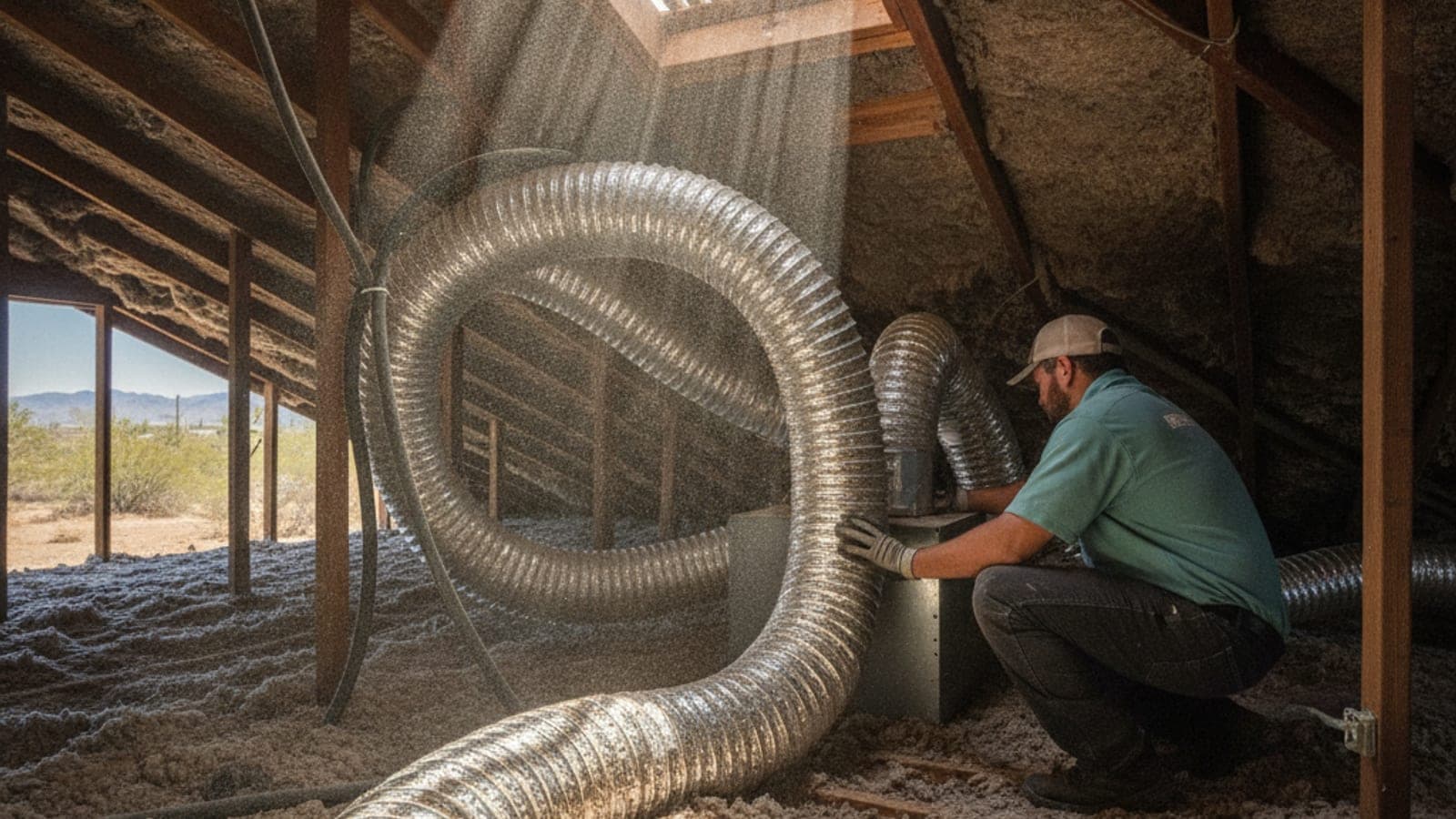
Leaky ducts waste cooled air before it reaches a room, and the fix is testing first, then sealing the leaks that testing finds. ENERGY STAR says a typical forced-air house can lose about 20% to 30% of the air moving through ducts. That’s a national typical-house statement, not a measurement of your Tucson home. Climate Pros Tucson matches you with licensed local pros for testing and sealing.
Why do Tucson ducts deserve a look?
Ducts that run through a hot attic or across a flat roof sit in the harshest spot in the house. Tucson International Airport averages about 68 days a year at or above 100F (1991-2020 normals), so a duct joint that loosens or a seam that cracks leaks cooled air into space nobody uses. Some homes have ducts in the attic, others in a slab or a crawlspace, and a rooftop package unit has its own duct runs. Ask the pro where yours run.
What are the signs of a duct leak?
- A room that never cools like the others.
- Dust blowing from vents or settling fast.
- A system that runs long and can’t catch up.
- Visible gaps, loose connections or crushed sections where you can see the ducts.
None of these proves a leak. A pro measures it.
How do pros test and seal ducts?
A pro can pressurize the duct system and measure how much air escapes, then locate the leaks. Sealing usually means mastic or approved tape on joints and seams, sealing at the air handler and boots, and replacing damaged sections. Ask what test the pro runs before and after, and ask for the result in writing. For whole-house air leakage testing, the City of Tucson’s 2024 IECC amendments require a tester with RESNET, BPI or other approved certification. That rule is about the house, not the ducts, but it’s a fair question for whoever tests yours.
Is duct cleaning the same as duct sealing?
No. The EPA doesn’t recommend routine duct cleaning on a fixed schedule, and says there’s little evidence that cleaning ducts alone improves efficiency. Sealing addresses leakage. Clean ducts when you see substantial visible mold, vermin, or excessive dust or debris. See duct cleaning for what that visit covers, and read indoor air quality in Tucson if dust is your concern.
Does TEP help pay for duct sealing?
As listed by TEP in October 2026, the Efficient Home Program pays up to $300 for duct sealing, varying with the leakage reduced, taken off the price as an instant rebate. You need a participating Efficient Home contractor. Amounts change, so confirm with TEP at 866-473-8761 before you book. Federal 25C ended for installs after 2025.
When should you replace ducts instead?
When ducts are crushed, disconnected or old and failing, replacement may beat patching, and it may follow a new system. Ask for both options in writing. HomeGuide lists $1,400 to $5,600 as the average cost to replace ductwork, or $25 to $55 per linear foot, as national figures (checked October 2026). Those aren’t Tucson prices; the written quote for your duct runs is the number that counts. If you’re replacing equipment, the permit and the load calculation cover the equipment, and duct condition belongs in the same conversation. See lower your AC bill in a Tucson summer, AC repair and the Tucson HVAC hub. Check any contractor’s license at roc.az.gov.
When to call us
When a room won’t cool or the system runs nonstop, we’ll match you with a licensed local pro who can test the ducts. Call (520) 353-2520 and we’ll match you with a licensed local pro.