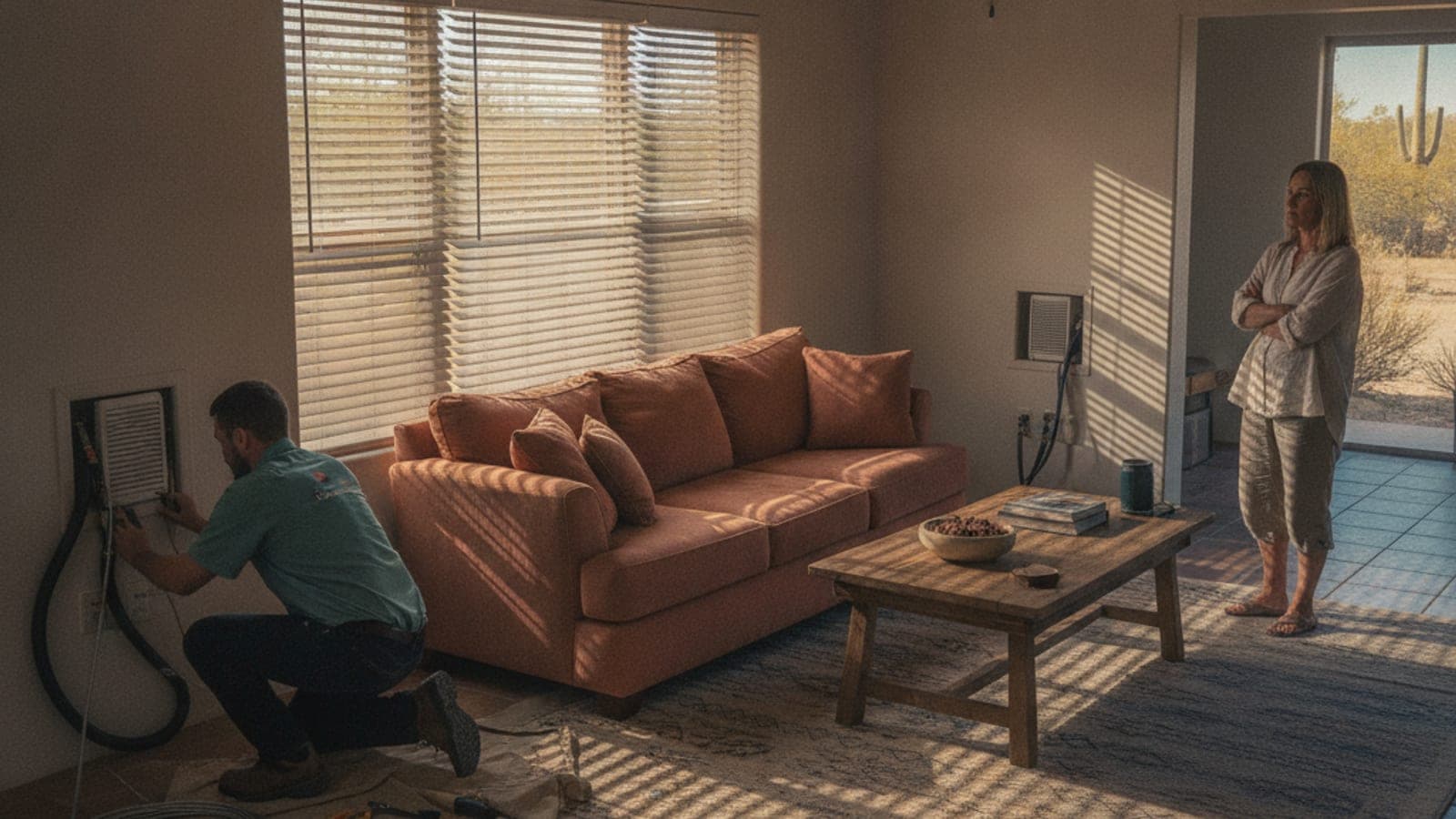
When your AC dies in a Tucson summer, protect people first and the equipment second. Shrink the part of the house you try to keep livable, block the sun, and watch anyone who is old, very young or ill. Then get a licensed pro on the job. Climate Pros Tucson matches you with one, and the steps below help you through the gap.
How do you keep a house livable with no AC?
Pick one interior room, close it off, and keep sun out of it. A room on the shaded side of the house with a door you can shut works best. Close blinds and curtains on every window that faces the sun, and keep exterior doors shut.
Tucson does not give you a cool night to recover. The 1991-2020 normals at Tucson International Airport show a July normal low of 76.3F, and the airport averages about 68 days a year with a high at or above 100F. A closed house that lost its AC stays warm well after sunset.
- Run ceiling fans and box fans only while someone is in the room. A fan moves air across skin but does not cool the room.
- Skip the oven, dryer and dishwasher until the house is cool again.
- Drink water steadily. Wet a towel and keep it on your neck or wrists.
- Open windows only if the outside air is actually cooler than the inside air, which is usually after dark and not always then.
When is it time to leave the house?
Leave when anyone in the home shows signs of heat trouble, or when the house stays too hot to rest in. Dizziness, headache, nausea, confusion, fainting or a stop in sweating are warning signs. Call 911 for confusion, fainting or a person who cannot be woken normally.
The CDC advises older adults to stay in air-conditioned buildings in hot weather and not to rely on a fan as the main cooling when it is very hot. The same caution fits babies, small children and anyone with a heart or breathing condition. Libraries, stores and a friend’s or relative’s home are all reasonable places to wait out the afternoon. Check Pima County and the City of Tucson for any cooling locations they have opened during extreme heat.
Pets feel it too. Bring them into the cooled room or along with you.
What can you check before you call?
Check the thermostat, the breaker and the filter. These take a few minutes and sometimes explain a dead system.
- Confirm the thermostat is set to Cool with a setpoint below the room temperature, and that its batteries are fine.
- Look at the breaker panel. A tripped breaker can be reset once. If it trips again, stop and leave it for the pro.
- Check the air filter. A badly clogged one can starve the system of air. See the AC not cooling checklist.
- Look at the outdoor unit or roof unit from a safe distance. Note whether the fan spins and whether you hear humming.
Do not open panels, touch wiring or climb onto a roof in this heat. If the system freezes over, turn it off and read about an AC freezing up.
What should you tell the pro?
Give the matched contractor the facts they would otherwise have to ask for. Say what the unit is (central split, roof package unit, mini split or evaporative cooler), what happened right before it quit, and what you saw and heard. Mention if anyone in the home is elderly, an infant or medically fragile.
Ask whether a tech is available now, yes or no, and ask for any after-hours fee as a dollar figure before you agree. Each company sets its own prices and policies. The emergency HVAC service page explains how matching works, and the AC repair page covers the repair side. Our Tucson HVAC hub lists the places we cover.
If you rent, Arizona law requires a landlord to keep HVAC facilities in good and safe working order. See does your landlord have to fix the AC in Arizona, and report the outage in writing right away.
When to call us
A dead AC in a Tucson summer is a job for a licensed pro. Call (520) 353-2520 and we’ll match you with a licensed local pro.