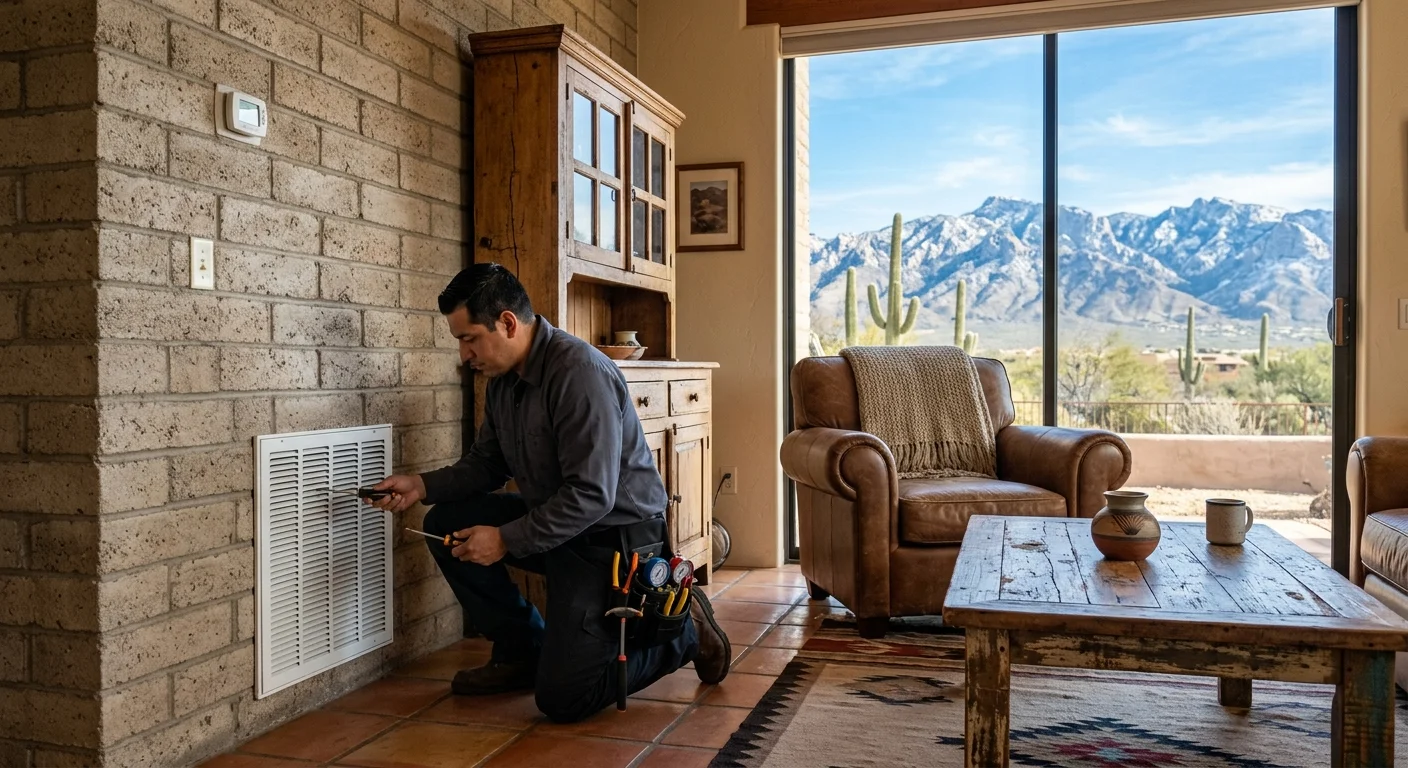
A whole-home humidifier in Tucson is a unit tied into your ducts that adds moisture to the air your furnace or heat pump already moves. It is a winter tool. After a swamp cooler is drained and capped, outdoor dew points at the airport sit in the 20s for most of the year, and closed-up heating air feels dry. Climate Pros Tucson matches you with a licensed HVAC pro who can say whether a bypass, fan-powered, or steam humidifier fits your system.
Portable tanks only treat one room. A whole-home unit rides the same supply air that already reaches the slump-block rooms, the hallway, and the bedrooms. That only works if you have ducts. A mini-split house, a casita, or a room with no trunk line needs a different conversation.
Why does Tucson air dry out once the swamp cooler is off?
The moisture source you used all cooling season is gone, and the outdoor air is dry again. A swamp cooler (enfriador evaporativo) cools by evaporating water into the house air. When you winterize the swamp cooler, that water path stops. Windows stay shut. The heater runs. Indoor air then tracks the dry desert air outside.
At Tucson International Airport, 1991-2020 normals show a January high of 66.5F and a low of 40.8F, and a December high of 65.5F and a low of 40.5F. The airport sees 1,333 heating degree days a year against 3,424 cooling degree days, about 2.6 cooling degree days for every heating degree day. Heating is real on the basin floor. It is also short compared with summer. Fewer than 12 nights a year drop to 32F or below. The National Weather Service in Tucson is the climate source to check.
Dew point is the local mechanism. Average dew points sit in the 20s for most of the year and jump into the high 50s in July and August, during the monsoon window of June 15 through September 30. That summer jump is why evaporative coolers fade in monsoon. It is also why winter is when people look up a whole home humidifier in Tucson. From October through spring, the air that leaks in is dry. Heat does not add water. It just warms dry air.
The Catalina Foothills, Oro Valley, and Marana sit in the same dry-winter pattern as the basin, with their own housing and utility. Vail and the east side follow the same winter dryness. Sahuarita and Green Valley do too. Mount Lemmon and Summerhaven are the heating outlier: about 4,024 heating degree days a year, about three times the airport, and about 53 nights at or below 32F. More heat runtime means more hours of indoor air without a moisture source. Backup heat there is a question for the pro, and so is whether a humidifier belongs on that system.
A heat pump can feel dry in heat mode for reasons that belong on a separate page. Read does a heat pump dry out the air for that physics. This page is the product: which whole-home humidifier can go on the ducts, and when it is the wrong add-on.
What is the difference between bypass, fan-powered, and steam humidifiers?
Three common whole-home types mount on a ducted furnace or air handler. They all add water. They do it in different ways, and that matters on a Tucson heat pump.
| Type | How it adds moisture | Needs hot supply air? | Extra electricity | Hard-water note |
|---|---|---|---|---|
| Bypass | A slice of warm air crosses a wet pad, then returns to the ducts | Yes. Works best on a gas furnace with long heat cycles | Little. The system blower does the work | Scale builds on the pad. Pads need regular replacement |
| Fan-powered | Its own fan pulls air across a wet pad | Helps, but it can run on shorter cycles than a plain bypass | The small fan motor | Same pad and scale issue as bypass |
| Steam | The unit boils water and injects steam into the trunk | No. Steam does not depend on furnace-hot air | Yes. The heating element is on your electric bill | Scale hits the canister or electrodes. Service follows the spec sheet |
A furnace humidifier in Tucson is often a bypass or fan-powered pad on a gas furnace. Warm supply air is what evaporates the water. Arizona statewide, 55% of homes used a central furnace as main heat in 2020, and 25% used a central heat pump. Those are Arizona figures, never Tucson shares. On the basin, a heat pump is still the sensible default for a new system: mild heating duty, and the same unit does the cooling the house needs. Cooler heat-pump supply air is a poor match for a bypass pad. Ask the pro to treat steam, or another design the manufacturer lists for heat-pump air, as the live option when the air handler is a heat pump.
Does a humidifier work when the AC is on?
Most evaporative whole-home units are meant to sit out cooling season. Air conditioning already pulls moisture at the coil. Adding water while the AC runs fights that coil. Tucson’s cooling load dwarfs heating, and July and August dew points are already in the high 50s. That is the opposite of the dry-winter problem. Confirm the lockout, humidistat, and summer disable in the spec sheet. Do not assume a steam unit should run in monsoon either. Extra indoor moisture on a sticky August night is a mold and comfort problem, not a fix.
You can add a humidifier to many existing ducted systems. The pro has to find a trunk, a water line, a drain, and a control. A rooftop package unit, a tight garage closet, or crushed flex can block a clean mount. Ductless mini-splits have no shared trunk for a bypass pad. Say that out loud on the first visit.
What can a whole-home humidifier fix, and what can it not?
It can raise the moisture in the air the ducts already deliver, which may ease dry skin, dry sinuses, static shocks, and wood that feels tight in January. It cannot clean desert dust, pollen, or smoke, and it is not a medical treatment for allergies or asthma.
Dry winter air pulls moisture from skin, nasal passages, and wood. People notice static on blankets, cracked furniture, and a scratchy throat after a night with the heat on. Adding moisture to whole-house air is the job this product has. Keep a hygrometer in the living space so you can see the number. The City of Tucson energy code (climate zone 2B, winter design dry bulb 35F, summer design 105F) does not set an indoor humidity target for occupied rooms. There is no published Tucson indoor RH rule to chase. Confirm comfort and equipment limits with the pro and the manufacturer’s spec sheet. Overshooting humidity helps dust mites and mold. The spec sheet and a working humidistat are what keep the unit inside its design range.
Dust, pollen, and wildfire smoke are particle problems. They need filtration and, in some houses, a dedicated cleaner. That work lives on indoor air quality and on a whole-home purifier conversation, not on a water pad. Ventilation is a third job. An ERV or HRV swaps stale indoor air with outdoor air. In a Tucson winter that outdoor air is dry, so ventilation does not replace a humidifier. Read ERV vs HRV ventilation in Tucson when fresh air is the actual question.
Leaky ducts waste the moisture you just added. ENERGY STAR states that a typical forced-air house can lose about 20% to 30% of the air moving through ducts to leaks, holes, and poor connections. That is a national typical-house statement, never a measured Tucson result. If return leaks pull dusty attic air, you are humidifying a mix you did not mean to condition. Ask the pro to look at ducts before they size the humidifier.
Do ducted heat pumps, gas furnaces, and hard water change the choice?
Yes. The heat source sets which humidifier can actually evaporate, and Tucson water leaves mineral scale on anything that boils or wets a pad.
On a gas furnace, a bypass or fan-powered pad can work because supply air is hot. On a ducted heat pump, supply air is cooler, cycles can be shorter, and a bypass pad may sit there damp without putting much water into the house. Steam does not need that hot air. Steam does use electricity. If your bill is from Tucson Electric Power (TEP), winter time-of-use on-peak is October to April, Monday to Friday, 6 to 9 a.m. and 6 to 9 p.m. Trico Electric Cooperative serves northwest Tucson and Marana south to Green Valley and Sahuarita. Trico’s standard residential rate (RS1) has a single energy charge with no on-peak split. No cents-per-kWh figure is published here. Ask the pro how the steam unit is controlled, and read your own bill to see who the electric company is.
Tucson Water says the area’s hard groundwater mixed with Central Arizona Project water builds calcium deposits in evaporative coolers, water heaters, and dishwashers. It advises regularly changing swamp cooler pads and adding an in-line filter. A whole-home humidifier is another device that puts that same water on a pad or in a boil chamber. A hardness number in grains or milligrams was not confirmed for this page. Do not size a softener or a pad schedule from a guessed figure. Put water treatment, pad changes, and steam-canister service on the quote, and follow the manufacturer’s spec.
Southwest Gas is the natural gas utility if the heat is a furnace. The humidifier still taps domestic water, not gas. The gas furnace is only the heat that makes a bypass pad work.
Mount Lemmon stays the exception on climate: Pima County zone 5B above 4,000 feet, winter design dry bulb 4F. A cold-climate heat pump or backup heat is a question for the pro there. So is whether a humidifier should run with that backup.
What should a licensed installer’s quote list?
The written quote from the pro is the number that counts for your home. There is no sourced Tucson market price for a whole-home humidifier, so this page publishes none.
Ask the quote to name the type (bypass, fan-powered, or steam), the model, and the spec sheet the installer is following. It should show where the unit mounts, how water is tied in, where the shutoff and drain go, and how overflow is handled. It should say how the humidistat is controlled, whether an outdoor sensor is included, and whether the unit is locked out in cooling. For a heat pump, it should state in writing that the chosen type is listed for that air temperature. For hard water, it should state the pad, canister, or filter plan without inventing a hardness number.
Have the installer check duct condition. ENERGY STAR’s national leakage statement is the reason, not a Tucson measurement. If steam is on the table, the quote should show the electrical circuit and how that load shows up on a TEP or Trico bill.
Permits: in the City of Tucson, new or replacement furnaces, heat pumps, and air conditioners need a permit, with load and sizing calculations. New evaporative coolers are listed too. A humidifier-only add-on is not named on that residential permit list. Whether this job needs a permit could not be confirmed from that list. The matched contractor should confirm with City of Tucson Planning and Development Services before they cut a duct or tap a water line. The contractor pulls any permit, never Climate Pros Tucson.
Licensing: residential heating and cooling is ROC class R-39 or its R-39R subclasses. Every pro we send is licensed. Check the card at the Arizona Registrar of Contractors. Casual work under $1,000 that needs no permit can fall under the handyman exemption. If PDSD says this job needs a permit, that exemption does not cover it.
Federal tax credits for a heat pump or AC installed in 2026 do not apply to this product conversation. Do not plan a humidifier purchase around a 25C credit.
Fold the humidifier into the rest of the season. A winter HVAC checklist for Tucson is the place to pair heat, filters, and this add-on so you are not solving dryness while a dirty filter starves the blower.
How much does a whole-house humidifier cost?
No Tucson or Arizona installed price is sourced for this page, so none is listed. National cost-guide bands are also omitted here because they are not a Tucson quote. Ask for a line-item written price that includes the unit, water and drain, controls, electrical work if steam, pad or canister service, and any permit the city requires. That written quote is what you accept or decline.
Can you add a humidifier to an existing HVAC system?
On many ducted furnaces and air handlers, yes. The limiter is space on the trunk, a legal water tap, a drain, and a control that matches heat-pump or furnace air. Package units, attic flex, and ductless systems are the common stops. The pro confirms on site.
What is the best whole-house humidifier for a Tucson HVAC system?
The one the manufacturer lists for your heat source, water, and ducts. A bypass pad on a gas furnace and a steam unit on a ducted heat pump are different fits. “Best” is the spec sheet plus the house, not a brand name on an ad.
When to call us
Call when winter air in the house feels dry after the swamp cooler is off, or when you want a licensed pro to say whether a bypass, fan-powered, or steam humidifier belongs on your ducts. Call (520) 353-2520 and we’ll match you with a licensed local pro.