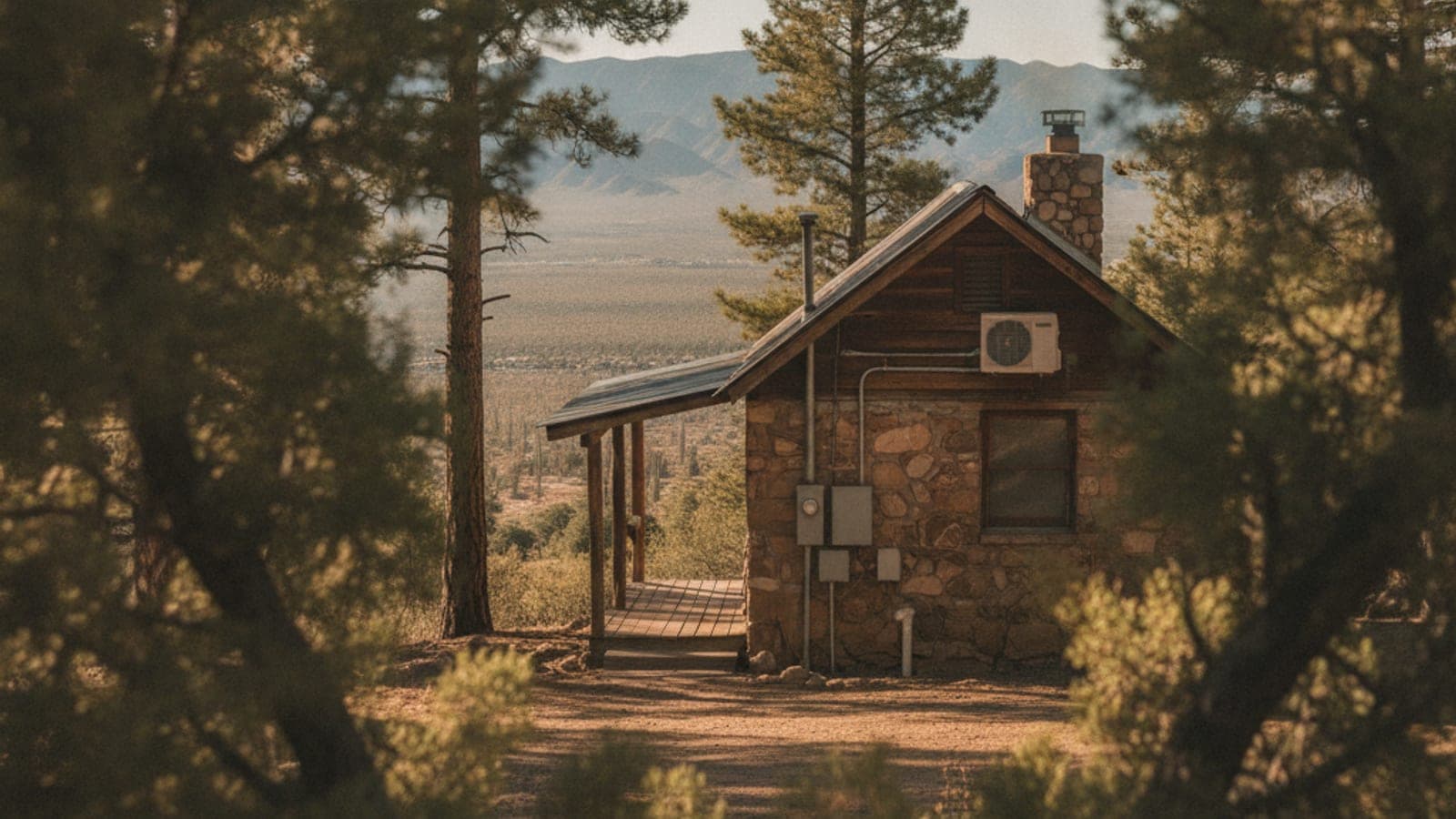
A Mount Lemmon cabin needs a heating plan built for real winter and for the weeks nobody’s there. That comes down to three decisions: the fuel, the backup, and how the place stays safe when it’s empty. The full climate and code picture is in HVAC for Mount Lemmon and Summerhaven; this page is the cabin owner’s checklist, especially for a part-time owner. Climate Pros Tucson matches you with licensed pros, and each can tell you whether they serve the mountain.
How different is the mountain from the basin?
Different enough that a basin plan doesn’t carry over. At the Mount Lemmon Willow Canyon station, about 7,047 feet, the 1991-2020 normals show about 53 nights a year at or below 32F and 4,024 heating degree days, about three times the Tucson airport. Pima County’s code sets the winter design dry bulb at 4F above 4,000 feet. That 4F is the number a load calculation for the cabin should use.
Which heat source fits a cabin?
Start with what reaches your lot. Statewide, 51% of Arizona homes heat mainly with electricity, 36% with natural gas and 2% with propane (EIA, 2020). Those are Arizona figures, not Summerhaven ones, and a gas line isn’t something to assume on a mountain lot.
| Option | What to ask the pro |
|---|---|
| Cold-climate heat pump | Will it carry the load at the 4F design number, and what backup heat does it need? |
| Propane furnace or heater | Where does the tank sit, and can a delivery truck reach it in winter? |
| Natural gas | Is there actually a line to the property? |
| Electric resistance heat | Simple to install, but it uses more electricity than a heat pump for the same heat |
In the Tucson basin a heat pump is the sensible default. At Summerhaven it’s a question for the pro, usually with a backup source in the plan.
What happens when the power goes out?
A heat pump stops without power, and many fuel-burning furnaces need electricity for the blower and controls too. Ask the pro whether your system keeps any heat going in an outage, and what a backup would take. For a cabin that sits empty, this matters more than efficiency.
How do you protect an empty cabin?
- A minimum heat setting picked with the pro for your plumbing and system. Don’t guess a number.
- A thermostat or sensor that alerts you by phone if the temperature drops or the power fails.
- A shut-off and drain plan if you close the cabin for the season.
- Someone nearby who can check on the place after a storm.
Frozen pipes cost far more than a cold house.
How do you plan service on the mountain?
Mountain homes sit far from most pros’ routes, and winter weather affects the road. Ask each contractor whether they serve Summerhaven and how they handle access, and book the heating check in fall rather than waiting for a winter breakdown. Outside the City of Tucson, ask the contractor which county rules apply to the work.
See heat pump service, do heat pumps work in Tucson winters and the Tucson HVAC hub.
Before the first freeze
Tell the pro your elevation, your fuel and how often the cabin sits empty. Call (520) 353-2520 and we’ll match you with a licensed local pro.