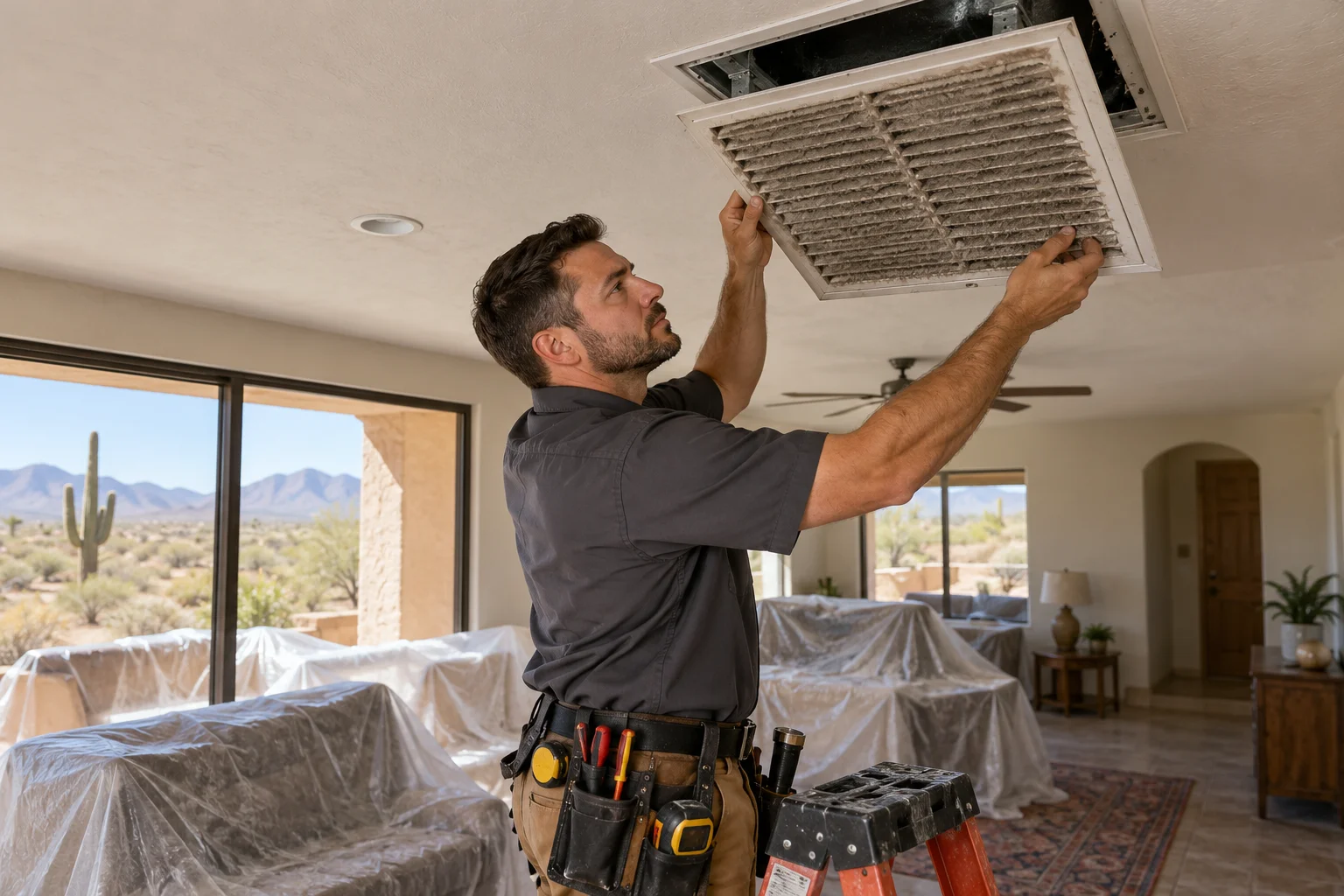
Remodel dust does not prove ducts need cleaning
Duct cleaning after a Tucson remodel isn’t automatically necessary. Consider it when an inspection finds excessive dust, debris, vermin, or substantial visible mold inside the system. Climate Pros Tucson can match you with a licensed local pro who can inspect the ducts and explain the evidence.
The EPA doesn’t recommend routine duct cleaning on a fixed schedule. It recommends cleaning as needed based on the duct system’s condition.
Drywall work, flooring removal, cabinet cutting, and sanding can leave dust across a home. That surface dust doesn’t prove the material entered the ducts. The decision depends on what happened during the remodel and what an inspection finds afterward.
Cleaning deserves a closer look when:
- Returns or registers remained open near dusty work.
- The HVAC system operated while dust was being produced.
- Loose material is visible inside accessible duct sections.
- Particles come from registers while the system runs.
- A pro documents excessive debris, vermin, or substantial visible mold.
- Dust returns after the room and accessible HVAC surfaces are cleaned.
A dusty grille alone isn’t enough evidence. The material may be limited to the grille, register boot, filter area, or nearby surfaces. Start with those accessible areas before approving whole-system duct cleaning.
Tucson’s climate also makes a careful approach practical. The 1991-2020 normals at Tucson International Airport show about 158 days each year with highs at or above 90°F.
Dust storms also occur during Arizona’s June 15 through September 30 monsoon window. Remodel dust and outdoor dust can appear together, so timing alone doesn’t identify the source. An inspection should show where the material is located.
Inspect returns, registers and accessible ductwork
Begin with a visual inspection of accessible areas.
Check these locations:
- Return grilles near the remodeled area
- Supply registers inside and beside the work zone
- The filter and filter slot
- Visible register boots
- Accessible metal duct surfaces
- The air-handler area visible without opening equipment
- Floors, trim, shelves, and ledges near each register
Take clear photos before wiping anything down. The photos can help a pro separate surface residue from material deeper inside the duct system.
Next, write down what happened during construction:
- Which rooms were remodeled
- What work produced visible dust
- Whether registers were covered
- Whether return openings were protected
- Whether the HVAC system ran during the work
- When the filter was last checked or changed
- Which registers appear to release particles now
Inspect the filter rather than changing it blindly. If replacement is appropriate, use the size and type specified for the system. A dirty filter can support further inspection, but it doesn’t prove every duct needs cleaning.
A pro should show you the condition behind the grille or inside accessible ductwork. Ask for photos or video tied to specific locations. “There is construction dust somewhere” isn’t a useful diagnosis.
For broader concerns about filters, particles, or equipment choices, review Tucson indoor air quality options. The goal is to match the response to the source, not buy every available add-on.
Cleaning, sealing and replacement solve different problems
Cleaning, sealing, and replacement aren’t interchangeable. Each addresses a different condition, and a post-remodel quote should say which condition was found.
| Option | What it addresses | Evidence to request | What it doesn’t establish |
|---|---|---|---|
| Surface cleanup | Dust on grilles, boots, floors, and nearby surfaces | Photos showing material limited to reachable areas | That deeper ductwork is clean or contaminated |
| Filter replacement | A loaded, damaged, or unsuitable filter | The removed filter and the system’s filter requirements | That whole-system duct cleaning is needed |
| Duct cleaning | Excessive dust, debris, vermin, or substantial visible mold inside ducts | Location-specific photos or video | A guaranteed health, comfort, or energy result |
| Duct sealing | Leaks, holes, or poor connections | Identified leak locations and proposed sealing scope | Removal of debris already inside the ducts |
| Duct replacement | Damaged sections that can’t be addressed by cleaning or sealing | Photos, measurements, and the exact sections proposed | That every duct run requires replacement |
The EPA says duct cleaning hasn’t been shown to prevent health problems. It also reports little evidence that cleaning ducts alone improves system efficiency. Treat promises about guaranteed health, lower bills, or improved comfort with caution.
Sealing addresses air leakage rather than dirt. ENERGY STAR says a typical forced-air house nationally can lose about 20% to 30% of the air moving through ducts because of leaks, holes, and poor connections. That is a national typical-house statement, not a measurement of your Tucson home.
A contractor still needs to locate leakage before proposing sealing. TEP’s Efficient Home Program listed up to $300 for qualifying duct sealing in October 2026, with the amount varying by leakage reduced. Program terms change, so check the TEP Efficient Home Program and confirm eligibility with a participating contractor.
Replacement should be tied to documented damage or another condition that cleaning won’t correct. Compare the proposed scope with our guide to duct replacement versus cleaning.
Questions to ask before accepting a quote
A useful quote connects each proposed service to visible evidence. Climate Pros Tucson refers homeowners to independent professionals, but the homeowner contracts with and pays the matched pro directly.
Ask these questions before authorizing work:
- What did you find, and where did you find it?
- Can you show me location-specific photos or video?
- Is the material limited to grilles, boots, or nearby duct sections?
- Which supply and return sections are included?
- Does the air handler require separate work?
- Is filter replacement included or listed separately?
- Did you find leaks, damage, vermin, or substantial visible mold?
- Why is cleaning appropriate instead of surface cleanup?
- Why is sealing or replacement proposed?
- How will nearby rooms and finishes be protected?
- What will document the condition after the work?
- Which optional products or treatments are included?
- Who provides any written warranty, and what does it cover?
You can also check the contractor through the Arizona Registrar of Contractors. Residential heating and cooling contractors use the R-39 classification or an applicable R-39R subclass.
A Tucson market price for post-remodel duct cleaning couldn’t be confirmed from an approved local source. Each independent company sets its own price. The written quote should list the inspected areas, included components, optional work, and total price before you agree.
For a broader decision framework, read whether duct cleaning is worth it in Tucson.
Should ducts be cleaned after every renovation?
No. A renovation creates a reason to inspect, not an automatic need for cleaning. The condition inside the system should drive the decision.
Will duct cleaning make the house less dusty?
Don’t accept that result as a guarantee. Ask the pro to demonstrate that material inside the ducts is contributing to the problem. Cleaning the ducts also won’t remove dust left on floors, trim, cabinets, or other room surfaces.
Does homeowners insurance cover post-remodel duct cleaning?
No Tucson-specific coverage rule could be confirmed. Your policy and insurer determine coverage. Ask the insurer whether the claimed condition is covered, what documentation is required, and whether authorization is needed before work begins.
How to keep new dust out afterward
Control dust at the work area before relying on another cleaning. Coordinate with the remodeling contractor and HVAC pro before later phases begin.
A practical plan includes:
- Isolating the work area where possible
- Protecting nearby returns and registers during dusty tasks
- Choosing whether the HVAC system should operate during that work
- Removing protective coverings before normal HVAC operation resumes
- Cleaning floors, trim, shelves, and grilles after each dusty phase
- Checking the filter after dust-producing work
- Photographing accessible openings before and after the next phase
- Inspecting for damaged duct connections near altered walls or ceilings
Tucson cooling needs can be significant, especially during summer remodeling. Plan containment and cooling together.
If particles continue appearing after surface cleanup and a filter check, request another documented inspection. The next step might be targeted cleaning, leak sealing, or repair rather than whole-system cleaning.
Homeowners across the Tucson HVAC service area can use the same evidence-first process. The important local question is how the home’s cooling needs, remodel schedule, and duct layout affect safe access and containment.
When to call us
Call when an inspection finds material inside the ducts, particles leave the registers, or the quote includes cleaning, sealing, or replacement without clear evidence. Call (520) 353-2520 and we’ll match you with a licensed local pro.