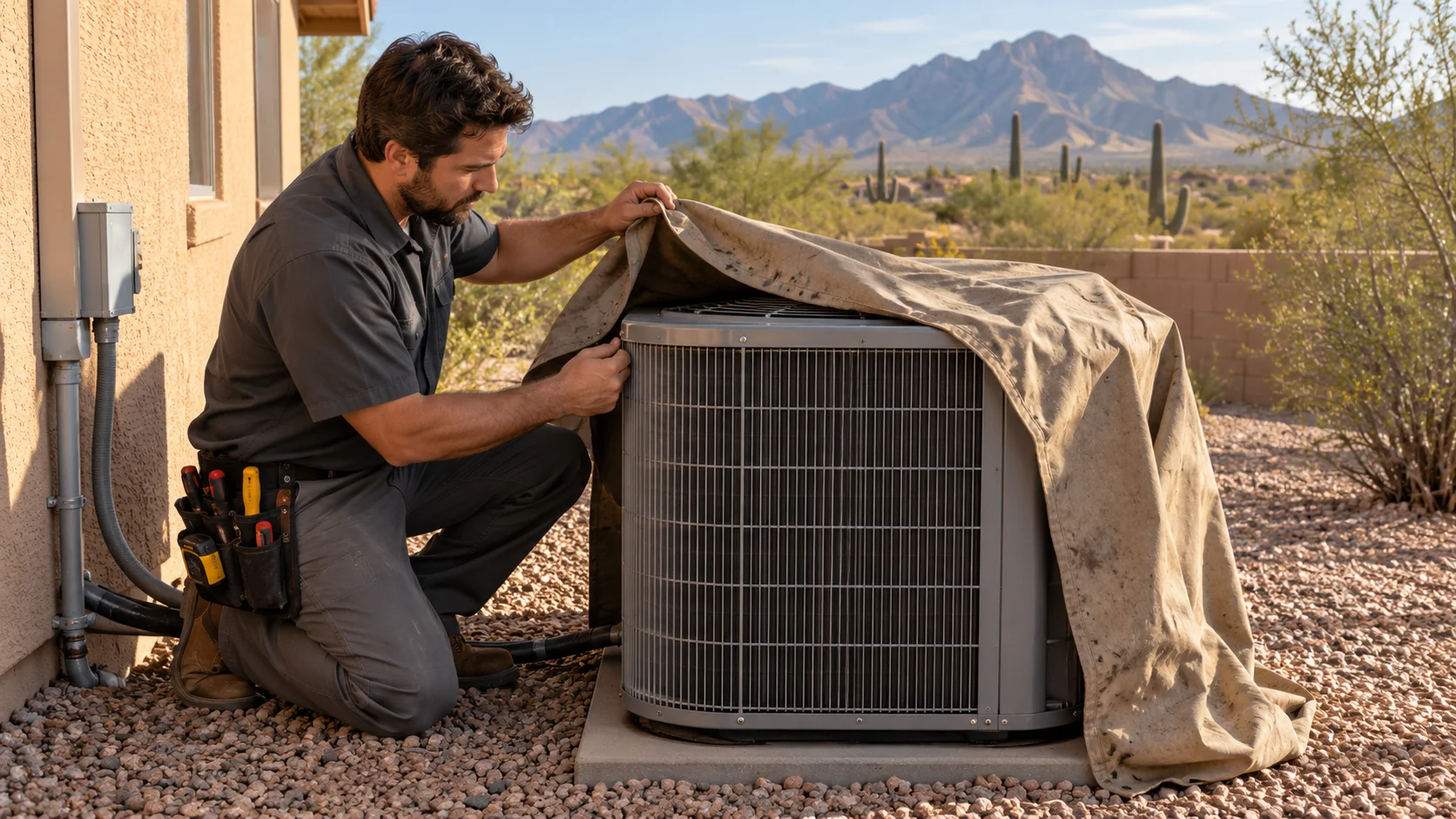
Tucson winter is mild, dust is not
Don’t wrap your outdoor unit before you identify what it does. A heat pump may run all winter, while an AC-only condenser may remain off until cooling season. Climate Pros Tucson can match you with a licensed local pro if you can’t tell which system you have.
Tucson’s winters don’t resemble winters in snow-heavy climates. The 1991-2020 normals at Tucson International Airport show fewer than 12 nights per year at or below 32F. No normal day stays below freezing.
Dust still reaches outdoor equipment. Windblown leaves, weeds, trash, and loose yard material can also collect nearby. A cover isn’t a substitute for clearing that material or checking the equipment before cooling season.
Start with the equipment label, owner’s manual, and thermostat. If the paperwork doesn’t clearly identify the outdoor unit, ask a licensed pro.
This quick comparison shows why one answer doesn’t fit every Tucson home:
| Outdoor equipment | Does it operate during heating season? | Before adding any cover |
|---|---|---|
| Heat pump | It can run in heating mode | Check the manual and keep required airflow paths open |
| AC-only condenser | It doesn’t provide the home’s heat | Check the manufacturer’s winter storage guidance |
| Evaporative cooler | It’s different from a condenser | Follow a separate swamp cooler winterizing process |
Our Tucson HVAC service guide can help you identify the right service for your system.
Heat pumps need airflow, covers trap ice
A heat pump’s outdoor unit must exchange air while heating your home. A full cover can obstruct that airflow, so don’t cover an operating heat pump.
Heat pumps are a sensible default for Tucson-basin homes. The City of Tucson uses a 35F winter design temperature, and the same equipment handles summer cooling. You can read more about how heat pumps work during Tucson winters.
Frost or steam near a working heat pump doesn’t automatically identify a failure. The system and conditions must be checked together. Our guide to a frozen or steaming heat pump outdoor unit explains what deserves professional attention.
A cover can make that assessment harder. It may hide frost, debris, or drainage problems. Material wrapped around the cabinet can also hold moisture or ice against the equipment. The exact risk depends on the unit and cover, so check the manufacturer’s instructions.
Arrange heat pump service if ice remains, airflow appears blocked, or the unit makes an unfamiliar sound.
Mount Lemmon and Summerhaven need separate judgment. Pima County places areas above 4,000 feet in climate zone 5B, with a 4F winter design temperature. Ask the pro whether the equipment, drainage, and winter setup suit that colder location.
AC-only condensers: what a cover cannot do
A cover can’t clean the coil, correct damaged parts, or prepare an AC for its first spring run. It also can’t replace the instructions written for your exact model.
If your outdoor unit serves cooling only, look for the manufacturer’s winter guidance. Some equipment may have an approved accessory or specific storage instructions. Don’t assume a universal cover fits every condenser.
Before using any cover, ask:
- Does the manufacturer allow one?
- Is it designed for this exact model?
- Does it leave required openings exposed?
- Could it interfere with drainage?
- Must it be removed before the system receives power?
- Does the warranty document address covers or accessories?
The answers couldn’t be confirmed for every make and model. Check the owner’s manual, warranty certificate, or manufacturer’s product page. A licensed pro can help interpret unclear instructions.
A generic tarp is especially hard to judge. Wind can shift it, and improvised ties may reach panels, tubing, or wiring. The correct attachment method couldn’t be confirmed for every unit, so follow the manufacturer’s written instructions.
If overhead debris is the concern, ask whether the manufacturer offers an approved top shield. Don’t copy snow-country advice without checking its fit for Tucson’s dry, dusty conditions.
What to clear before the first heat call
Clear loose material around the outdoor unit without opening its cabinet. The goal is an unobstructed exterior, not a DIY internal cleaning.
Check for:
- Weeds or loose yard material touching the cabinet
- Leaves and trash gathered around the base
- A forgotten cover, tarp, or tie-down
- Visible damage to the cabinet or accessible fins
- Water collecting where it can’t drain away
- Animal nesting material visible from outside
- Ice that remains instead of clearing
- Anything resting against refrigerant lines or conduit
The safe DIY scope couldn’t be confirmed for every model. Check the owner’s manual or ask a licensed pro before doing more than an exterior visual check.
Check the National Weather Service Tucson forecast when the first freeze approaches. Don’t rely on a remembered freeze date. Conditions vary across the basin, foothills, and higher elevations.
For the rest of the seasonal transition, use the Tucson winter HVAC checklist. That page covers the whole system, while this guide focuses on outdoor-unit covers.
Questions to ask a licensed pro on a fall visit
Ask the pro to identify the equipment before discussing a cover. Climate Pros Tucson matches homeowners with independent licensed HVAC contractors who can inspect the actual unit.
Useful questions include:
- Is this outdoor unit a heat pump or an AC-only condenser?
- Does it run when the thermostat calls for heat?
- Does the manufacturer permit a winter cover?
- Is there an approved cover or top shield for this model?
- What airflow and drainage openings must remain clear?
- Is visible frost normal for this unit’s current operating state?
- Is any debris inside the cabinet affecting operation?
- Are the cabinet, coil, wiring, and refrigerant lines intact?
- What should I check before the first cooling call?
- What does the written warranty say about accessories?
Every pro we send is licensed. You can also check a contractor’s status through the Arizona Registrar of Contractors. Residential HVAC work falls under R-39 or an applicable R-39R subclass.
A fall HVAC maintenance visit should address the equipment you actually own. Ask the contractor to document any recommended cover, accessory, cleaning, or repair in writing.
Are you supposed to cover your AC during a Tucson winter?
Not automatically. First determine whether the outdoor unit is a heat pump or an AC-only condenser. An operating heat pump needs open airflow. For AC-only equipment, follow the manufacturer’s written instructions.
How cold is too cold to run central air?
There isn’t one confirmed temperature for every system. Operating limits depend on the equipment and controls. Check the model’s manual or ask the manufacturer and licensed contractor.
Does the three-minute AC rule affect winter covers?
Any restart delay belongs to the equipment’s controls and instructions. It doesn’t make operating a covered unit safe. Remove any prohibited cover and follow the manufacturer’s startup procedure.
Does the $5,000 rule decide whether I should buy a cover?
No. That repair-versus-replacement rule of thumb doesn’t answer airflow, fit, or warranty questions. Cover guidance must come from the equipment documentation and a qualified inspection.
When to call us
Call when you can’t identify the outdoor unit, see persistent ice, or need model-specific cover guidance from a licensed HVAC pro. Call (520) 353-2520 and we’ll match you with a licensed local pro.