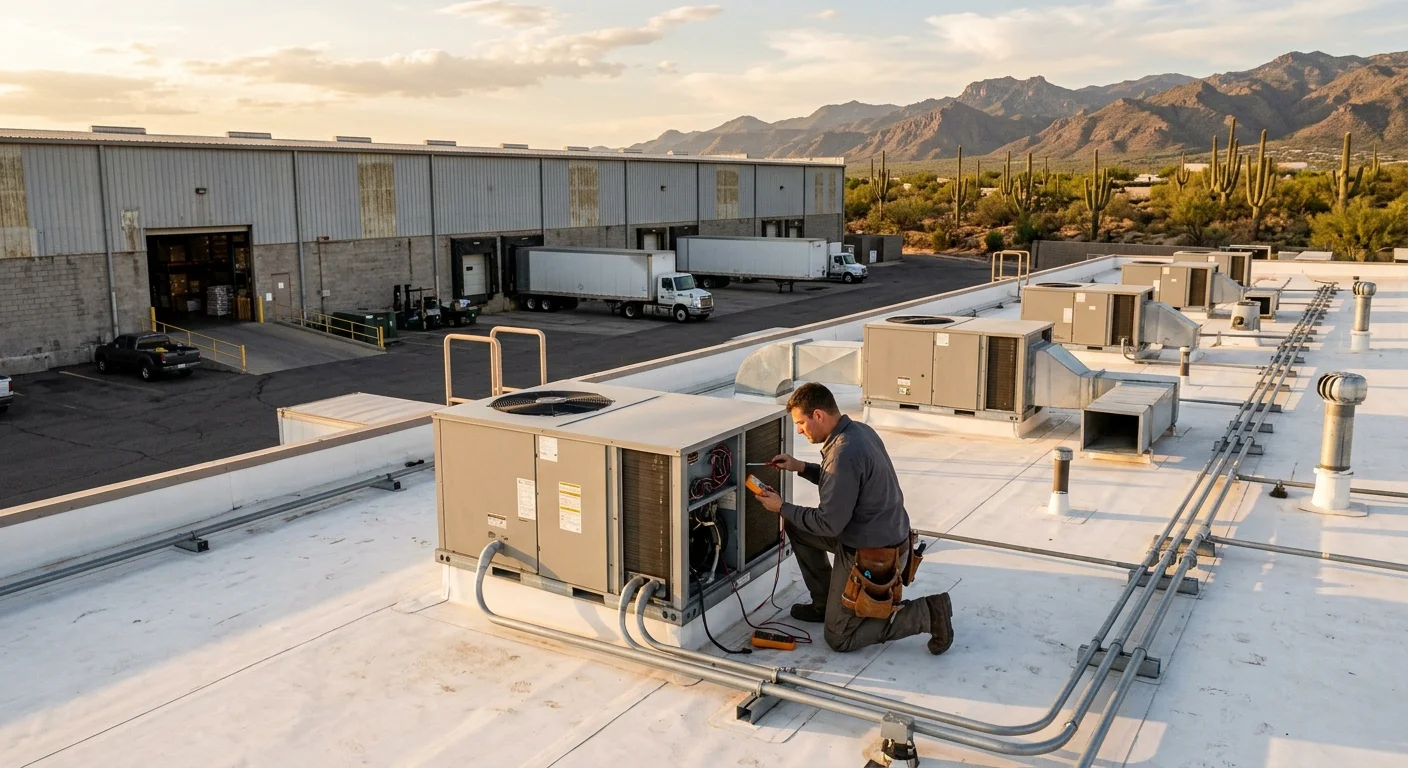
A Tucson warehouse is not an office load with a bigger box on the roof. Dock doors dump hot outdoor air onto the floor, the roof sits in 100F sun, and monsoon dust coats the coils. Climate Pros Tucson matches you with licensed independent HVAC pros who can survey that mixed job. We don’t own the rooftop units, and we don’t pull the permit.
Commercial HVAC for light industrial buildings in the City of Tucson, Oro Valley and Marana is a different brief from a shop or a clinic. The pro sizes to the way the building actually runs, not to a floor-plan label.
Why is a Tucson warehouse not an office HVAC load?
The warehouse fights outdoor air, roof heat and volume. An office fights people and computers in closed rooms.
At Tucson International Airport, 1991-2020 normals show about 68 days a year at or above 100F, and about 158 days at or above 90F. The City of Tucson energy code is climate zone 2B, with a 105F summer design dry bulb. June’s normal high is 101.2F. In 2024, the National Weather Service counted 112 days at or above 100F, a record.
That outdoor air walks in every time a dock door goes up. The occupied office on the mezzanine still wants comfort. The open floor may only need a workable band for people, product or equipment. Treating those as one thermostat is how a warehouse feels fine in the office and brutal on the concrete.
A retail HVAC job is an occupied sales floor with doors that mostly stay shut. A warehouse is infiltration plus a huge volume of air. Climate-controlled storage is closer to a sealed product room. Light industrial HVAC in Tucson sits between those two.
Heating is the smaller half of the year at the airport: 3,424 cooling degree days against 1,333 heating degree days, about 2.6 cooling degree days for every heating degree day. The equipment still has to heat the office on the few cold mornings. The floor often does not.
What do dock doors, roof units and desert dust change?
Dock-door cooling in a Tucson warehouse is mostly a fight with infiltration. When the door is open, the unit is trying to condition the lot.
Count the doors. Note how long they stay up. Confirm seals, shelters and any fans that run when a door is open. That is the load the contractor has to see on site.
A warehouse rooftop unit in Tucson sits in that same sun. Package units are one equipment type on commercial roofs. Do not assume every warehouse has one. A ground split, a makeup-air unit or several smaller units can show up instead. If the quote is an AC installation or a rooftop swap, the pro still has to match curb, electrical, refrigerant circuit and airflow to this building.
Dust is the monsoon problem. The official monsoon window is June 15 through September 30. Dust storms are part of that season. Coils, filters and outdoor fans load up. After a storm, a dirty rooftop unit can short-cycle, ice or trip. Filter access and coil cleaning belong on the survey.
TEP serves the Tucson metropolitan area. Trico Electric Cooperative serves northwest Tucson and Marana south to Green Valley and Sahuarita. The warehouse meter tells you which one. Commercial rate plans are set by that utility. No single commercial tariff for warehouses was confirmed here, so read the tariff with the contractor. Do not borrow a residential time-of-use chart.
How do office mezzanines and the open floor differ?
They are two climates stacked in one shell.
The mezzanine is usually small, occupied and closed. People, computers and a thermostat that gets complaints. The open floor is high, dusty and leaky at the docks. Cool air falls. Heat stacks under the roof. One rooftop unit ducted to both often starves one of them.
| Zone | What the air is doing | What the quote should treat separately |
|---|---|---|
| Office or mezzanine | Occupied rooms, computers, closed doors | Comfort cooling and a dedicated thermostat |
| Open floor | High volume, forklifts, heat under the roof | Airflow, stratification and dust loading |
| Docks | Outdoor air whenever a door is up | Infiltration, not a sealed room |
A small-business HVAC suite can often share one system. A warehouse usually cannot, unless the office is tiny and the floor is only spot-cooled. Spot cooling, office splits and floor units can all be on the table. The pro decides from the survey, not from a blog.
Even if you already use HVAC service in Tucson for a shop or office, treat the warehouse as its own building. The load calc does not transfer.
What should a licensed contractor survey?
A walkthrough that never leaves the office is incomplete. The licensed contractor should walk the roof, the docks and the mezzanine.
Ask them to record:
- How many dock doors, and how they are used during peak hours
- Office square footage versus open-floor volume
- Existing rooftop units, curbs, duct drops and open discharge
- Filter type, access and how fast they load with dust
- Electrical capacity at the units and the panel
- Roof condition around the curbs
- Which utility serves the meter, TEP or Trico
- Who issues the permit: City of Tucson, Oro Valley or Marana
No verifiable commercial warehouse HVAC permit rule for the City of Tucson, Oro Valley or Marana turned up in the sources used here. Home HVAC permit lists do not automatically cover a warehouse. Ask Tucson Planning and Development Services, or the building department in Oro Valley or Marana if the property sits there. Do not assume a Pima County unincorporated rule. That path was not verified here. The matched contractor pulls the permit.
Check the contractor’s license at the Arizona Registrar of Contractors before you sign. Every pro we send is licensed. You still look the license up. Technicians who handle refrigerant must hold EPA Section 608 certification.
Climate Pros Tucson is the match, not the installer. You contract with the independent pro. You pay that pro.
How do you read a light-commercial quote without prices?
Read scope, zones and assumptions. Compare dollars only against the same scope.
A usable warehouse quote should list:
- Each zone: office, floor, docks, and whether they share equipment
- Equipment type, capacity and efficiency ratings, by unit
- What is reused: curbs, duct, electrical, controls
- What is new: units, transitions, controls, filtration
- Load and sizing method, in writing
- Who pulls the permit, and which city or town
- Manufacturer warranty on the equipment, in writing
- ROC license name and number so you can check roc.az.gov
- Startup, controls training and filter schedule
If two quotes disagree on dock-door assumptions, they are not the same job. If one treats the mezzanine as a closet on the floor unit, ask why. You hear the price before any work starts. Ask the pro what their site-survey fee is. Each company sets its own policy.
Design to 105F in the City of Tucson, and to the heat you actually get on the roof in June and July. Oro Valley and Marana set their own code path. Confirm design conditions with that town’s building department. Existing R-410A systems can still be serviced. Ask the contractor which equipment they are quoting, and keep the written model numbers.
Does a warehouse need the same HVAC as a store?
No. A store is occupied and mostly closed. A warehouse is volume plus dock infiltration. Use a warehouse survey, not a store template.
Can one rooftop unit do the office and the floor?
Only if the contractor can show airflow and control for both. Mixed-use with one thermostat is the usual complaint. Ask for separate control when the office is occupied all day.
Who confirms the permit?
The licensed contractor, with the city or town that has the building. Climate Pros Tucson does not pull permits.
When to call us
Call when the office is livable and the floor is not, when a rooftop unit is down, or before you replace equipment on a dock-heavy building. Call (520) 353-2520 and we’ll match you with a licensed local pro.