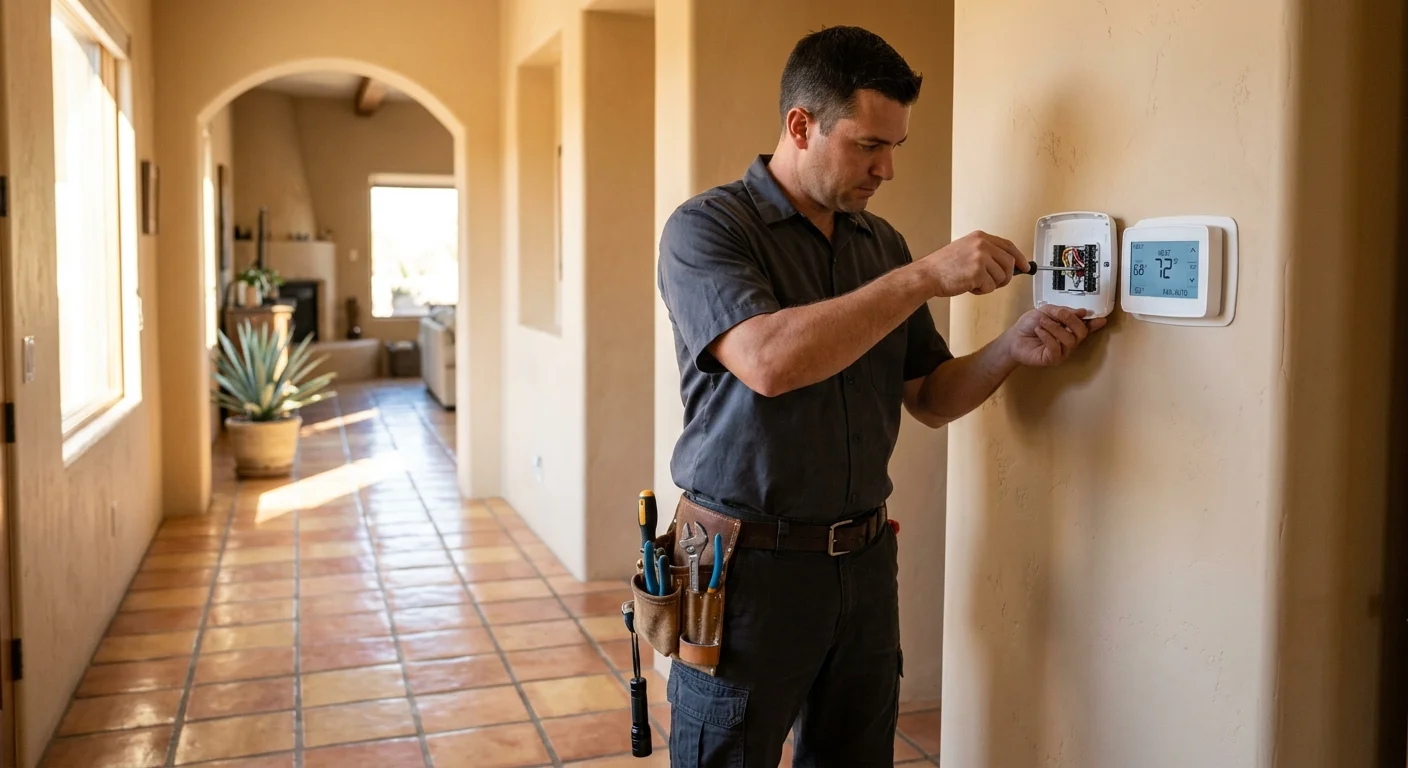
The first time you switch a Tucson thermostat from cool to heat, cool can still run and heat can sit dead. Start with the mode switch, the fan setting, and the batteries. If those checks do not bring heat on, Climate Pros Tucson matches you with a licensed local HVAC pro who can separate a wall-control problem from a furnace or heat pump problem.
That split is the October job in this basin. Cooling ran from June through the monsoon window of June 15 to September 30. Heat sat unused. At Tucson International Airport, 1991-2020 normals give about 3,424 cooling degree days and 1,333 heating degree days, about 2.6 cooling degree days for every heating degree day. Fewer than 12 nights a year drop to 32F or below. Heat is a short season on the valley floor, so the first call of the year is when a forgotten setting or a silent furnace shows up.
Cool works, heat does not: the first split
Cool working is useful information. It means the thermostat still has power, the display still talks to you, and the cooling circuit answered all summer. Heat is a different call. A thermostat stuck on cool in Tucson is often still set to Cool, or it is calling for heat on a wire the equipment is not answering.
Do not treat the two modes as one system. A midtown ranch, an Oro Valley two-story, and a Vail tract home all spend most of the year in cool. Catalina Foothills nights in early fall can feel sharp while the afternoon is still in the 80s. The wall control may never have left Cool. Mount Lemmon and Summerhaven are the other climate. Pima County treats land above 4,000 feet as zone 5B. The airport records 1,333 heating degree days. The Mount Lemmon station records 4,024, about three times that, with about 53 nights at or below 32F. Heat there is not a once-a-year test.
If the screen is alive and AC still starts, skip the generic dead-thermostat loop and go to heat-mode checks. The broader blank-screen path is on our thermostat troubleshooting page. If a smart unit cools on a schedule and ignores a heat setpoint, use the smart thermostat not cooling notes for app and mode conflicts, then come back here for heat.
Photograph the thermostat face and, if you can lift the cover without forcing it, the subbase with the wires on the terminals. No wiring-color chart belongs on this page. Terminal letters vary by brand and by heat pump versus furnace. Let the licensed tech read the photo.
System switch, fan setting and dead batteries
Set the system to Heat, raise the setpoint a few degrees above the room reading, and set the fan to Auto. That is the whole first pass.
Cool leftover from summer is the usual miss. Off, Cool, and Heat are not the same. A hold from July can pin the mode. A smart schedule can still be in a cooling program. Open the app and confirm Heat there too, not only on the wall.
Fan On is the next miss. Auto lets the equipment run, then the blower. On runs the blower by itself. You get air. You may not get heat. People call that a dead furnace when the burner never got a call.
Batteries next, if the thermostat uses them. A fading display, a missing backlight, or a low-battery icon is enough reason to swap them. Use the off switch or breaker if you need to pull the unit off the subbase. Put it back on the same terminals. If you are not sure it seated, stop and take the photo instead.
Power at the breaker and the outdoor disconnect still matter for a heat pump, because the outdoor unit has to run in heat. A furnace needs its own switch and, on gas, an open gas supply. Do not touch a gas valve. If you smell gas, leave the house and call Southwest Gas or 911.
Setpoint has to be above the room. A 68F hold does nothing if the hall already reads 70F. January’s normal low at the airport is 40.8F, and December’s is 40.5F. Early October nights are milder. You may need a higher setpoint than you think to force a first call.
If those checks fail and the unit is old, cracked, or blank after fresh batteries, thermostat installation is the service path. Ask the pro what their diagnostic fee is and whether it applies toward the repair. Each company sets its own policy.
Heat pump vs gas furnace, what changes on the stat
The Heat setting does different work on a heat pump than on a gas furnace. Arizona’s 2020 residential survey puts a central heat pump as main heat in 25% of homes statewide, and a central furnace in 55%. Statewide main heating fuel was electricity in 51% of homes and natural gas in 36%. Those are Arizona figures, not Tucson counts. In the Tucson basin a heat pump is the sensible default, because heating duty is mild and the same unit already does the cooling. City of Tucson energy code is climate zone 2B, with a 35F winter design dry bulb. Backup heat at Mount Lemmon is a question for the pro, not a default.
| What you have | What Heat should do | What “no heat” often is |
|---|---|---|
| Heat pump | Outdoor unit runs. Vents warm after a delay. | Outdoor unit silent, or Emergency heat left on |
| Gas furnace | Burner fires, then the blower moves warm air | Fan On with no burner, or no ignition at all |
| Dual fuel | Heat pump first, furnace when the pro’s lockout says so | Wrong system type in the thermostat setup |
On a heat pump, Heat is not a strip of electric heat by default. The outdoor unit should start. Air can feel tepid at first. That delay is normal on a mild Tucson night. Aux or Emergency heat is a separate setting. Emergency heat is for a failed outdoor unit, not for a 50F evening in Marana. If someone set Emergency heat in July while testing, the compressor may never come on. Reversing-valve and O/B terminal setup belongs on our smart thermostat with a heat pump page. Do not guess the O/B jumper from wire color. Photograph the terminals and let the pro confirm.
On a gas furnace, Heat should produce ignition, then the blower. If the thermostat clicks and the furnace stays dark, the wall control may be fine. If the blower runs and the air stays room temperature, the call may be fan-only. Package units on a roof or a slab follow the same split: one cabinet, two modes. Treat them as heat pump or gas pack based on what is actually in the cabinet, not on the house style.
TEP winter time-of-use, October through April, puts on-peak at 6 to 9 a.m. and 6 to 9 p.m. Monday through Friday. A first heat call on a weekday morning can land in that window. Trico’s standard residential rate (RS1) has no on-peak split. Confirm which utility serves the house before you blame the thermostat for a high bill.
When the thermostat is fine and the furnace is not
The thermostat is probably not the failure when the display is clear, the mode is Heat, the setpoint is above the room, the fan is Auto, and still nothing warm comes out. That is an equipment call.
Change the filter if it is packed. Tucson dust after monsoon storms loads a filter that sat still all summer. A clogged filter can shut a furnace down on a safety or starve a heat pump. It is a homeowner step. Opening the burner compartment is not.
Listen from the hallway. A click at the thermostat with silence at the furnace points at the equipment or the cable, not the screen. A furnace that tries, shuts off, and tries again is a furnace repair visit, not a new wall control. Our first cold night furnace page covers that seasonal start. Leave flame sensors, igniters, gas valves, and heat exchangers to an ROC-licensed tech. Residential heating and cooling work is class R-39 or an R-39R subclass. Check the company at roc.az.gov before anyone opens the cabinet.
A heat pump with a live thermostat and a silent outdoor unit is the same idea on the other side of the house. Confirm the outdoor breaker and disconnect, then stop. Frozen or steaming outdoor coils, reversing valves, and aux strips are licensed work.
In the City of Tucson, a new or replacement furnace, heat pump, or air conditioner needs a permit, and load and sizing calculations are required. The matched contractor pulls that permit. A thermostat-only swap is a different job. Do not assume a handyman can take it. The Arizona handyman exemption is only for casual work under $1,000 that does not need a local building permit.
Renters have a separate clock. An Arizona landlord must supply reasonable heat where the unit is installed and keep HVAC in good and safe working order. Tell the landlord in writing. Keep the thermostat photos. Then call for a licensed pro if the landlord asks you to.
What to tell the licensed tech before they arrive
A short list saves a second trip. Send it in the same message you use to request the match.
- City or area: Tucson, Oro Valley, Marana, Vail, Sahuarita, Green Valley, Catalina Foothills, or Mount Lemmon.
- Utility: TEP or Trico, plus Southwest Gas if you have a gas furnace.
- System type if you know it: heat pump, gas furnace, dual fuel, or package unit.
- Cool still works, yes or no.
- Last date you remember heat running.
- Mode, fan, setpoint, and whether you changed batteries.
- Photos of the thermostat face and the subbase terminals.
- Any code or message on the screen or the furnace board.
- Owner or renter, and whether the landlord already has the note.
Ask whether a tech is available, yes or no, and ask for the after-hours fee as a dollar figure if you are calling at night. You hear the price before any work starts. Climate Pros Tucson does not set that price and does not send employees. The pro you are matched with is the contractor you hire.
If the wall control is the actual failure, replacement is still licensed work when it is tied to a heat pump or furnace. Keep the old unit until the new one is proven in Heat, not only in Cool.
Why does cool work if heat mode does not?
Cool and heat use different outputs. A summer of AC only proves the cooling circuit. Heat may be a wrong mode, a fan set to On, a heat-pump Emergency setting, or a furnace that never ignites.
My thermostat will not turn on the furnace. What should I check first?
Heat, a setpoint above the room, fan on Auto, and fresh batteries if it takes them. If the display is fine and the furnace stays dark, treat it as equipment. Do not open the gas train.
Is a heat pump supposed to feel weak on the first Tucson heat call?
Vent air can start tepid while the outdoor unit runs. That delay is common on a mild night. A silent outdoor unit, or Emergency heat left on, is a different problem. Mount Lemmon homes should ask the pro about backup heat. Basin homes usually should not need Emergency heat for a 40F low.
When to call us
If mode, fan, and batteries are right and the house still has no heat, stop at the wall. A licensed HVAC pro should open the furnace or heat pump. Call (520) 353-2520 and we’ll match you with a licensed local pro.