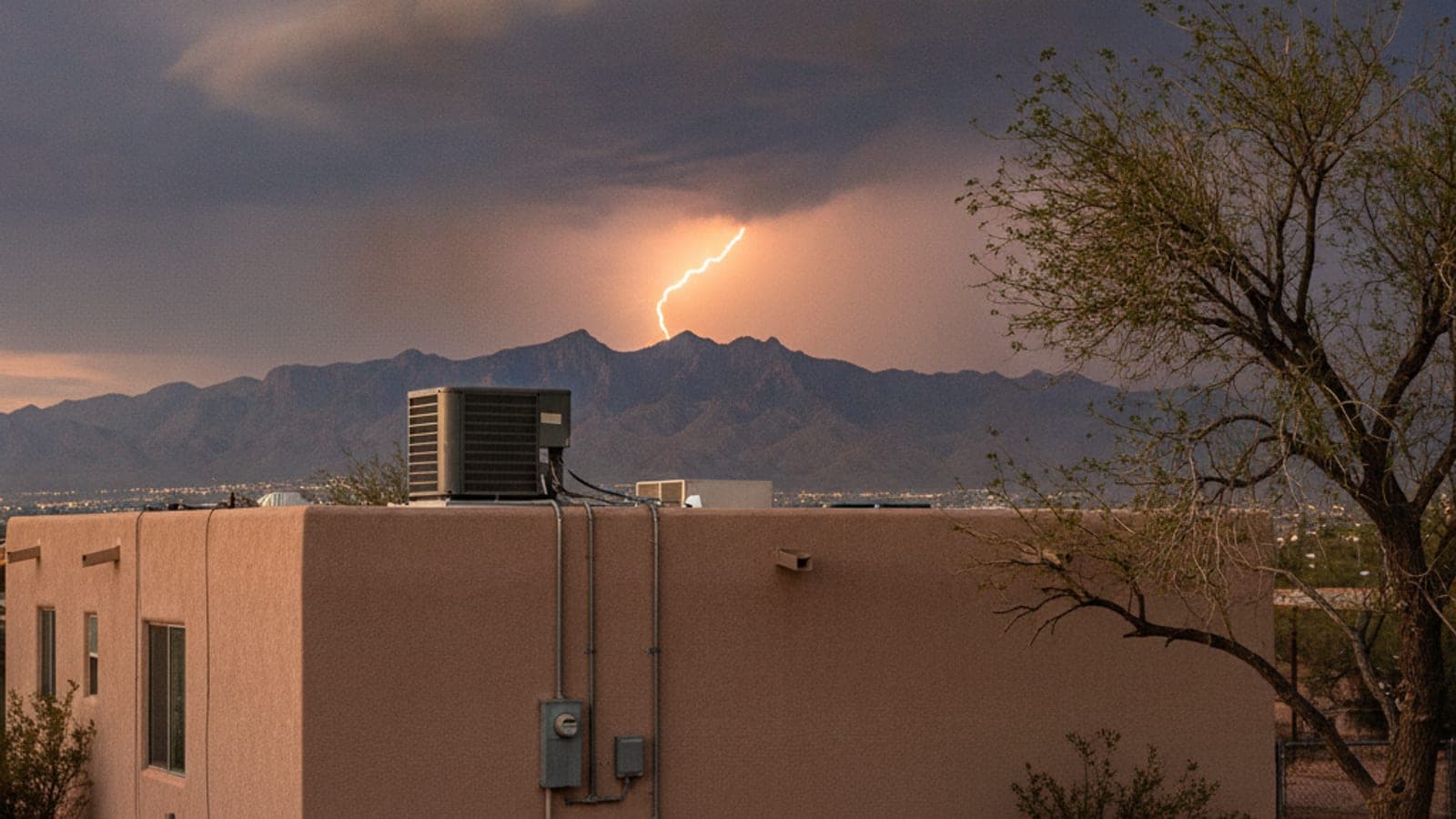
When a monsoon storm rolls in, switch the thermostat to off, and leave it off until the power has been steady for several minutes. That one habit keeps the compressor from trying to restart into a flicker. A surge protector adds a layer, but it won’t stop a direct strike or save a part that was already failing. Climate Pros Tucson matches you with a licensed pro when the AC won’t recover. If the storm has passed and the unit won’t start, the step-by-step reset is in AC not working after a power outage.
Why are monsoon storms hard on an AC?
Because they hit when the AC is working hardest. The official monsoon runs June 15 through September 30, and its hazards include lightning, strong winds and dust storms, any of which can drop power for a second or for hours. The storms land in the same months as Tucson’s heaviest cooling load: July’s normal low at Tucson International Airport is 76.3F (1991-2020 normals), so the system is often running when the lights blink. A compressor that loses power and gets it back seconds later tries to restart against pressure that hasn’t settled. That’s the moment that strains the start parts.
What should you do before and during a storm?
- When thunder is close, switch the thermostat to off. The house holds its cool for a while.
- Stay inside. Don’t go out to the condenser or the panel while there’s lightning.
- After the power is back, wait several minutes, then switch to cool.
- Leave a tripped breaker for after the storm. Reset it once. If it trips again, stop and call a pro.
What does storm damage look like?
The start and switching parts take the hit first. The capacitor gives the compressor and fan their start, and the contactor switches them on and off. Signs that one of them is damaged:
| What you notice | What a pro will likely check |
|---|---|
| Outdoor unit hums but the fan doesn’t turn | Capacitor, fan motor |
| Clicks, starts, quits within a minute | Contactor, capacitor, safety controls |
| Breaker trips as soon as it starts | Compressor, wiring, contactor |
| Thermostat dark or rebooting | Thermostat power, control board, fuse |
| Burnt smell from the outdoor unit | Shut it off at the breaker and call |
AC capacitor failure in Tucson heat explains why that part is the weak link, and AC short cycling covers a unit that keeps stopping and starting after power returns.
What can a surge protector do?
It limits a voltage spike that comes in on the line, which is the common case in a storm. It can’t stop a direct lightning strike, and it won’t fix a part that’s already weak. There are two places to put one:
- At the outdoor unit, protecting the AC alone. An HVAC pro can quote this.
- At the main panel, protecting the whole house. Arizona’s R-39 HVAC license lets a contractor add a circuit to an existing panel, but not install a new service panel or sub-panel, so whole-house work may need an electrician.
Ask the pro which one fits your equipment, and how you’ll know when the device has absorbed enough hits to need replacing.
Is it worth adding a time-delay or hard-start part?
Ask the pro. Many systems have a built-in restart delay, and your unit’s manual or label may show it. If the compressor labors on every start, a hard-start kit is one option the pro may raise. For storm-season repairs, see AC repair. The hub at HVAC service in Tucson lists where we cover.
When to call us
Call when the AC won’t start after a storm, the breaker trips twice, or you smell something burnt at the outdoor unit. Call (520) 353-2520 and we’ll match you with a licensed local pro.