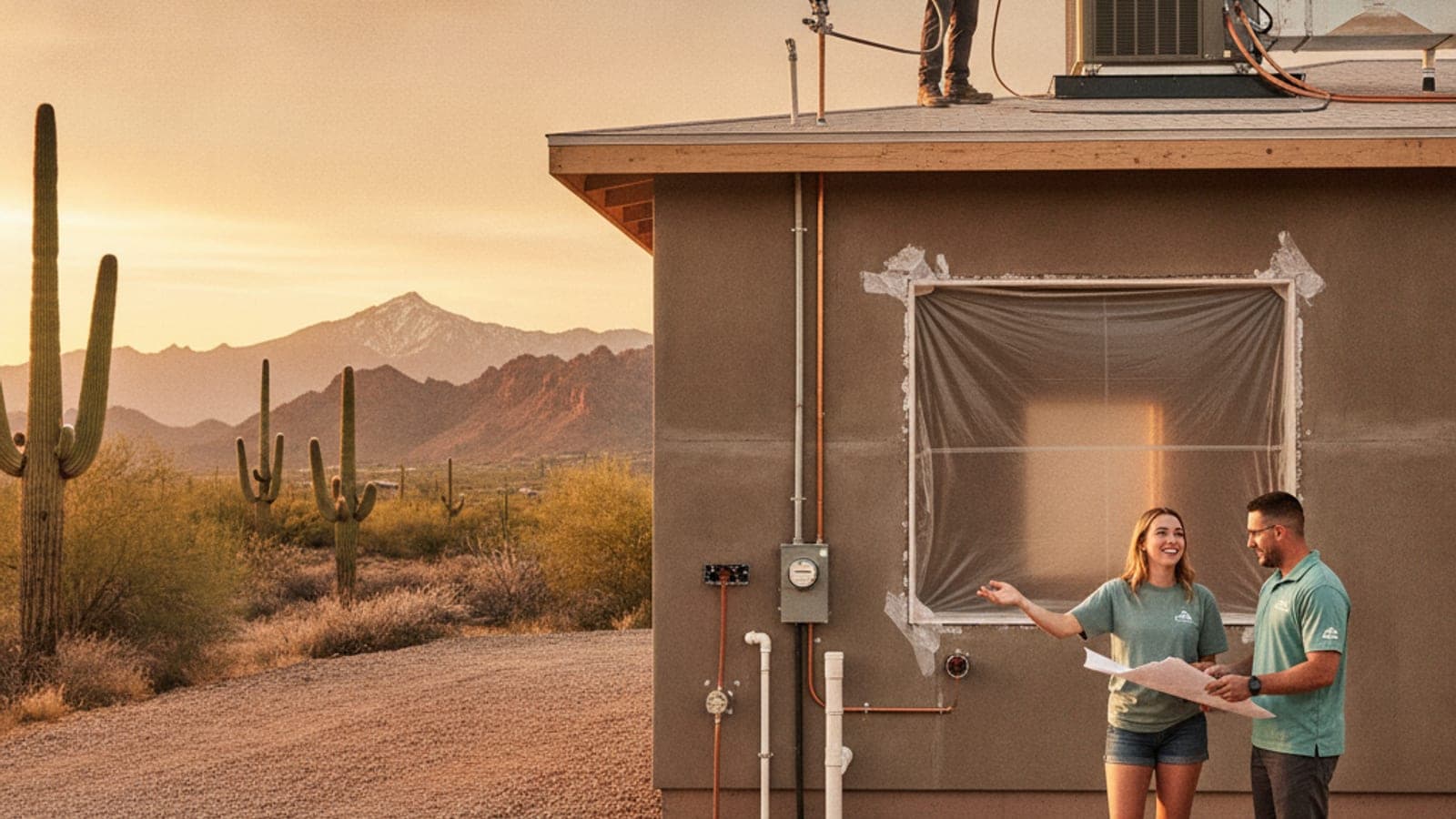
For new construction in the Tucson area, settle the HVAC design before the ducts go in. The code, the climate and the load calculation decide what size and type of system fits. Climate Pros Tucson matches you with a licensed pro who can review the builder’s plan.
What code applies?
The City of Tucson adopted amendments to the 2024 International Energy Conservation Code, and it puts the city in climate zone 2B. Residential air leakage testing must be done by RESNET, BPI or another approved certification.
Pima County’s rules for areas outside the city can differ. Below 4,000 feet, county amendments use the same 35F, 105F and 66F wet bulb conditions in zone 2B, or 36F, 107F and 69F wet bulb west of the Tohono O’odham Reservation’s easterly boundary. Above 4,000 feet, county amendments list climate zone 5B, a 4F winter design temperature and a 90F summer design temperature. Ask your builder which jurisdiction and edition apply to your lot.
What design conditions drive sizing?
The City of Tucson lists exterior design conditions of 35F for winter dry bulb, 105F for summer dry bulb and 66F wet bulb. The load calculation uses these along with your orientation, windows, insulation and duct location. The City requires load and sizing calculations for new and replacement HVAC equipment.
Ask the builder for the Manual J load calculation, the equipment selection and the duct design. Those are the standard design steps. An oversized system costs more up front and can cool poorly.
What system fits a Tucson new build?
Tucson needs about 2.6 cooling degree days for every heating degree day, so cooling drives the design. A heat pump gives you heating for little extra equipment. See heat pump vs AC. Roof package units and ground split systems are both options a builder might offer. Read split system vs rooftop package unit.
What should you push on?
- Duct location. Ducts in conditioned space lose less than ducts in a hot attic.
- Duct sealing and testing. ENERGY STAR says a typical forced-air house can lose about 20% to 30% of duct airflow to leaks.
- Shading, glazing and roof color, which change the load.
- Zoning for large or multi-level homes. See HVAC zoning.
- Thermostat placement away from direct sun.
What about permits and rebates?
The licensed contractor pulls the permit. TEP’s Efficient Home Program applies when retiring an older working unit or a non-working AC, so ask TEP whether new construction qualifies. Carrier’s replacement coverage, for one, excludes new construction, so read the written warranty for the model you’re getting.
What licensing should you check?
Check the contractor’s license with the Arizona Registrar of Contractors at roc.az.gov. Residential HVAC falls under the R-39 classification and its R-39R subclasses.
Read about AC installation and heat pump service. See the Tucson hub and our post on replacing furnace and AC together.
Get a second opinion on the plan
If your builder’s HVAC plan is vague, or you’re buying a new build and want a second opinion, a licensed pro can review it. Call (520) 353-2520 and we’ll match you with a licensed local pro.