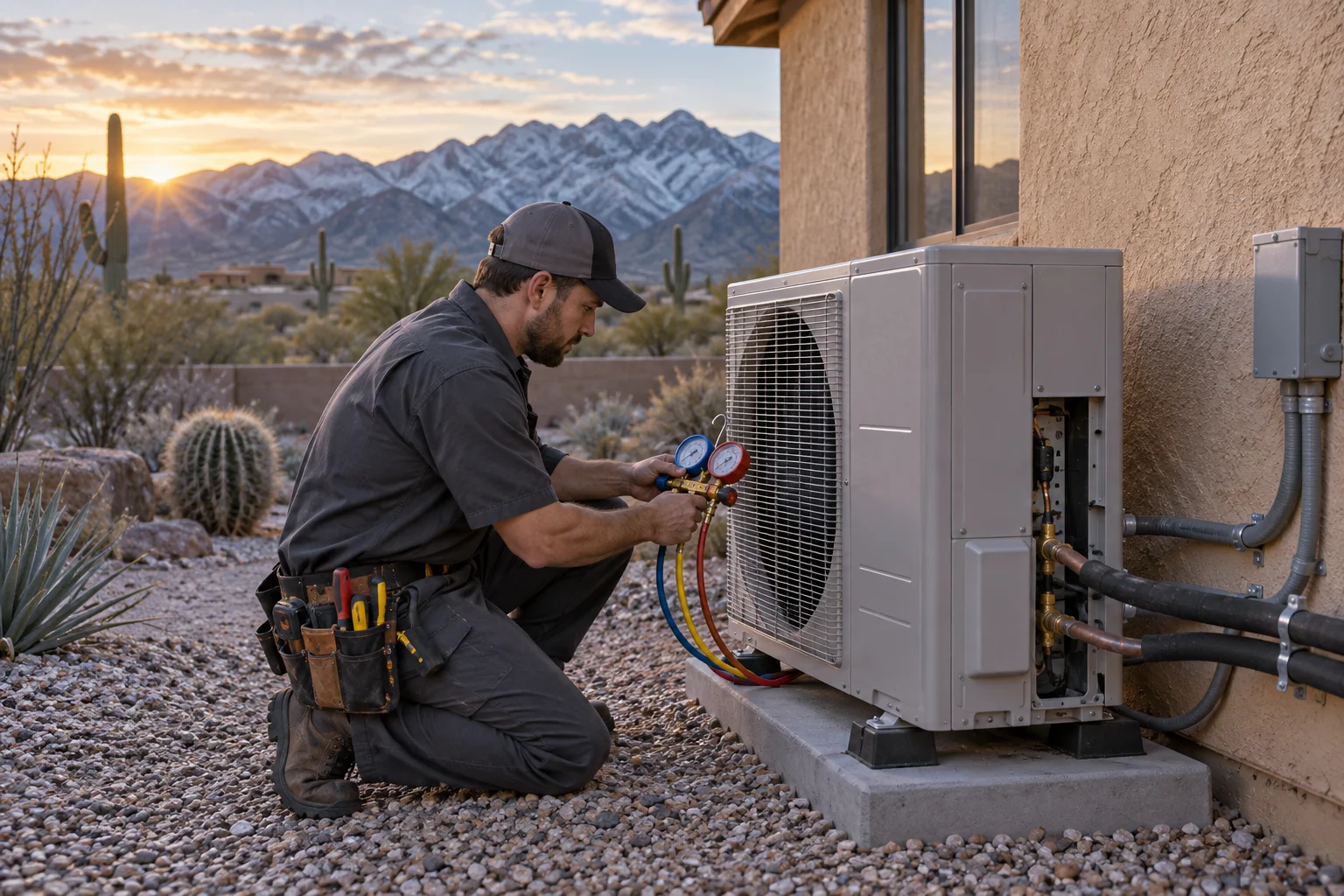
A heat pump that runs through a Tucson winter night isn’t automatically broken. The key is whether the home reaches and holds the thermostat setting. Other symptoms, such as persistent ice or unusual sounds, also matter.
Climate Pros Tucson can match you with a licensed local pro. Before making that call, a few observations can narrow the problem.
Long heat cycles can have different causes
Runtime alone doesn’t identify a fault. Your equipment manual is the right reference for your model, controls, and expected operating pattern.
Start by comparing what the system does with what the thermostat requests.
| What you observe | What to record | Next step |
|---|---|---|
| The home reaches and holds the set point | Outdoor conditions, thermostat mode, and displayed messages | Compare the behavior with the equipment manual |
| The home stays below the set point | The temperature gap and how it changes overnight | Arrange heat pump service |
| The thermostat reaches its setting, but air keeps moving | Fan setting and any status message | Check the thermostat manual before changing settings |
| Heating becomes uneven between rooms | Which rooms change and whether vents are open | Report the pattern to the licensed pro |
A contractor may need to separate thermostat behavior from airflow, controls, equipment sizing, duct conditions, or a mechanical fault. Those checks require the model information and measurements from the home.
Tucson’s local conditions add useful context. The City of Tucson uses climate zone 2B and a winter design dry bulb of 35F. That design figure isn’t a nightly forecast or a universal heat-pump cutoff.
At Tucson International Airport, 1991-2020 normals show fewer than 12 nights per year at or below 32F. You can compare the night in question with observations from the National Weather Service Tucson. Don’t apply a generic outdoor-temperature threshold unless the equipment manufacturer provides one.
Heat pumps remain a sensible default for Tucson-basin homes. They handle the area’s mild heating duty while providing the cooling those homes also need. For more context, read how heat pumps work during Tucson winters.
Long runtime deserves closer attention when the system can’t hold the set point. The same applies when its behavior changes sharply without a matching thermostat or weather change. If the system produces little or no heat, use the separate Tucson heat pump not-heating guide.
Check the thermostat and outdoor unit safely
Start with the thermostat settings and visible conditions around the equipment.
At the thermostat, record:
- The room temperature and requested temperature
- Whether the mode says Heat
- Whether the fan says Auto, On, or something else
- Any auxiliary, emergency, defrost, or equipment-stage message
- Whether a schedule changed before the long cycle began
- Whether the displayed temperature rises, falls, or stays steady
- The time each displayed status appears or disappears
Don’t assume every thermostat uses the same labels. Check its manual for the exact meaning of each message. If the screen and equipment seem out of step, photograph the display for the pro.
Next, record what you can see and hear at the outdoor unit:
- Whether the fan is moving
- Whether ice is visible
- Whether the coil looks partly frosted or heavily covered
- Whether leaves, storage, or other objects sit against the cabinet
- Whether the sound is steady or includes a new rattle, buzz, or repeated stop-start pattern
- Whether water or vapor appears during a change in operation
Ice doesn’t reveal its own cause. The licensed pro must determine whether the unit is following its designed defrost sequence or needs testing. The equipment manual may describe normal indicators for that model. Our guide to a frozen or steaming heat-pump outdoor unit explains what to document without forcing a diagnosis.
Check the filter only as the manufacturer directs. Record its size, condition, and installation date if known. Don’t install a different filter rating based on guesswork. The system manual or licensed pro should identify the suitable replacement.
Avoid repeatedly changing the thermostat setting to test the unit. That can make the operating record harder to interpret. A steady setting provides clearer information about whether the home gains, holds, or loses temperature.
How auxiliary heat changes the diagnosis
An auxiliary-heat message changes what the pro needs to investigate. It shows that the thermostat or system is calling for another heating stage, but the exact meaning depends on the installed controls.
Write down the complete message rather than shortening it to “aux.” Also record whether the message stays on, appears briefly, or returns repeatedly. Don’t assume auxiliary heat and emergency heat mean the same thing on your thermostat.
The focused guide to auxiliary heat on Tucson heat pumps explains the terms without turning this article into a no-heat guide. Your thermostat and equipment manuals remain the authority for the installed system.
Auxiliary-heat activity also matters when reviewing electricity use. A high bill alone can’t identify the cause. Compare the billed energy use with prior periods, then note thermostat changes and displayed heating stages.
TEP serves the Tucson metropolitan area. Its Time-of-Use winter on-peak periods run from October through April, Monday through Friday, from 6 to 9 a.m. and 6 to 9 p.m. Check the current details on TEP’s Time-of-Use page. Don’t assume your account uses that plan. Confirm the plan name on the bill.
A heat pump running all night in Arizona may cross different utility periods. Runtime and the bill total still don’t prove which component operated. The thermostat history and a contractor’s system testing provide better evidence.
What differs across Tucson and Oro Valley
The diagnostic questions stay the same in Tucson and Oro Valley. The address changes which permitting authority, utility, and local requirements may apply.
Climate Pros Tucson covers Oro Valley as well as Tucson. We don’t invent temperature differences between the two places or apply City of Tucson rules to an Oro Valley address.
For a Tucson or Oro Valley home, confirm:
- The service address and jurisdiction
- The electric utility shown on the current bill
- The thermostat and outdoor-unit model numbers
- Whether the equipment is a split system or package unit
- Whether backup heat is installed and how the controls label it
- Whether any recent thermostat or electrical work preceded the change
In the City of Tucson, new and replacement heat pumps require permits. Load and sizing calculations are also required for new and replacement HVAC equipment. The matched contractor pulls the permit, never Climate Pros Tucson.
Those City of Tucson requirements shouldn’t be presented as Oro Valley rules. Ask the matched contractor which authority has jurisdiction and what applies to the address.
Tucson Electric Power serves the metropolitan area. Trico Electric Cooperative serves northwest Tucson and Marana south to Green Valley and Sahuarita. The utility name on your bill is the safest way to identify your provider.
Our Tucson HVAC service hub explains the referral process and covered services. The homeowner contracts with and pays the independent professional directly.
What to report to the licensed pro
A concise operating record helps the pro start with the right questions. It also prevents “runs constantly” from hiding several different symptoms.
Provide:
- Your address and jurisdiction, if known
- Thermostat make and model
- Indoor and outdoor equipment model numbers
- Requested and displayed room temperatures
- Approximate start and stop times
- Every thermostat status message
- Whether the home reaches the set point
- Rooms that feel different from the rest
- Visible ice, water, vapor, or debris
- New sounds or repeated stopping and starting
- Filter size, condition, and last known change
- Recent thermostat, electrical, or HVAC work
- Photos of the thermostat and outdoor unit
Record model information that is already readable. Tell the pro when a label can’t be read.
Ask the contractor to explain:
- Whether the observed runtime matches the manufacturer’s operation
- What the thermostat history shows
- Whether auxiliary or emergency heat operated
- Whether airflow and duct conditions need testing
- Whether the outdoor unit completed its designed defrost behavior
- Which repairs are recommended and why
- What appears on the written quote
- Whether a permit applies to the proposed work
Every pro we send is licensed. You can also check an Arizona contractor through the Registrar of Contractors. Residential heating and cooling work falls under R-39 or its R-39R subclasses.
What causes an outdoor heat pump to freeze?
Visible ice can have more than one explanation, so don’t diagnose it from appearance alone. Record where the ice appears, photograph it safely, and check the manufacturer’s instructions. A licensed pro can test whether defrost operation, airflow, controls, or the refrigerant circuit needs attention.
Why did my electric bill rise while the heat pump ran longer?
The bill doesn’t identify which heating stage used the electricity. Compare billed energy use, thermostat history, weather, and utility-plan periods. Then ask the pro which equipment stages operated and whether the system held its set point.
Should I turn the heat pump off because it keeps running?
Don’t use a generic runtime limit to make that decision. Follow the equipment manual, especially when ice, electrical smells, unusual sounds, or emergency-heat messages appear. If the home isn’t holding temperature, contact a licensed pro.
When to call us
Call when the home can’t hold its set point, ice persists, unfamiliar sounds begin, or the thermostat repeatedly shows auxiliary or emergency heat. Call (520) 353-2520 and we’ll match you with a licensed local pro.