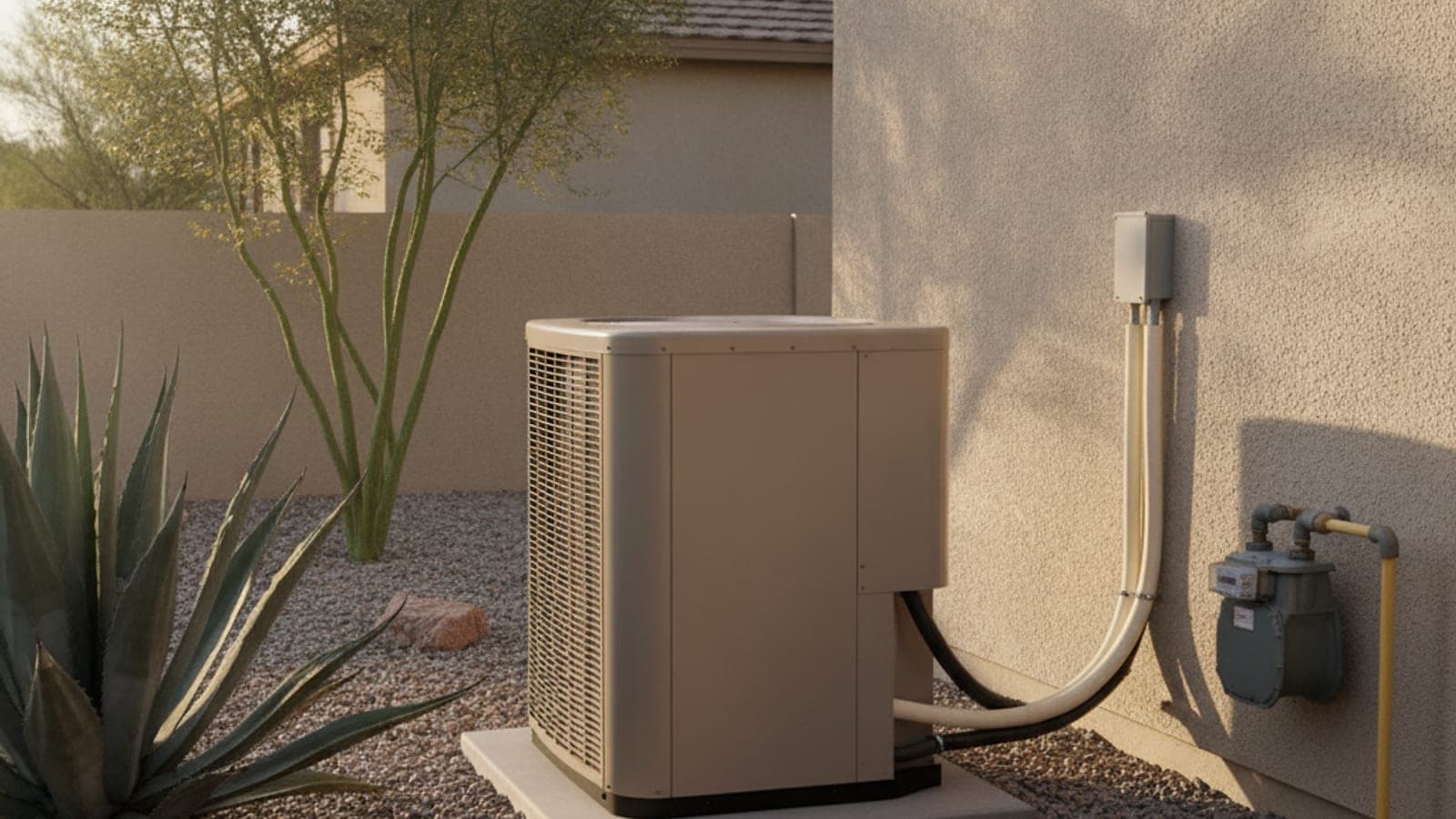
For a home in the Tucson basin, a dual fuel system is usually unnecessary, because the heat pump can handle the winters on its own. A dual fuel setup pairs a heat pump with a gas furnace that takes over when it’s cold. Climate Pros Tucson matches you with licensed pros who can tell you whether your house is an exception.
What is dual fuel, and how does it work?
The heat pump heats and cools. The gas furnace, on gas from Southwest Gas, steps in below a set outdoor temperature. A control decides which one runs. It’s common in colder regions where heat pumps lose output on the coldest days.
Does Tucson’s climate call for it?
Usually not. At Tucson International Airport the normals show about 3,424 cooling degree days and 1,333 heating degree days a year, roughly 2.6 cooling degree days for every heating degree day. The airport averages fewer than 12 nights a year at or below 32F, and the City of Tucson’s winter design temperature is 35F. The same unit that cools the house all summer can do the mild heating. A heat pump is the sensible default for a Tucson-basin home.
Where is the exception?
Mount Lemmon and Summerhaven. At the Mount Lemmon station, the normal annual heating degree days are 4,024, about three times the airport, with about 53 freezing nights a year. Pima County’s design conditions above 4,000 feet include a winter design temperature of 4F. There, backup heat is a question for the pro, not a default. See our Mount Lemmon and Summerhaven guide.
When might a basin home still want gas backup?
- You already own a good gas furnace and want to keep it.
- You have a strong preference for gas heat.
- A pro finds a reason in your particular house.
Ask the pro to quote a heat pump alone and a dual fuel option side by side, in writing, with the control strategy explained. Each company sets its own prices, so compare the two quotes line by line.
What about rebates?
As listed by TEP in October 2026, the TEP Efficient Home Program lists up to $720 for a heat pump quality installation, through participating contractors. The Southwest Gas 2026 Arizona residential rebate application lists no furnace or HVAC rebate. Arizona’s HEAR rebates are for income-qualified households and, under guidance effective September 1, 2026, no longer pay to replace gas appliances with electric ones. Check Efficiency Arizona for your situation. Our rebate stack guide has more.
What does a permit involve?
A City of Tucson permit is required for new or replacement furnaces and heat pumps, with load and sizing calculations. The contractor pulls it.
What should you ask a pro?
- Do I need backup heat at my address, and why?
- What’s the switchover temperature, and who sets it?
- Can I see the heat pump-only quote next to the dual fuel one?
See heat pump service and furnace repair, and compare equipment in package unit heat pump vs gas pack.
Heat pump alone or dual fuel?
If you’re deciding between a heat pump alone and a dual fuel setup, a licensed pro can look at your house. See the Tucson area. Call (520) 353-2520 and we’ll match you with a licensed local pro.