AC Installation for Tucson homes, through a licensed local company we match
you with. Tucson: Valley-floor desert at about 2,400 to 2,900 feet across the city. Tucson International Airport averages about 68 days a year at or above 100F, then a humid monsoon from June 15 to September 30. A new AC in Tucson starts with a load calculation, a City of Tucson permit inside city limits, and a quote that names the exact equipment.
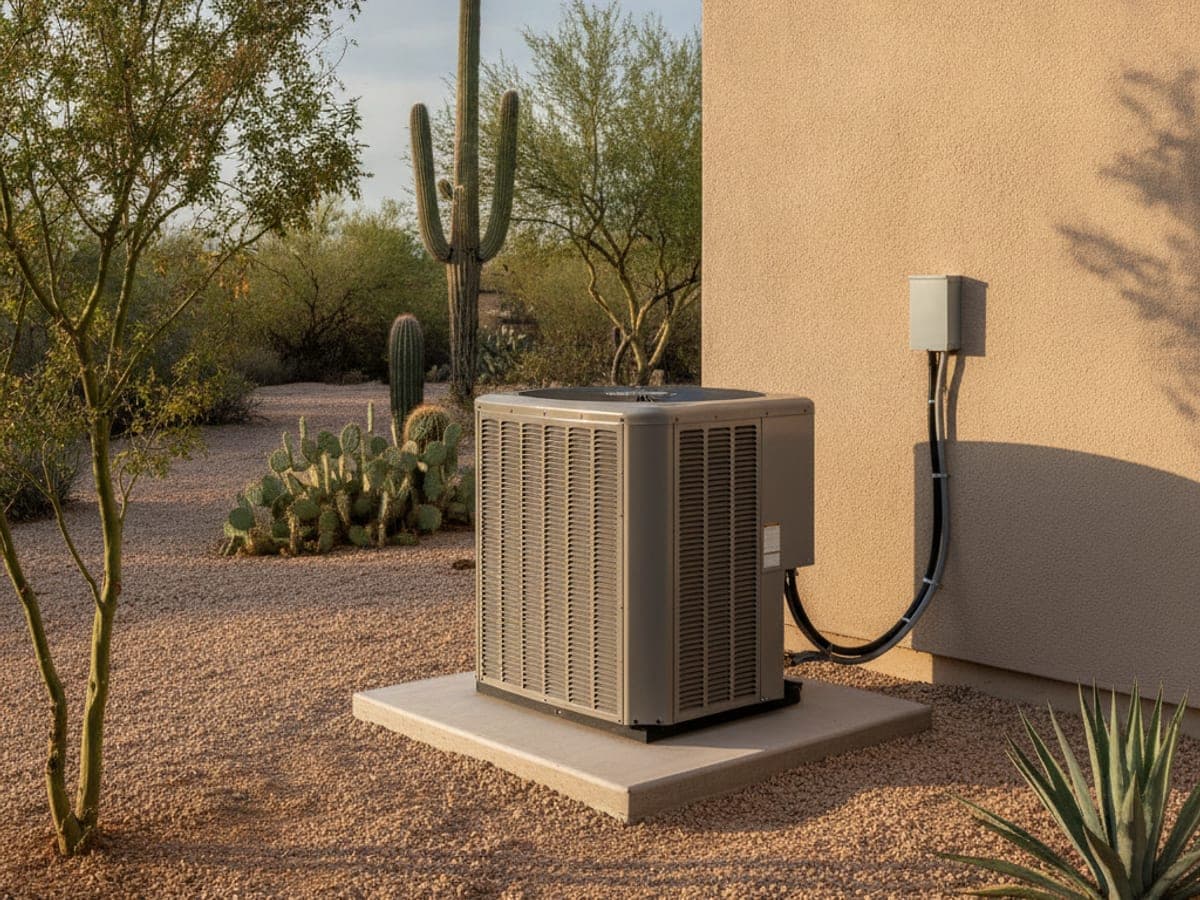
Homes in Tucson have an ACS median build year of 1979. A replacement in a house of this age should be sized from a fresh load calculation, and it is worth testing the original ducts at the same time. At about 2,700 feet, Tucson is valley-floor desert; Tucson International Airport averages about 68 days a year at or above 100F. The City of Tucson requires a permit for a new or replacement AC, heat pump or furnace, with load and sizing calculations. The licensed contractor pulls it. If TEP is your utility, ask whether the company you're matched with is a participating contractor in TEP's Efficient Home Program, which pays instant rebates as listed by TEP in October 2026. About 51.8% of homes in Tucson are owner-occupied (ACS 2020-2024), so many repairs here go through a landlord. AC installation in central Tucson often means fitting cooling into a house that was built without it. Thick adobe or brick walls, flat roofs and tight lots shape where equipment can go, and ductless mini splits or a ground-set system replacing a roof unit are both on the table. The City of Tucson requires a permit and a load calculation for new and replacement equipment.
The City of Tucson is the core of the service area: 547,073 people (ACS 2020-2024), a median home built in 1979, and an owner-occupancy rate of 51.8%, so close to half of households rent. That last number shapes the call. A homeowner is choosing equipment; a tenant needs the landlord to act, and Arizona law says the landlord has to.
Heat is the main event. The 1991-2020 normals at Tucson International Airport put the June normal high at 101.2F and the July normal low at 76.3F, so a system that struggles in June gets no overnight break in July. The National Weather Service counted a record 112 days at or above 100F in 2024. The city needs about 2.6 cooling degree days for every heating degree day, which is why a heat pump is the sensible default for most replacements here.
The monsoon changes the job halfway through summer. Average dew points at the airport sit in the 20s most of the year and jump into the high 50s in July and August. That's when an evaporative cooler that kept up in May starts to lose ground, and when condensate drains and frozen coils show up on refrigerated systems. Older homes in the central city may have a roof package unit, an evaporative cooler, or both. Newer tracts usually sit on a ground-set split system or heat pump.
Neighborhoods and subdivisions in Tucson include Downtown, Sam Hughes, El Encanto, Barrio Viejo, Armory Park, Rita Ranch, Midvale Park, Menlo Park, Amphi, Bear Canyon.
What an AC installation job covers, and the signs a home needs one, are on our AC installation page. The company you're matched with
confirms the scope for your home in Tucson before any work starts.
What do Tucson homeowners ask about AC installation?
What does AC installation cost in Tucson?
Quoted after the load calculation; equipment, ducts, electrical work, roof access and permits set the price. Climate Pros Tucson doesn't set prices; the contractor confirms the number for Tucson before any work starts.
How does Tucson's climate affect this service?
Valley-floor desert at about 2,400 to 2,900 feet across the city. Tucson International Airport averages about 68 days a year at or above 100F, then a humid monsoon from June 15 to September 30. At about 2,700 feet, Tucson is valley-floor desert; Tucson International Airport averages about 68 days a year at or above 100F.
My swamp cooler stopped keeping up once the monsoon hit. Is it broken?
Maybe not. Evaporative cooling depends on dry air, and at Tucson's airport average dew points jump from the 20s into the high 50s in July and August. A cooler that worked in May can fall behind without anything being wrong with it. The pro you're matched with can check the pads, pump and water supply, and talk through adding refrigerated air for the humid weeks. Tucson Water says hard water scales coolers and advises changing pads regularly and adding an in-line filter.
Does replacing my AC in the City of Tucson need a permit?
Yes. The City of Tucson requires a permit for new or replacement furnaces, heat pumps and air conditioners, and load and sizing calculations are required for new and replacement HVAC equipment. A new evaporative cooler needs a permit; a replacement cooler isn't listed. The licensed contractor you hire pulls the permit, not Climate Pros Tucson.
My rental's AC is out. What does my landlord have to do?
Arizona law, A.R.S. 33-1324, requires a landlord to supply reasonable air conditioning or cooling where it's installed and keep heating and cooling in good and safe working order. The Arizona Attorney General has said Tucson rentals cooled by air conditioning may not exceed 82F in habitable rooms, and evaporative-cooled units 86F. Put the request to your landlord in writing. If you're the owner, call us and we'll match you with a licensed company.
Is a heat pump a good fit for a Tucson house?
For most of the valley floor, yes. Tucson needs about 2.6 cooling degree days for every heating degree day, the city's winter design temperature is 35F, and the airport averages fewer than 12 nights a year at or below freezing. That's light heating work, and the same unit handles the cooling you need anyway. The pro sizes it from a load calculation, which the City requires on replacements.
Is there a TEP rebate on a new heat pump or AC?
TEP's Efficient Home Program is active and works as an instant rebate through a participating contractor. As listed by TEP in October 2026, it showed up to $720 for a heat pump quality installation and up to $600 for an AC quality installation. Amounts change, so confirm with TEP or the contractor at quote time. The federal 25C credit ended for equipment installed after 2025.
Service area
Where we cover Tucson
Serving Tucson
Need AC installation in Tucson?
We match you with a licensed local HVAC pro for your repair or replacement.